AI for Creating Dashboards in 2026: Tools, Workflow, and Where LLM Observability Fits
AI for creating dashboards in 2026: Hex Magic, Mode AI, Power BI Copilot, Tableau Pulse, Looker compared, plus a six-step build workflow and observability.
Table of Contents
TL;DR
| Question | Answer |
|---|---|
| What does AI for dashboards mean in 2026? | Natural-language question into SQL, chart, and narrative summary, end to end, with anomaly detection on a schedule. |
| Best tools to evaluate | Hex Magic, Mode AI, Power BI Copilot, Tableau Pulse, Looker Studio (Gemini), ThoughtSpot Sage, Sigma, Omni, Domo. |
| How accurate is the generated SQL? | Public text-to-SQL benchmark results (Spider 2.0, BIRD-SQL) vary widely by model, schema complexity, and evaluation setup. Sample and review on your own schema. |
| Top failure modes | Hallucinated joins, fabricated columns, silently wrong filters, stale data refreshes. |
| Governance basics | Curated semantic layer, human review on v1, traced prompt-to-SQL logs, faithfulness scores on a sample. |
| Where does Future AGI fit? | Not a BI tool. Future AGI is the AI dashboard for LLM observability and agent reliability (Agent Command Center). Pair it with your BI tool. |
Why teams use AI for dashboards
The traditional dashboard build looks like:
- Data collection and prep.
- Manual layout, metric selection, filter setup.
- Maintenance, refreshes, schema migrations.
Each step needs time, technical skill, and usually a dedicated analyst. AI dashboards compress the loop. The benefits show up on five axes.
Time efficiency
Natural-language prompts collapse the analyst-to-chart loop from hours to minutes. A product manager can type “weekly active users by cohort for the last 90 days” and get a usable answer on the first try, assuming the semantic layer is clean.
Real-time insights
AI dashboards monitor incoming streams, alert on anomalies, and update without manual refresh. The shift from periodic reports to continuous monitoring is one of the most material productivity gains in BI since the move to cloud warehouses.
Improved accuracy (on the right setup)
The accuracy story is more nuanced than vendor marketing suggests. On clean semantic layers with reviewed metrics, AI-generated SQL is solid. On raw tables with poor naming, it hallucinates joins. Treat semantic layer quality as a precondition.
Advanced analytics
Predictive models, anomaly detection, and pattern recognition are now standard. The interesting question is whether the AI explains its reasoning well enough for a non-analyst to trust it. Tools that surface the generated SQL alongside the chart make this easier.
Scalability
AI dashboard tools can work against terabyte-scale warehouses, with cost and performance determined by query design and warehouse capacity. The dashboard layer compresses the analyst-time tax. Costs scale with query volume against the warehouse, not with analyst headcount.
Key components of AI dashboards in 2026
- Data integration. Native connectors to Snowflake, BigQuery, Databricks, Postgres, MySQL, plus SaaS sources (Salesforce, HubSpot, Stripe). dbt or a lakehouse layer underneath.
- Semantic layer. dbt Semantic Layer, AtScale, Cube, or the tool’s own modeling layer. Curated metrics, dimensions, joins.
- NL-to-SQL planner. The LLM that reads the question, generates the SQL plan, and emits the query.
- Visualization layer. Auto-picked chart type, interactivity, drill-downs.
- Narrative engine. Writes summaries, suggests next actions, generates titles.
- Automation. Scheduled refreshes, anomaly alerts, Slack and email routing.
- Personalization. Role-aware views, learned shortcuts, frequently-used metrics promoted.
Top AI dashboard tools to evaluate in 2026
This is a niche where Future AGI does not compete head-to-head. It is the AI dashboard for LLM observability, not a general BI tool. The list below is general BI and analytics platforms.
1. Hex (Hex Magic)
Notebook-first analytics with strong AI for SQL, Python, and chart generation (overview). Strongest for analyst-led teams that want a notebook plus a polished sharable surface. AI features include text-to-SQL, code completion, and narrative summaries.
2. Microsoft Power BI Copilot
The default for enterprises already on Microsoft 365 and Azure (overview). Copilot writes DAX, summarizes reports, generates narrative insights, and builds visuals from prompts. Strongest where the rest of the stack is Microsoft.
3. Tableau Pulse
Salesforce-stack default for conversational metric monitoring (overview). Pulse surfaces personalized metric digests with NL summaries and drives proactive insight delivery via Slack and email. Good for executive-facing metric tracking.
4. Mode AI
Mode by Thoughtspot (docs) ships AI-assisted SQL writing, chart selection, and narrative summarization aimed at modern analytics teams.
5. Looker and Looker Studio with Gemini
The Google Cloud picks (Looker overview, Looker Studio overview). Looker is the governed BI platform with LookML semantic modeling, while Looker Studio is the free self-serve reporting tool. Gemini integration enables NL queries, formula generation, and chart suggestion across LookML models in Looker and across connected Google data sources in Looker Studio. Strongest where BigQuery is the warehouse.
6. ThoughtSpot Sage
NL-search-first BI with a strong semantic layer (overview). Type a question, get a search-result answer plus an editable chart. Differentiates on the search UX.
Honorable mentions worth piloting: Sigma Computing for spreadsheet-style cloud BI, Omni for hybrid SQL plus low-code, Domo for embedded BI, Qlik Cloud for associative analytics.
A six-step workflow for AI-built dashboards
Step 1: Connect and curate data sources
Connect the warehouses and SaaS sources you need. Then invest in a semantic layer (dbt Semantic Layer, AtScale, Cube, or your tool’s own). Document tables, columns, joins, and metrics. The semantic layer is the trust contract between the AI and your data. Skip it and the AI will hallucinate joins.
Step 2: Let the AI profile your data
Modern tools profile schemas, detect joins, suggest dimensions and measures, and flag data quality issues. Use that pass to fix obvious problems (nulls, duplicates, stale columns) before you build the first dashboard.
Step 3: Ask in natural language
Type or speak the question. The tool generates SQL, picks a chart, and writes a summary. Check the generated SQL and the chart. If the SQL is wrong, the dashboard is wrong, no matter how good the chart looks.
Step 4: Refine with rubric and feedback
Edit the SQL or chart, mark outputs as correct or incorrect, and let the assistant learn your conventions. Track text-to-SQL accuracy on a sampled slice each week. A simple rubric: “is the generated SQL semantically equivalent to a reviewed reference query?” Score it with a calibrated LLM judge or by hand for the first month.
Step 5: Automate refresh and alerts
Schedule refreshes, set anomaly alerts, route to Slack or email. Tools like Tableau Pulse and Power BI Copilot generate the narrative summary automatically. Set drift thresholds for the metrics that matter most.
Step 6: Monitor the underlying LLM stack
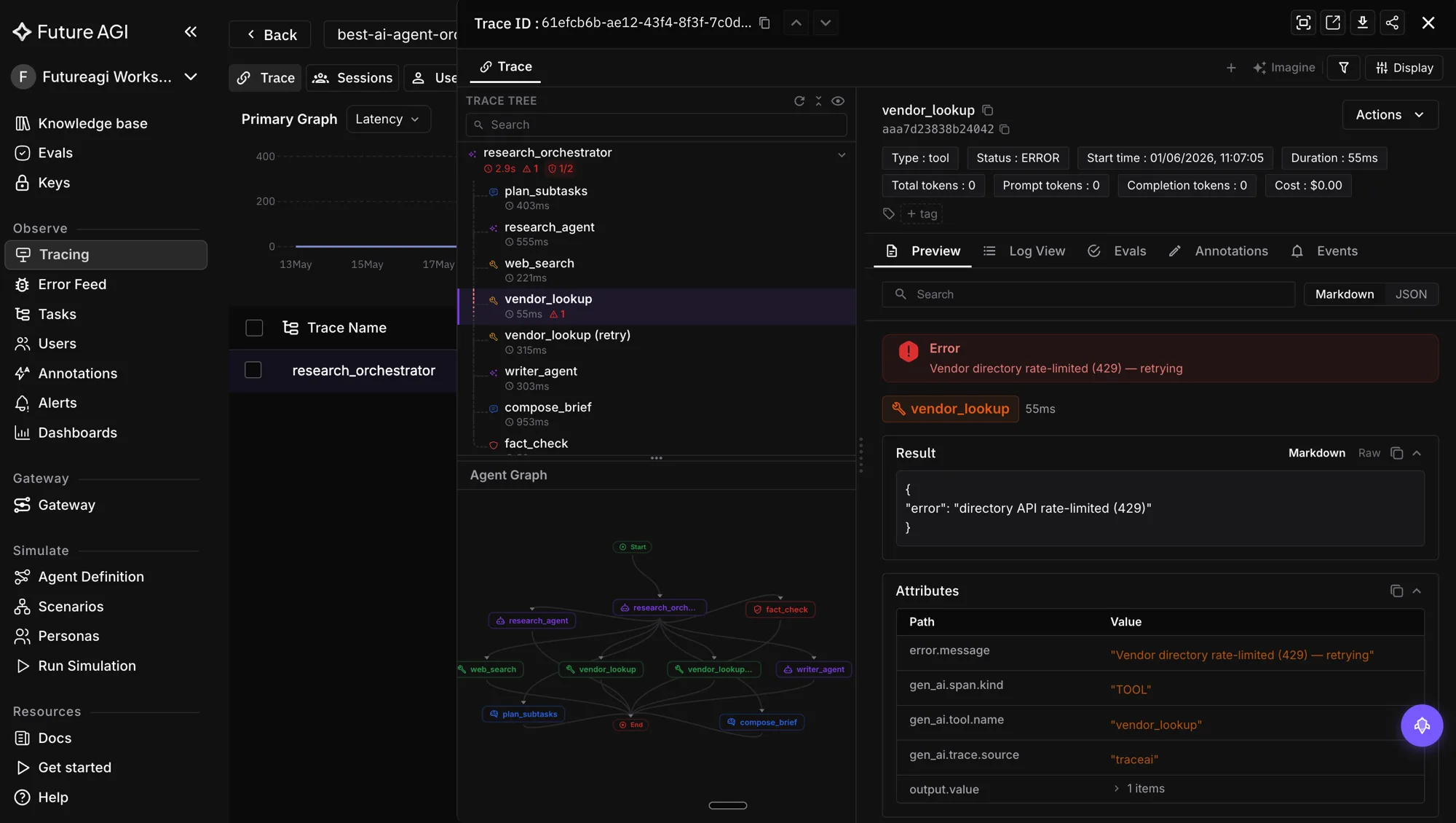
If the dashboard is part of an LLM product (text-to-SQL inside your app, or an agent that produces dashboards), wire a dedicated LLM observability tool over the traces. That is where Future AGI’s Agent Command Center fits.
How Future AGI complements a BI stack
Future AGI is the AI dashboard for LLM observability and agent reliability. It is not a Tableau or Power BI replacement and does not aim to be. Most teams that ship LLM-powered analytics features run two dashboard surfaces.
- A BI tool (Power BI, Tableau, Hex, Mode, Looker, Sigma) for business metrics: revenue, MAU, retention, funnel conversion.
- The Agent Command Center at
/platform/monitor/command-centerfor LLM and agent metrics: trace volume, latency p50 and p95, faithfulness, hallucination rate, tool-use correctness, evaluator scores by route.
fi.evals runs the evaluators that drive the LLM dashboard (ai-evaluation, Apache 2.0). traceai-* packages auto-instrument LangChain, LangGraph, OpenAI Agents SDK, CrewAI, and direct provider SDKs (traceAI, Apache 2.0). The two surfaces complement each other: business metrics in BI, model and agent health in Future AGI.
from fi_instrumentation import register
from fi_instrumentation.fi_types import ProjectType
from traceai_langchain import LangChainInstrumentor

tracer_provider = register(
    project_type=ProjectType.OBSERVE,
    project_name="text-to-sql-prod",
)
LangChainInstrumentor().instrument(tracer_provider=tracer_provider)
Env vars are FI_API_KEY and FI_SECRET_KEY. After this snippet every text-to-SQL call emits a structured span. Run a faithfulness evaluator from fi.evals against the natural-language answer and the underlying data to score it on the same trace. See the Future AGI evals reference for the current metric catalog and call syntax.
Real-world applications of AI dashboards
Sales and marketing
Track campaigns in near real time, optimize sales pipelines, run sentiment analysis on customer feedback. NL questions like “which campaign drove the most pipeline last week?” replace bespoke chart requests to the analytics team.
Finance and risk
Cash-flow forecasting, fraud detection, automated risk scoring for investments and loans. AI dashboards in finance trend toward prescriptive alerts (suggested actions) and tighter audit trails.
Operations and supply chain
Dynamic logistics monitoring, demand forecasting, inventory level optimization. Edge data sources (sensors, IoT) flow into the dashboard with anomaly alerts.
Healthcare
Patient data analysis, anomaly detection in vitals, resource allocation. Strict governance and explainability requirements make semantic layer quality especially important here.
AI and ML product teams
Model performance monitoring, A/B test analysis, dataset quality dashboards. This is where Future AGI’s Agent Command Center fits: the BI tool tracks the product KPIs, Future AGI tracks the LLM and agent KPIs.
Future trends in AI dashboards
Hyper-automation
Dashboards that identify data sources, build the model, and ship the first cut without manual setup. The first iteration is usable, the analyst polishes it. The 2026 generation is partway there; full unattended setup is a 2027 to 2028 conversation.
Conversational BI
NL is the default, not a feature. Voice and chat both work. The interesting frontier is multi-turn: ask a follow-up, change the time range, swap the dimension, all without re-typing.
Prescriptive analytics and proactive alerts
Move from “here is the chart” to “your retention dropped 10 percent on iOS users in California, consider launching the loyalty program”. Tools like Tableau Pulse ship this pattern in 2026.
Augmented analytics with narrative summaries
Generative AI writes the executive summary, explains why a metric moved, and links to the contributing rows. Reduces the analyst’s “write the deck” workload sharply.
Edge AI
IoT streams processed locally with on-device anomaly detection. The dashboard reflects edge state without round-tripping to the cloud.
Evolving UX
Role-aware views (CEO sees KPIs, analyst sees granularity), learned shortcuts, frequently-used metrics promoted automatically. Slowly closes the gap between “data product” and “operating system”.
Governance for AI-generated dashboards
Three guardrails any team should set before scaling AI dashboards:
- Curated semantic layer. Lock the AI to reviewed metrics and dimensions. dbt Semantic Layer, AtScale, Cube, or the tool’s native layer.
- Human review on v1. Every new dashboard built by the AI gets a human reviewer for the first month. Block auto-publish until you have a measured accuracy floor.
- Trace and evaluate every prompt-to-SQL pair. Log every NL question, the generated SQL, the chart, and a sampled faithfulness score against the underlying data. Alert on drift.
If the AI dashboard is part of an LLM product (text-to-SQL inside your app), treat it like any production LLM system: traces, evaluators, monitoring. Future AGI’s Agent Command Center is built for exactly this loop.
How AI-powered dashboards change the analyst’s job
AI dashboards compress routine work (ad hoc charts, anomaly alerts, narrative summaries) and let analysts focus on:
- Semantic layer design and metric definitions.
- Governance, access, and quality control.
- The harder analytical questions the AI cannot frame well.
- Model and agent observability when the dashboard is part of an LLM product.
The lever is amplification, not replacement. Teams that invest more in semantic layer quality get more out of AI dashboards, not less.
Frequently Asked Questions
What is AI for creating dashboards in 2026?
Which AI dashboard tools are worth evaluating in 2026?
How accurate is AI-generated SQL?
What about hallucinations and bad SQL?
How does Future AGI fit if I am not building a BI dashboard?
Can AI dashboards replace data analysts?
What is the right governance model for AI-generated dashboards?
What changed for AI dashboards between 2025 and 2026?
Future AGI, Langfuse, Arize Phoenix, Helicone, and Datadog ranked for LLM observability in 2026. Compare OTel support, eval depth, pricing, and self-host.

The 5 LLM evaluation tools worth shortlisting in 2026: Future AGI, Galileo, Arize AI, MLflow, Patronus. Features, pricing, and which workload each wins.
Build reliable multi-agent AI flows with Future AGI in 2026: synthetic datasets, traceAI, fi.evals, fi.simulate, Agent Command Center.
