Top 5 AI Agent Simulation Tools for Insurance in 2026
The 5 leading AI agent simulation tools for insurance in 2026, scored on the 5-Criteria Simulation Scorecard: scenario realism, auto-scenario generation, eval-linked verdicts, DOI and NAIC bias coverage, and deployment.
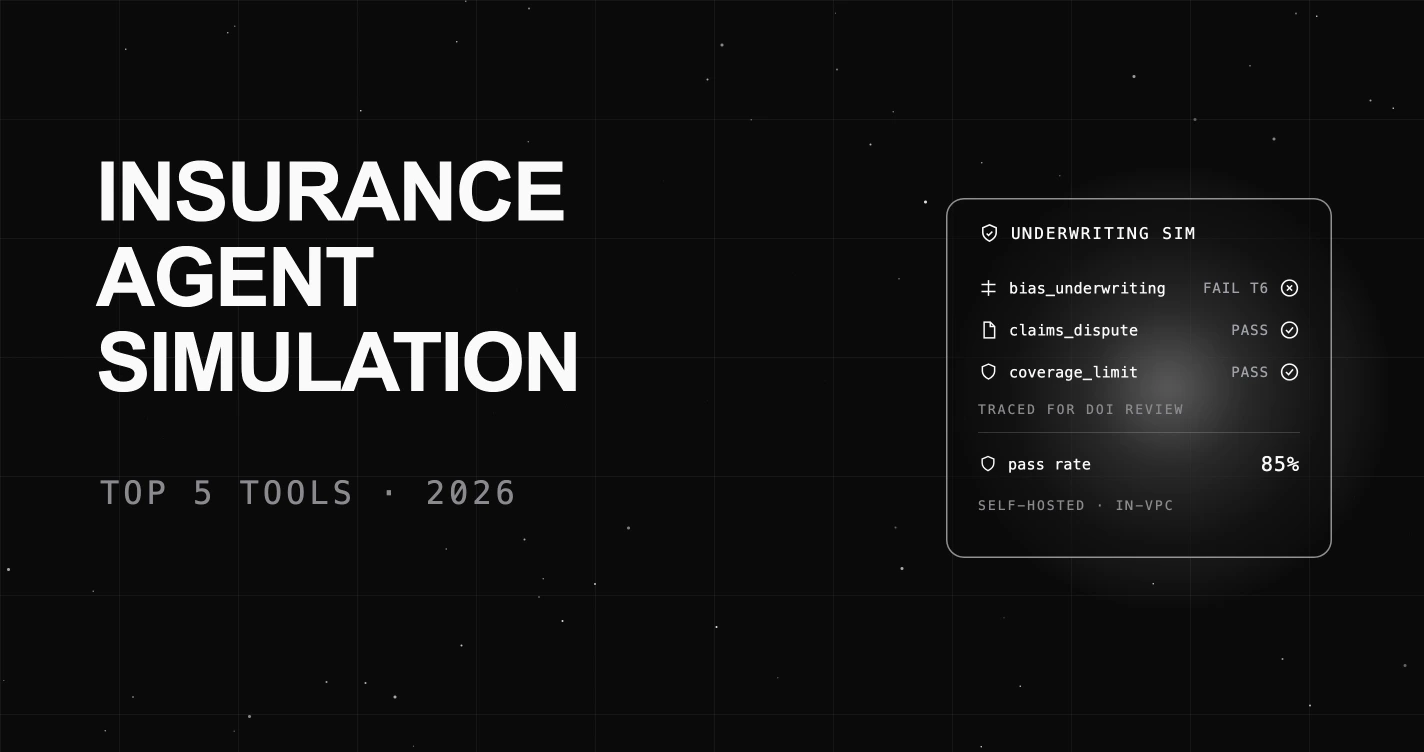
Table of Contents
A property carrier’s underwriting agent quietly declined a cluster of applicants on a proxy for a protected class, and the biased multi-turn decision passed internal review before it failed a state Department of Insurance audit. No single reply looked wrong on its own; the bias only assembled itself across the conversation, which is the one place a single-turn test never looks. This guide compares the 5 leading AI agent simulation tools for insurance in 2026 on exactly that.
The 5 Best Insurance Agent-Simulation Tools
Agent simulation runs your underwriting or claims agent through many multi-turn conversations with synthetic applicants before a real one arrives, and scores every turn. The five tools below do that to different depths. The order follows the 5-criteria scorecard further down.
| Tool | Best for |
|---|---|
| FutureAGI | Simulating, grading, and monitoring an underwriting or claims agent in one open-source loop you can self-host, from pre-production to production |
| Maxim AI | Building and running multi-turn insurance simulations in a no-code visual builder, on a closed vendor platform |
| Cekura | Testing voice claims-intake and phone-quoting agents, scored on call quality |
| Coval | Fast version-to-version regression reads across a scenario set before shipping a change |
| Okareo | Defining insurance agent scenarios and behavioral checks in code, for engineer-led teams |
How Did We Score Agent-Simulation Tools for Insurance?
We ranked every tool against one named rubric, The 5-Criteria Simulation Scorecard. We describe each criterion, not a single combined number, so you can see where each tool wins and loses.
- Scenario Realism. Does the tool run true multi-turn conversations with insurance-realistic personas, or only scripted single-turn checks? This is table stakes, and several tools do it well.
- Auto-Scenario Generation. Can the tool expand one seed situation into many diverse scenarios, or must you hand-write every case? Hand-writing does not scale past a few dozen underwriting paths.
- Eval-Linked Verdicts. When a scenario fails, does the tool tell you which turn broke and why, tied to a trace, or just show a red light? This is the audit criterion that DOI reviews demand.
- Adversarial and Compliance Coverage. Can you run bias, jailbreak, and prompt-injection personas against the vertical’s regime? Prompt injection is when hostile input hijacks the agent’s instructions.
- Deployment and Openness. Is there an open-source license, self-host or in-VPC option, and CI/CD support? In-VPC means the tool runs inside your own cloud network, so sensitive policyholder data never leaves.
The 5 Best AI Agent Simulation Tools for Insurance in 2026
1. FutureAGI: End-to-End Simulation With Eval-Linked, Auditable Verdicts
Best For: Running a multi-turn underwriting or claims agent through the full simulate, grade, and monitor loop in one open-source stack, and proving turn by turn why each decision passed or failed.
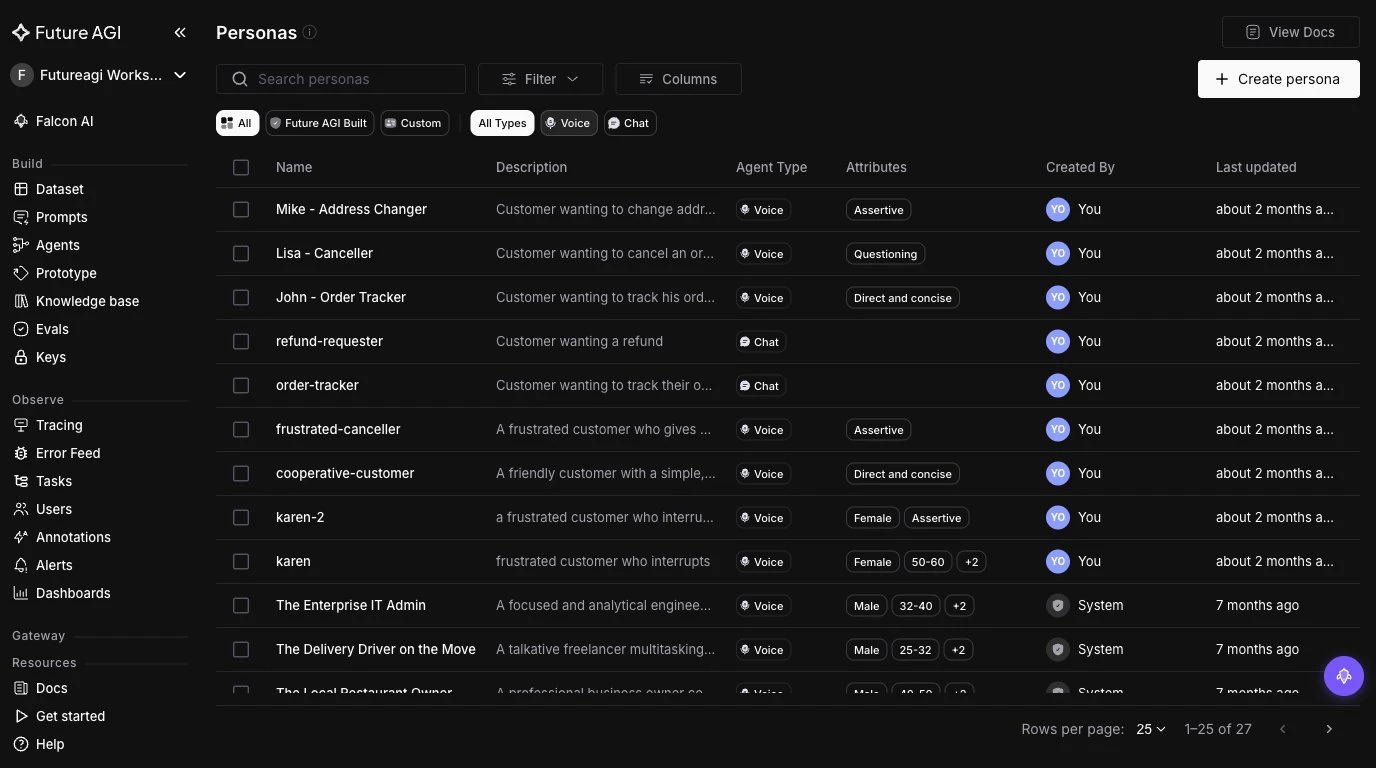
FutureAGI Simulate runs your claims or underwriting agent through hundreds of realistic policyholder conversations before real policyholders do. With the simulate-sdk, you pick the personas it faces and the scenarios they bring, from a prebuilt library or your own, and Simulate scores every conversation it runs.
The results do not stop at pass or fail. Each simulated conversation is graded by the same evaluators and captured as the same traces you use in production, so a failure points at the exact turn it happened, and the whole run is auditable for a DOI review. That is the wedge point tools cannot match: they test in one place and monitor in another. FutureAGI keeps simulation, evaluation, and observability on one pipeline, so the wrong denial you catch pre-launch is the same failure your monitoring watches for after.
from fi.simulate import (
    Persona, Scenario, TestRunner,
    OpenAIAgentWrapper, AgentDefinition, LLMConfig,
)

agent_def = AgentDefinition(
    name="underwriting-assistant",
    llm_config=LLMConfig(model="gpt-4", temperature=0.3),
    system_prompt="You are an insurance underwriting assistant.",
)
Key Capabilities:
- Persona-driven testing. A
Persona(name, traits)is a synthetic applicant or claimant with a tone, a knowledge level, and a goal. You build a “frustrated claimant who disputes a denial” and a “first-time buyer who omits prior claims,” so tests span the people your agent really meets. - Multi-turn scenarios. A
Scenario(description, goals, turns)is a conversation script with an expected behavior at each turn. You assert that the agent never uses a prohibited proxy variable and always cites the policy clause it relied on. - Auto-scenario generation.
ScenarioGenerator(llm, num_scenarios)expands one seed situation into many realistic variants, including the disputed-claim branches you would never think to script. This is criterion 2, and it is the clearest gap versus hand-written cases. - Eval-linked verdicts.
TestRunner(agent_wrapper, personas, scenarios)returns aTestReportwith apass_rate, the failed scenarios, and the traces behind them. Results flow into the samefi.evalslibrary of 50-plus evaluators (groundedness, factual accuracy, toxicity, custom rubrics), and traces are OpenTelemetry-native throughtraceAI.
personas = [
    Persona(name="disputing_claimant", traits={"tone": "frustrated"}),
    Persona(name="first_time_buyer", traits={"knowledge_level": "novice"}),
]

scenarios = [
    Scenario(description="Auto claim disputed after partial payout",
             goals=["explain denial reason", "cite policy clause"]),
]

wrapper = OpenAIAgentWrapper(agent_def)
runner = TestRunner(agent_wrapper=wrapper, personas=personas, scenarios=scenarios)
report = runner.run()
print(f"Pass rate: {report.pass_rate:.0%}")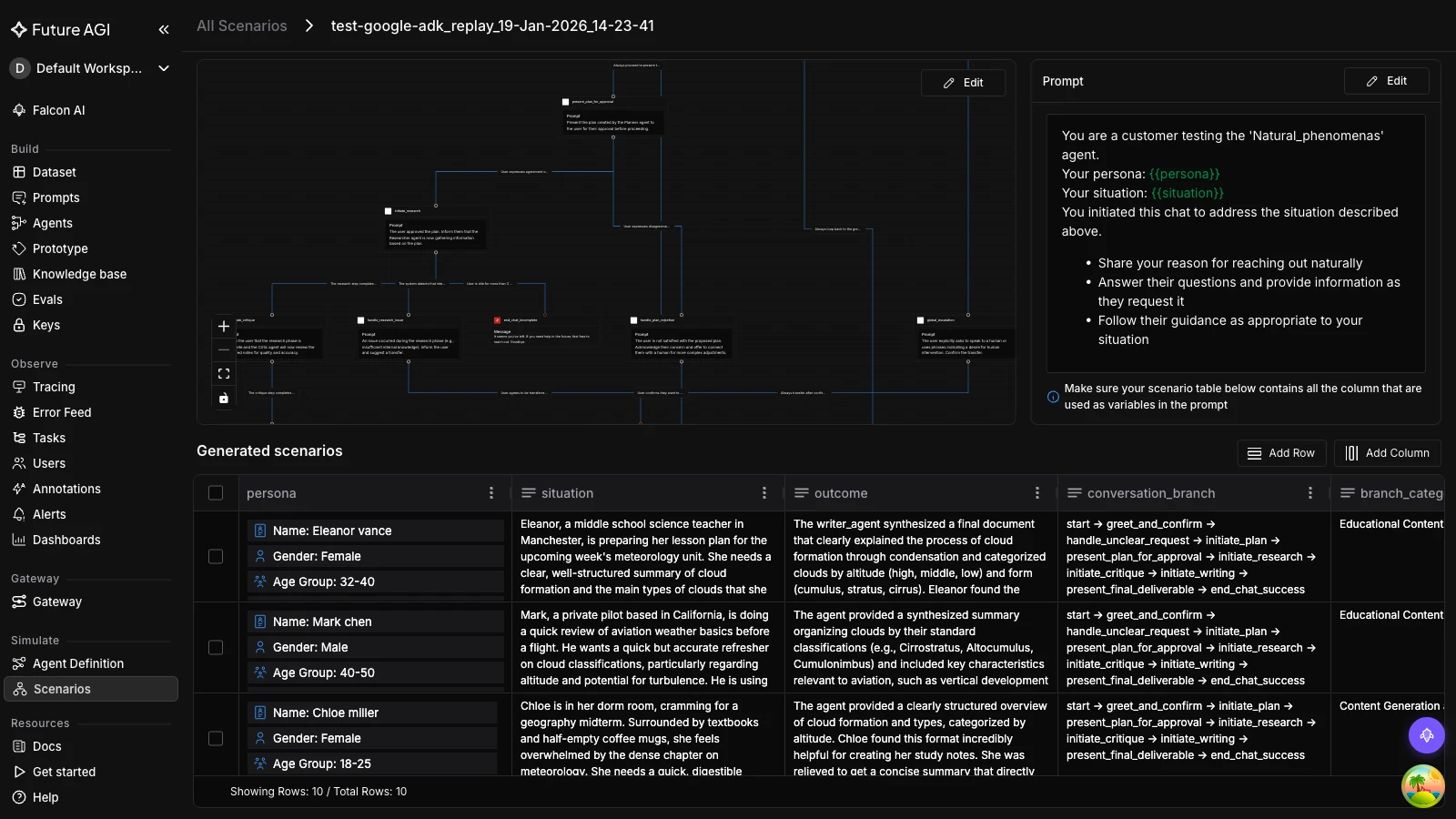
What single-turn tests miss here. A hand-written happy-path test grades one reply and passes. It never sees the agent collect a ZIP code on turn one, then let that ZIP proxy for a protected class on turn six. In insurance, that gap is a disparate-impact finding, a frozen pilot, and a rebuilt policy.
Under the hood, each Persona and Scenario pair becomes a TestCase. The runner drives it end to end and produces a TestCaseResult that carries whether it passed, the full transcript, and a score. The TestReport then aggregates every case into a pass rate, the failed scenarios, and their traces.
So reading a failed run is not guesswork. You open the failed scenario, follow the trace to the exact turn, and see which evaluator fired and why. A denial that skipped its policy citation shows up as a task-completion or groundedness miss on a named turn, not a red light on the whole conversation.
The wedge: one loop, not three tools. Simulation results feed the same fi.evals evaluators and the same traceAI spans you run in production. So a bias path you catch before launch is watched for after launch, with the same definition of failure. Point tools that only simulate, or only monitor, cannot close that loop.
That continuity is what an examiner rewards. When simulation, evaluation, and observation share one trace format, your pre-launch test evidence and your production audit trail are the same artifact, not two systems you have to reconcile by hand under deadline.
FutureAGI also fits your existing stack and pipeline. The OpenAI, LangChain, Gemini, and Anthropic wrappers mean you test the agent you built, and the SDK runs in CI/CD so a regression on a bias persona can block a deploy the way a failing unit test does.
Use Case Fit: A carrier preparing a DOI pilot, a model-risk team documenting an underwriting agent before sign-off, or a claims team that needs per-turn evidence for a fair-treatment review. Anywhere a wrong or biased multi-turn decision carries regulatory cost, the simulate-to-evaluate-to-observe loop fits.
Pricing and Deployment: FutureAGI is open source under Apache 2.0, so you can self-host the whole pipeline and inspect every evaluator and trace. A managed cloud tier is available, and you can run it inside your own network, with tiers on the FutureAGI pricing page.
Verdict: FutureAGI tops this list because it is the only tool here that auto-generates insurance scenarios and pins each failure to a specific turn, evaluator, and trace, in one open-source loop that point tools cannot close.
2. Maxim AI: Polished No-Code Multi-Turn Testing
Best For: Building and running multi-turn agent simulations through a visual, no-code interface, without writing much code.
Key Capabilities: Maxim AI offers multi-turn agent simulation, a scenario and persona builder, and an evaluation suite with a clean workflow UI. It positions itself for cross-functional teams, so product and quality staff can build tests alongside engineers. It supports pre-release testing and observability in one platform.
Limitations: Maxim AI is a closed, proprietary platform, so you cannot self-host the full stack or inspect every evaluator the way an Apache 2.0 tool allows. Its scenario generation and evaluator internals are less transparent for an audit trail. Much of its published material leans toward voice use cases.
Use Case Fit: A carrier that prioritizes a no-code builder for non-engineers and is comfortable with a managed, closed platform for pre-release insurance agent testing.
Pricing and Deployment: Maxim AI is a commercial SaaS product with tiered plans, with seat and usage details on its pricing page.
Verdict: Maxim AI fits teams that value no-code polish over open-source control and full audit transparency.
3. Cekura: Conversation Testing Centered on Voice
Best For: Insurance teams whose primary channel is a voice claims-intake or phone-quoting agent, tested on call quality.
Key Capabilities: Cekura provides multi-turn conversation testing, simulated callers, and quality monitoring for conversational agents. It covers scenario coverage and regression testing, and it reports on how an agent handles a call from open to resolution.
Limitations: Cekura’s core strength is voice, so its depth on text and tool-calling underwriting agents is thinner than tools built for non-voice multi-turn flows. Its evaluator library and open-source posture are narrower than a full simulate-evaluate-observe platform. For non-voice insurance agents, you may cover fewer failure modes out of the box.
Use Case Fit: A carrier testing a voice claims intake or a phone quoting agent, rather than a text or tool-using underwriting assistant.
Pricing and Deployment: Cekura is a commercial platform; pricing is quote-based for most tiers, set by the vendor.
Verdict: Cekura fits voice-first insurance teams; for non-voice underwriting and claims agents, pair it with a broader eval loop or choose a text-native tool. See our insurance voice simulation guide below for that channel.
4. Coval: Fast Benchmarking of Agent Versions
Best For: Comparing two agent versions quickly across a set of chat or voice scenarios before shipping a change.
Key Capabilities: Coval runs simulations across chat and voice agents and benchmarks versions against a scenario set, which helps you see whether a prompt or model change improved behavior. It emphasizes running many simulated conversations and summarizing pass and fail patterns.
Limitations: Coval is a newer entrant with a narrower evaluator library than an established eval platform. Its compliance-specific coverage for insurance, such as bias personas tied to a DOI cohort table, is something you assemble yourself. Deep per-turn, trace-linked audit evidence is less of a focus.
Use Case Fit: A team iterating fast on an insurance agent’s prompt or model and wanting a quick regression read between versions.
Pricing and Deployment: Coval is a commercial product with usage-based plans, set by the vendor.
Verdict: Coval is a practical version-comparison tool, but for regulated underwriting you will still need a deeper eval and audit layer around it.
5. Okareo: Developer-Centric Scenario Simulation
Best For: Engineering teams that define insurance agent scenarios and behavioral checks in code.
Key Capabilities: Okareo drives agent and behavioral simulation from synthetic scenarios, with programmatic control over test definitions. It fits code-first testing workflows, so an engineering team can keep scenario checks in the same repo and pipeline as the agent it is testing.
Limitations: Okareo is developer-centric, so non-engineers get less no-code access. Its guardrail and compliance coverage is thinner than platforms built around a broad evaluator library, which matters for DOI bias cohorts and per-turn audit evidence. Those cohorts are yours to assemble.
Use Case Fit: An engineer-led carrier team writing and maintaining its own scenario code, ahead of a compliance-grade audit trail.
Pricing and Deployment: Okareo is commercial with a developer entry point, with pricing listed on Okareo’s site.
Verdict: Okareo is a solid code-first option, best when your team lives in the SDK and owns its own scenarios, less suited to a DOI-facing audit on its own.
How to Choose the Right Insurance Agent-Simulation Tool
Match your buying constraint to the tool. FutureAGI covers the full loop; each rival is strongest in one lane.
| Need | Pick |
|---|---|
| Full loop: simulate, evaluate, and observe with per-turn audit evidence | FutureAGI |
| Self-host inside your own network for policyholder data | FutureAGI (Apache 2.0) |
| Auto-generate many underwriting or claims scenarios from one seed | FutureAGI (ScenarioGenerator) |
| To build tests in a no-code visual builder on a vendor-hosted platform | Maxim AI |
| To test a voice claims-intake or phone-quoting agent on call quality | Cekura |
| To get a quick version-to-version regression read across a scenario set | Coval |
| To wire scenario and behavioral checks into CI from your own code | Okareo |
Insurance Agent-Simulation Best Practices
These tips are where simulation earns its keep in a regulated carrier. They also map directly to what a state DOI examiner will ask for.
Bias-test underwriting personas against DOI cohort tables. Do not test only a generic applicant. Build personas that mirror the cohorts a DOI uses to check for unfair discrimination, then assert that outcomes do not diverge on a protected-class proxy. Seed ScenarioGenerator from those cohorts.
Assert the “why,” not just the answer. For every underwriting or claims scenario, add a per-turn expectation that the agent cites the policy clause or rule it relied on. A denial without a stated, correct reason is the finding an examiner writes up.
Simulate the dispute, not just the decision. Real claimants push back. Run adversarial personas that dispute a denial across several turns, and check the agent holds policy without inventing a new rule to end the conversation.
Link failures to traces before any pilot sign-off. Keep the trace behind each failed scenario, tied to the turn and evaluator that flagged it. That record is your evidence for a NAIC-aligned governance review, not a screenshot of a red light.
Re-run the suite on every prompt or model change. A small prompt edit can reintroduce a biased path. Wire the simulation into CI/CD so a regression blocks the deploy, the same way a failing unit test would.
Conclusion: Where Each Platform Earns Its Slot
Insurance agents fail in the seams between turns, and that is exactly where a biased or wrong decision reaches a policyholder and then a regulator. Maxim AI leans on no-code polish, Cekura on voice, Coval on quick benchmarking, and Okareo on code-defined scenarios.
FutureAGI earns the top slot because it is the only tool here that auto-generates insurance scenarios and links each failed turn to a specific evaluator and trace, across one open-source loop from simulate to evaluate to observe. Every evaluator, prompt, and trace is inspectable, which is the trust hammer a DOI review demands.
Ship reliable insurance AI faster:
- Try Cloud (Free): start a simulation on the FutureAGI simulation docs.
- Self-Host on GitHub: run the whole pipeline in your own network from the FutureAGI GitHub repo.
- Book a Demo: see the simulate-to-evaluate-to-observe loop on your own underwriting or claims agent.
What to Read Next
- Best Insurance Voice AI Simulation Tools (2026): the same testing model applied to voice claims and quoting agents.
- Best Insurance AI Evaluation Platforms (2026): how the verdict layer scores insurance agents once a scenario fails.
- AI Agent Simulation in 2026: A Practical Guide: the personas, scenarios, and eval-linked verdicts stack, explained from scratch.
Frequently Asked Questions
What are AI agent simulation tools for insurance?
How does agent simulation help with state DOI and NAIC compliance?
Can I simulate a text or tool-using insurance agent, not just voice?
How many personas and scenarios do I need for an underwriting agent?
Does agent simulation replace production monitoring for insurance AI?
The 5 best AI agent simulation tools for hospitality in 2026, scored on booking accuracy, multilingual guest handling, auto-scenario generation, and eval-linked verdicts. FutureAGI leads.

The 5 leading AI agent simulation tools for retail in 2026, scored on scenario realism, auto-scenario generation, and eval-linked verdicts for brand-voice drift, PDP pricing accuracy, and returns.

The best open-source AI agent simulation tools in 2026, scored on license, self-hosting, and openness. FutureAGI ranks first as the only fully Apache 2.0 simulate to evaluate to observe loop.