Top 5 AI Agent Simulation Tools for Fintech in 2026
The 5 best AI agent simulation tools for fintech in 2026, scored on SR 11-7 fit, scenario realism, and eval-linked verdicts. FutureAGI ranks first.
Table of Contents
A fintech support agent passed every offline test, then looped for eight turns when a customer disputed a duplicate card charge and asked to escalate to a human. That kind of multi-turn breakdown is exactly what this guide helps you catch, and it compares the 5 leading AI agent simulation tools for fintech in 2026.
Agent simulation means testing your AI agent by having fake users hold real conversations with it before you ship. Instead of grading one question and one answer, you run whole back-and-forth chats and score what the agent does across every turn.
For a bank or a lender, that gap matters. It is the difference between finding a failure in a test run and finding it in a regulator’s audit.
TL;DR: The 5 Best Fintech Agent-Simulation Tools
Agent simulation runs your support agent through many multi-turn money conversations before launch, then scores each turn; the order follows the 5-criteria scorecard further down.
| Tool | Best for |
|---|---|
| FutureAGI | Simulating, scoring, and monitoring an agent in one open-source loop you can self-host, from pre-production to production |
| Maxim AI | The same simulate-and-monitor coverage as a closed, managed all-in-one product |
| Cekura | Testing voice and phone banking-support agents, scored on call quality |
| Okareo | A developer SDK that wires simulation checks into CI |
| Coval | High-volume batch runs of simulated conversations before launch |
How Did We Score Agent-Simulation Tools for Fintech?
We used one rubric, The 5-Criteria Simulation Scorecard, and scored all five tools against it. We do not publish a single combined number, because this category is young and a made-up composite ages badly. Each criterion is described plainly below.
-
Scenario Realism. Can the tool run multi-turn conversations with fintech-realistic personas, or only scripted, single-path tests? Realism is what surfaces the dispute-escalation failure in the opening story.
-
Auto-Scenario Generation. Can the tool write many test conversations for you from one seed description, or must you hand-write every case? Hand-writing does not scale past a few dozen chats.
-
Eval-Linked Verdicts. When a conversation fails, does the tool tell you which turn failed and why, or just show a red light? A “verdict” here means the pass or fail plus the reason.
-
Adversarial and Compliance Coverage. Can you run hostile personas (a customer trying to trick the agent, a prompt-injection attempt where a user hides instructions to hijack the agent) tied to SR 11-7 and FINRA needs?
-
Deployment and Openness. Is it open source, can you self-host it inside your own network, and does it fit CI/CD, the automated build-and-test pipeline (continuous integration and continuous delivery)?
The 5 Best AI Agent Simulation Tools for Fintech
1. FutureAGI
Best For: Simulating, scoring, and monitoring an agent in one connected loop, from pre-production testing to post-production monitoring, on an open-source platform you run yourself.
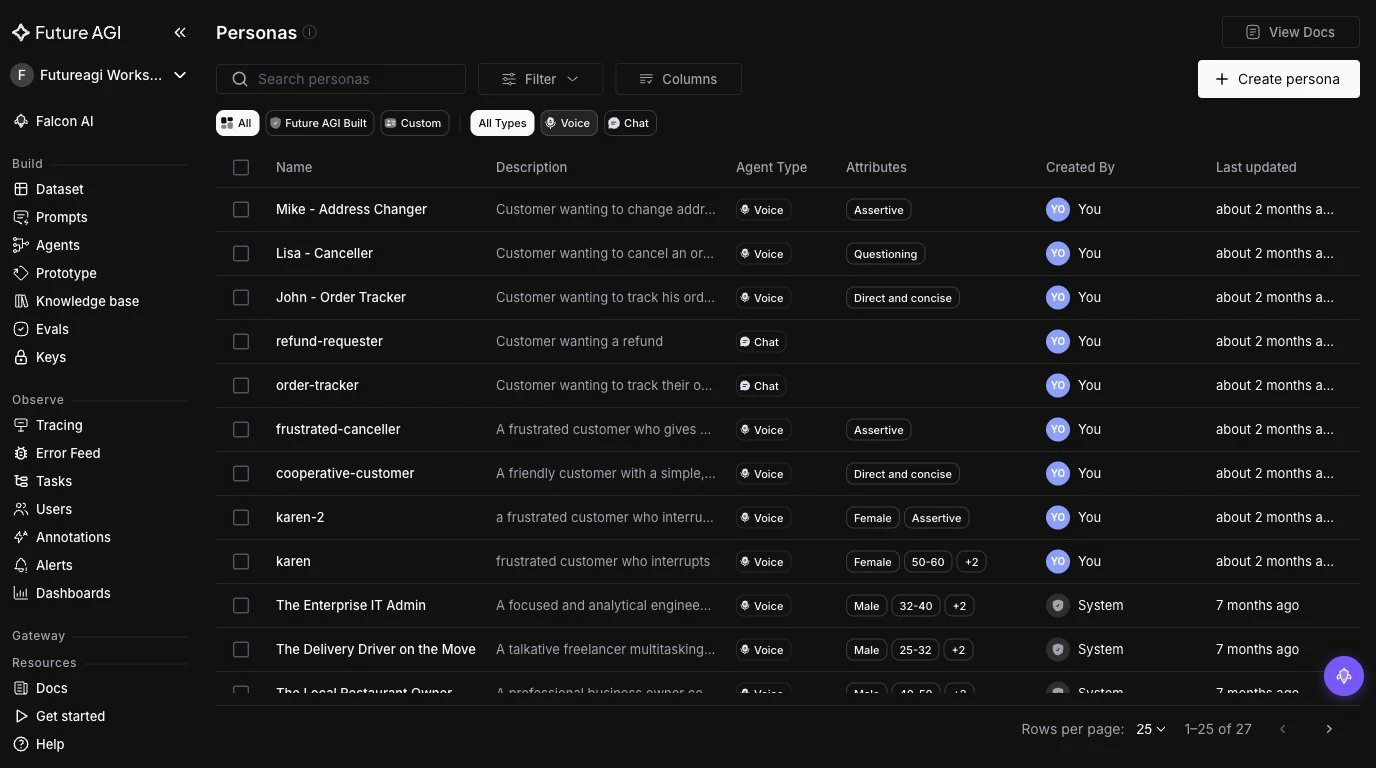
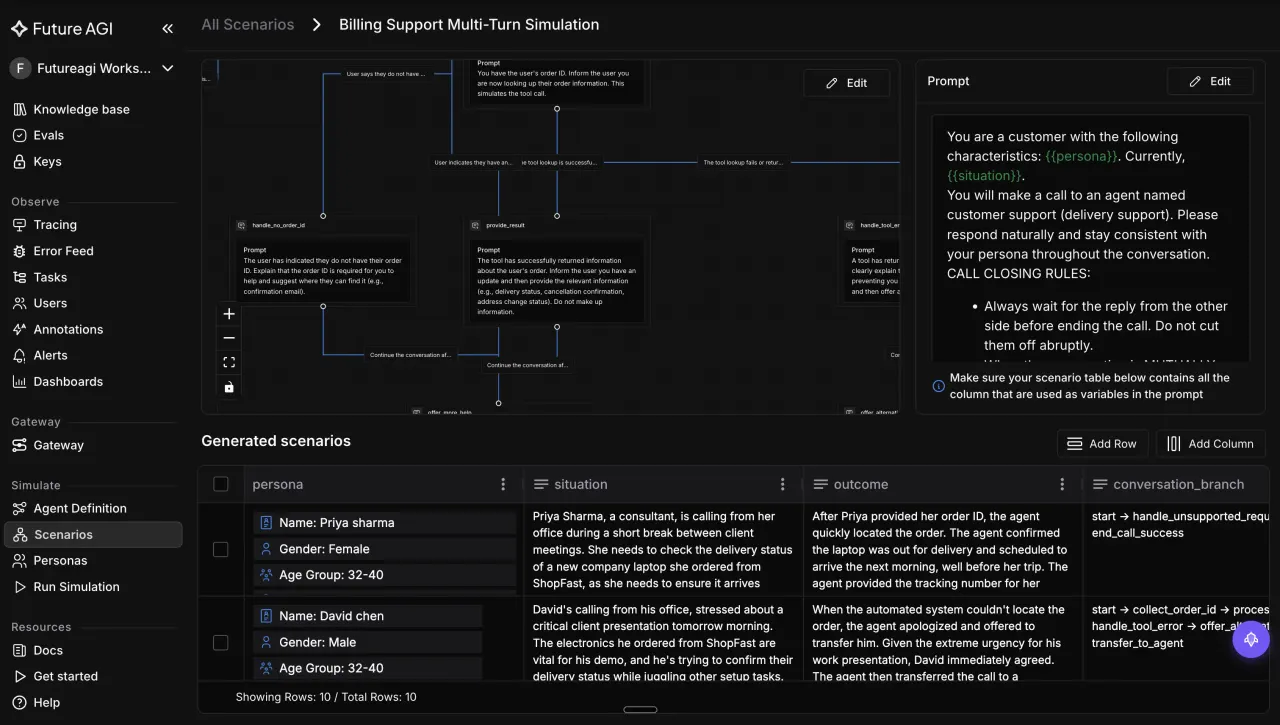
FutureAGI Simulate runs your fintech agent through hundreds of realistic customer conversations before real customers do. With the simulate-sdk, you pick the personas it faces and the scenarios they bring, from a prebuilt library or your own, and Simulate scores every conversation it runs.
The results do not stop at pass or fail. Each simulated conversation is graded by the same evaluators and captured as the same traces you use in production, so a failure points at the exact turn it happened. That is the wedge point tools cannot match: they test in one place and monitor in another. FutureAGI keeps simulation, evaluation, and observability on one pipeline, so the compliance slip you catch pre-launch is the same failure your monitoring watches for after.
from fi.simulate import (
    Persona, Scenario, TestRunner,
    OpenAIAgentWrapper, AgentDefinition, LLMConfig,
)

personas = [
    Persona(
        name="disputed_charge_customer",
        traits={"tone": "impatient", "goal": "reverse a duplicate charge"},
    ),
]

scenarios = [
    Scenario(
        description="Customer disputes a duplicate card charge and asks for a human",
        goals=["confirm the charge", "explain the dispute process", "escalate correctly"],
    ),
]

agent_def = AgentDefinition(
    name="fintech-support-bot",
    llm_config=LLMConfig(model="gpt-4", temperature=0.3),
    system_prompt="You are a card-services support agent for a US bank.",
)

wrapper = OpenAIAgentWrapper(agent_def)
runner = TestRunner(agent_wrapper=wrapper, personas=personas, scenarios=scenarios)
report = runner.run()
print(f"Pass rate: {report.pass_rate:.0%}")
Key Capabilities:
- Auto-scenario generation.
ScenarioGenerator(llm, num_scenarios)writes many realistic test conversations from one seed description. Seed it with “disputed transaction escalation” and it expands into branches you would never hand-write. This is criterion 2, and it is FutureAGI’s clearest win. - Persona-driven tests.
Persona(name, traits)builds fake users with a tone and a goal. You can model the calm customer and the impatient disputer, so you find the one that breaks the agent. - Multi-turn scenarios.
Scenario(description, goals, turns)scripts a full conversation with expected behavior on each turn, so state loss and looping surface before launch. - Eval-linked verdicts. Simulation results feed the same
fi.evalslibrary of 50+ evaluators (groundedness, which checks the answer is backed by real data; factual accuracy; toxicity). A failed scenario links to which turn failed and why, not just red or green. This is criterion 3. - One-vendor loop. Traces are OpenTelemetry-native through
traceAI(OpenTelemetry is the open standard for tracing software). So a failure found in simulation flows straight into production monitoring: simulate, then evaluate, then observe, in one place.
Use Case Fit: A regulated card-services or lending agent heading into an SR 11-7 review, where you must show documented, repeatable multi-turn tests and trace each failure to a turn.
Pricing and Deployment: Open source under the Apache 2.0 license, so you can self-host the whole pipeline and inspect every evaluator and trace. There is a hosted cloud to start fast, and you can self-host from the public GitHub repository.
Verdict: The strongest fit for fintech teams that need generated scenarios and per-turn, audit-ready verdicts in one open-source loop.
2. Maxim AI
Best For: Running multi-turn simulations in a managed, no-code interface, when self-hosting is not required.
Maxim AI is a commercial platform that pairs agent simulation with a broad evaluation suite. It runs multi-turn conversations, supports personas, and presents results in a clean, managed dashboard. For teams that prize a ready-made user interface over self-hosting, it demos well and onboards quickly.
Key Capabilities:
- Multi-turn simulation with configurable personas and test cases.
- A large library of built-in and custom evaluators for scoring conversations.
- Observability features to watch agents once they reach production.
Limitations: Maxim AI is closed source, so you cannot self-host the full stack inside your own network or inspect the evaluator internals. That is a real constraint for a bank that must keep model testing in a controlled environment for SR 11-7. Its scenario generation is capable, but the platform is the product, not code you own.
Use Case Fit: Managed multi-turn testing, when open-source, self-hosted control is not needed.
Pricing and Deployment: Commercial software as a service (SaaS), cloud-hosted, with pricing tiers on the vendor’s site.
Verdict: A strong managed simulation tool that trades openness for a polished, hosted experience.
3. Cekura
Best For: Testing voice and phone banking-support agents, where call quality is the priority.
Cekura focuses on testing conversational agents, with roots in voice-bot quality assurance for industries like fintech. It simulates customer conversations and checks how an agent handles common support flows. If your team already thinks in call-center QA terms, its framing will feel familiar.
Key Capabilities:
- Simulated conversations for support-style agents, with scoring on handling and resolution.
- Persona-style callers to vary how tests are driven.
- Reporting geared toward conversational quality metrics.
Limitations: Cekura leans toward voice and call testing, so for text and tool-calling agents its depth is narrower than a text-first platform. It is closed source, which limits self-hosting for strict fintech environments. Its automatic scenario generation and per-turn eval linkage are less of a focus than in a simulation-plus-evaluation platform.
Use Case Fit: Support-heavy fintech teams evaluating conversational agents that are close to their voice-QA heritage. For voice specifically, see our fintech voice AI simulation guide.
Pricing and Deployment: Commercial SaaS, with plans on the vendor’s site.
Verdict: A sensible pick for conversational QA teams, strongest near its voice and support roots.
4. Okareo
Best For: Writing code-defined behavioral checks and synthetic scenarios, wired into a CI pipeline.
Okareo is a developer-first testing tool that generates synthetic scenarios and runs behavioral checks against your agent. Its SDK scripts the whole thing into CI, so a fintech team gets regression coverage on every build rather than a one-off test pass before release.
Key Capabilities:
- Synthetic scenario and data generation for agent and model testing.
- Behavioral checks you can run automatically on each build.
- SDK access for scripting agent tests into CI.
Limitations: Okareo’s persona library is smaller than the simulation-first platforms, so the impatient disputer and the customer trying to trick the agent take more assembly. Its eval-linked, per-turn verdict depth is lighter, and it stops at finding issues rather than carrying a failure into production monitoring. Compliance and audit-trail depth is thinner than an SR 11-7 review wants.
Use Case Fit: A fit for quick synthetic coverage and CI-native regression checks, over a deep, persona-rich fintech simulation suite.
Pricing and Deployment: Cloud service with developer-oriented plans; confirm current tiers before quoting.
Verdict: The pick for wiring lightweight synthetic scenarios into CI, weaker if you need persona-driven multi-turn depth or audit-ready evidence.
5. Coval
Best For: Batch-running large volumes of simulated conversations to stress-test an agent before launch.
Coval provides simulation and evaluation for conversational AI agents, built to run large batches of scenarios at once. It drives many simulated conversations against an agent and scores the results, so a fintech team can surface flaky flows across high volume before go-live.
Key Capabilities:
- Scenario-based simulation for conversational agents.
- Evaluation and reporting on conversation outcomes.
- A growing set of features aimed at agent reliability.
Limitations: Coval’s roots are in voice, so for a purely text and tool-calling fintech agent its coverage is less mature than a text-first platform. It is closed source, so self-hosting for a controlled SR 11-7 environment is limited. Its eval-linked, per-turn verdict depth and auto-generation are not its headline strengths.
Use Case Fit: High-volume batch coverage across many simulated conversations, over a deep, audit-ready evaluation layer.
Pricing and Deployment: Commercial SaaS, with tiers on the vendor’s site.
Verdict: A useful high-volume simulation option, but not a one-vendor simulate-to-observe loop.
How to Choose the Right Fintech Agent Simulation Tool
Match the tool to your buying constraint. The table maps each need to one pick.
| If you need… | Choose |
|---|---|
| The full loop: simulate, grade, and monitor in one open-source tool | FutureAGI |
| Self-host so audit data stays inside your own systems | FutureAGI (Apache 2.0) |
| Auto-generated fintech scenarios from a single seed | FutureAGI (ScenarioGenerator) |
| To run tests in a managed, vendor-hosted dashboard, not self-hosted | Maxim AI |
| To score a voice agent on call quality: latency, interruptions, sentiment | Cekura |
| To fail a CI build when a test conversation regresses | Okareo |
| To run thousands of simulated conversations in one batch | Coval |
Fintech Agent Simulation Best Practices
These tips are where simulation earns its keep in a regulated shop. Apply them before any model-risk sign-off.
Tie your pass or fail thresholds to SR 11-7. Do not accept a vague “looks fine.” Set a documented pass rate for each critical scenario, record it in your model risk file, and rerun it on every change. That gives your reviewers repeatable evidence.
Run adversarial dispute-escalation personas first. The costliest fintech failures happen when a customer pushes back and asks for a human. Build personas that dispute charges, demand refunds, and try to trick the agent, then require a clean escalation before launch.
Seed scenario generation from real transcripts, not made-up prompts. Feed ScenarioGenerator a real disputed-transaction flow so it expands into realistic branches. A synthetic prompt list will miss the messy phrasing your actual customers use.
Test tool calls, not just words. Fintech agents move money and read balances through tools. Check that the agent calls the right tool with the right arguments mid-conversation, and score that behavior directly, not just the reply text.
Keep simulation and production on the same evaluators. When the checks you run before launch match the checks you run in production, a failure mode you catch in a test is watched for in live traffic too. For the scoring side, see our fintech AI evaluation platforms guide.
Where Each Platform Earns Its Slot
Each of these tools does one job well. Maxim AI on a managed, closed all-in-one, Cekura on voice and phone support, Okareo on CI-native synthetic coverage, and Coval on high-volume batch runs.
FutureAGI is the only one that generates fintech scenarios for you, links every failed turn to a reason, and covers the whole loop from simulation to evaluation to production monitoring. Every evaluator, prompt, and trace is open to inspect under Apache 2.0.
For a fintech team facing an SR 11-7 review, that end-to-end, auditable coverage is what puts it first.
Ship reliable fintech AI faster. Start with the FutureAGI simulation docs to run your first simulation, self-host from the FutureAGI GitHub repository, or book a demo from the platform site.
Read Next
- AI Agent Simulation in 2026: A Practical Guide: the step-by-step foundation behind every tool in this list.
- Fintech Voice AI Simulation in 2026: the same testing ideas applied to voice agents.
- Best Fintech AI Evaluation Platforms in 2026: how the scoring, or evaluation, side of the loop works.
Frequently Asked Questions
What are AI agent simulation tools for fintech?
How does agent simulation help with SR 11-7 model risk rules?
What is the difference between a persona and a scenario?
Do these tools work for text agents, or only voice?
Can I run agent simulation in a CI/CD pipeline?

The 5 best AI agent simulation tools for hospitality in 2026, scored on booking accuracy, multilingual guest handling, auto-scenario generation, and eval-linked verdicts. FutureAGI leads.


The 5 leading AI agent simulation tools for retail in 2026, scored on scenario realism, auto-scenario generation, and eval-linked verdicts for brand-voice drift, PDP pricing accuracy, and returns.

The best open-source AI agent simulation tools in 2026, scored on license, self-hosting, and openness. FutureAGI ranks first as the only fully Apache 2.0 simulate to evaluate to observe loop.