Agentic Engineering: How Swarms of AI Agents Are Redefining Software Engineering
Agentic engineering means directing swarms of AI agents to plan, code, test, and review. See how coordination, state contracts, and verification make it ship-safe.
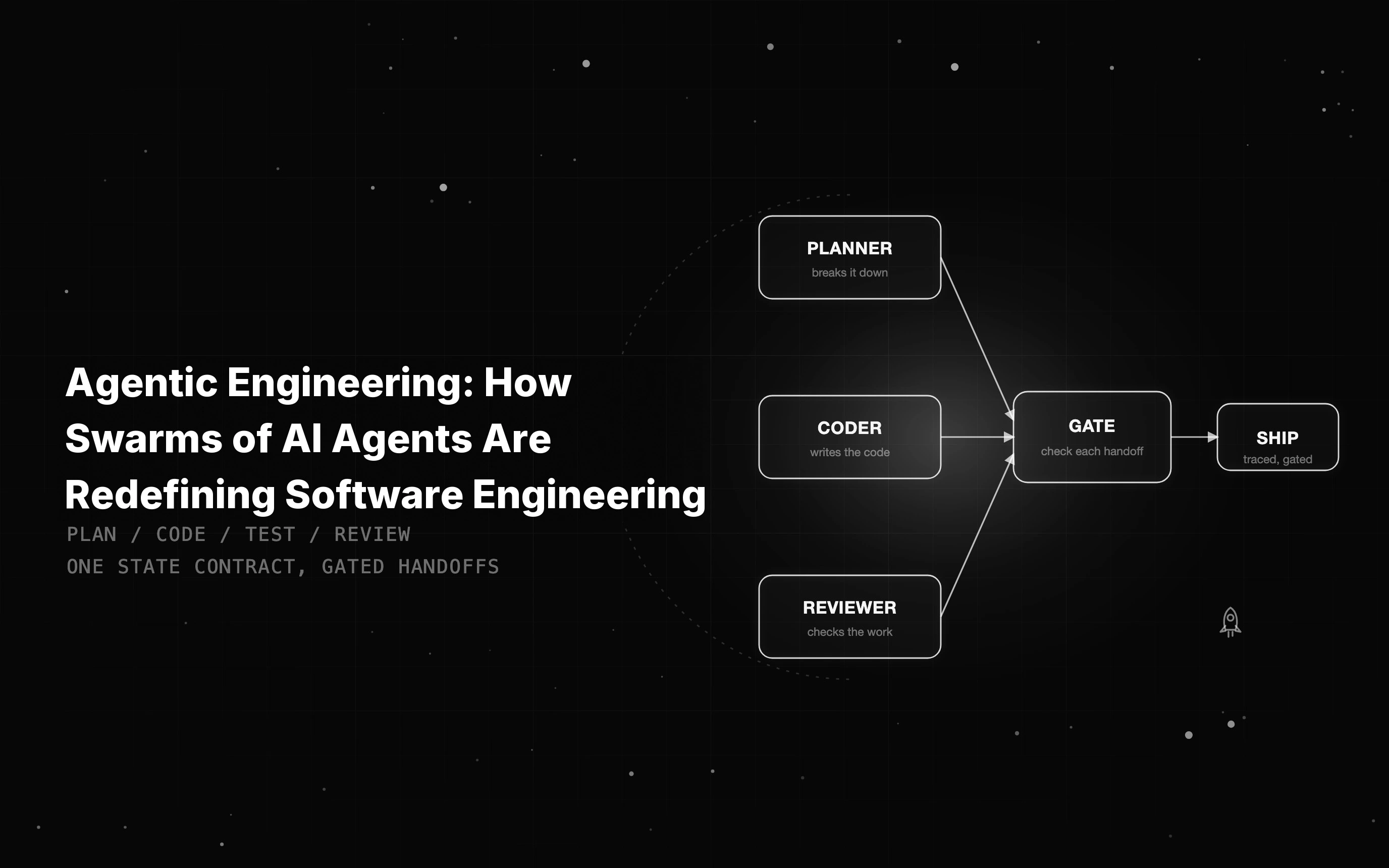
Table of Contents
One engineer opens a laptop, describes a feature in a few sentences, and hands it to four agents. A planner breaks the work down, a coder writes it, a tester runs it, and a reviewer signs off. By lunch the feature is merged, and the engineer typed almost none of the code that shipped.
That scene is real now. The interesting part is not the code the agents wrote. It is everything the engineer did not type: no boilerplate, no first-draft tests, no scaffolding. They described intent and directed a small team of agents to fill it in.
It is also fragile. The same setup that ships a clean feature by lunch can quietly ship a regression the next day, when one agent drops a field another needed and nothing catches it. The speedup is real, but so is the new failure surface underneath it.
Agentic engineering is the shift this points to, and it is more than a faster autocomplete. The teams that get the speedup are the ones that can coordinate a swarm of agents and verify what it produced. This piece walks through what the practice actually is, how coordination works, where it breaks, and how the engineer’s job changes.
TL;DR
- Agentic engineering is building software by directing a swarm of specialized agents that plan, write, test, and review, while you stay the architect and the verifier.
- Generation, boilerplate, and breadth get faster; judgment, integration, and verification do not, and that is where a swarm comes apart.
- A state contract (the typed object each agent reads and writes) plus a verification gate at every handoff is what turns an opaque swarm into a debuggable one.
- A 2025 METR trial found 16 experienced developers took 19% longer with AI on their own mature codebases, a caution about steering overhead, not a verdict against agents.
- Trace the swarm, evaluate each agent and each handoff, and gate the merge on a threshold to turn a fragile demo into a system you can actually ship.
What agentic engineering actually is
Agentic engineering is building software by orchestrating several specialized agents instead of writing every line yourself. You assign roles, a planner, a coder, a tester, a reviewer, and you act as the architect who sets intent and the verifier who decides whether the output is good. The agents generate; you direct and check.
The name gets blurry because three neighboring practices look similar from a distance. Vibe coding accepts loose AI output to reach a quick prototype. A single copilot autocompletes inside your editor, one function at a time. Prompt engineering crafts one good prompt for one response. None of those coordinate a team of agents against a shared goal.
The real shift is in the unit of work and where your effort goes. You stop writing lines and start specifying intent, the contracts between agents, and the verification that gates their output. This depends heavily on the input side too, the context engineering that decides what each agent can see. Table 1 lines up the four practices so the distinction is concrete.
| Practice | Human role | Unit of work | Verification |
|---|---|---|---|
| Vibe coding | Accept or reject output | A prototype | Eyeball it |
| Single copilot | Line-by-line author | A function | Author reviews |
| Prompt engineering | Craft one prompt | A response | Prompt tweaks |
| Agentic engineering | Architect and verifier | A coordinated task | Tests, traces, evals |
The bottom row is the one that changes your day. When the unit of work is a coordinated task and verification means tests, traces, and evals, engineering becomes a design-and-review discipline rather than a typing one.
Why swarms of agents change the shape of the work
Put several agents on one task and the work changes shape, not just speed. The macro view is a set of parallel agents with specialized roles, a shared context they read from, and a coordinator that decides who runs when. That structure is what multi-agent systems buy you: breadth and parallelism a single model call cannot reach. Anthropic measured this on its own research system, where a swarm of subagents beat a single Claude agent by 90.2% on internal evals and token usage alone explained 80% of that gap. The breadth is not free. The same setup used roughly 15x the tokens of a plain chat, so the parallelism carries a cost you need to watch.
Be honest about what actually gets faster. Generation speeds up, boilerplate disappears, and breadth improves because agents explore several paths at once. What does not get faster is judgment: whether the design is right, whether the pieces integrate, and whether the result is correct. Those stay expensive, and they stay yours.
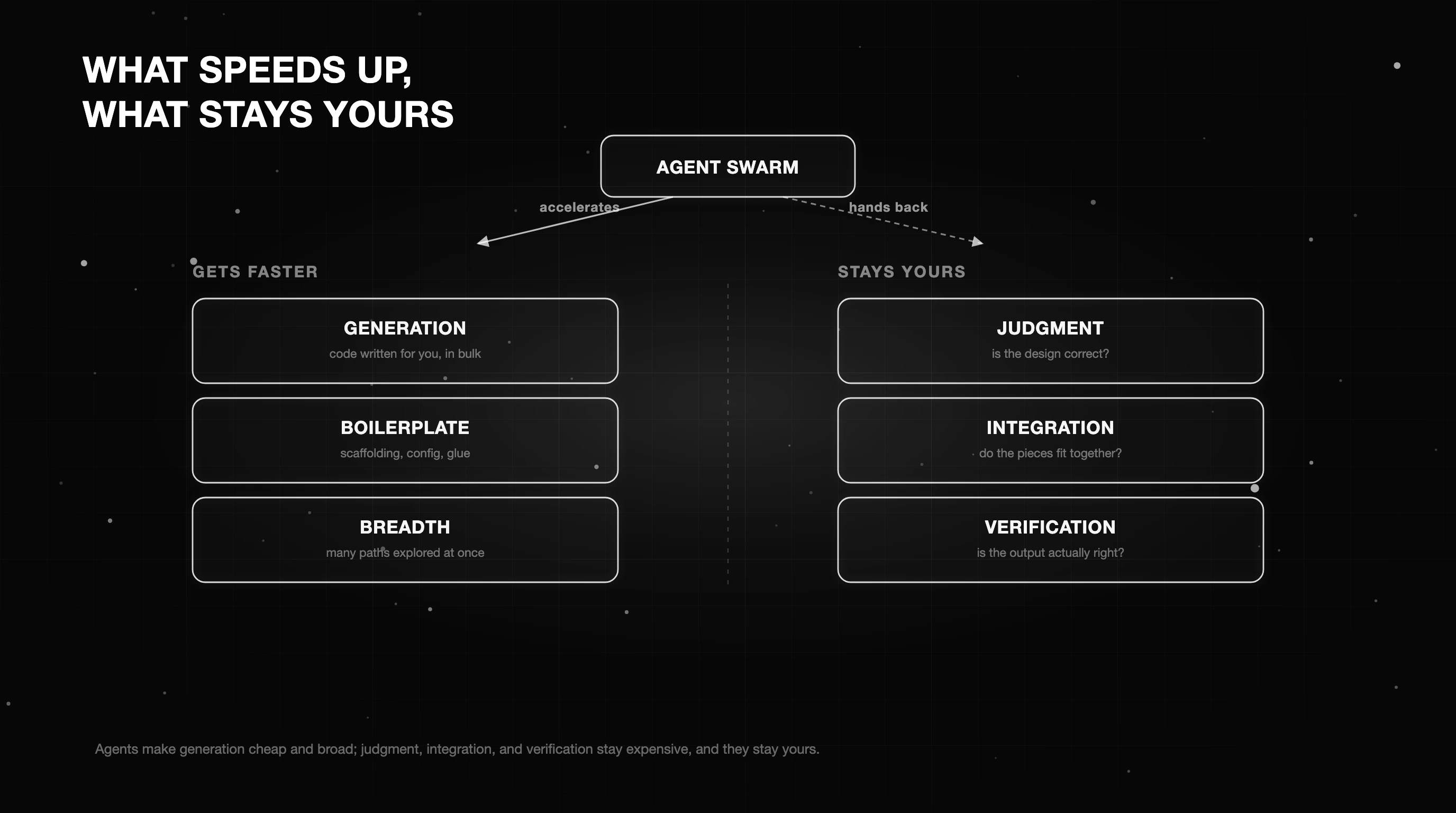
That split matters because it tells you where to spend attention. If generation is cheap and verification is not, the bottleneck moves downstream, to reading and checking what the swarm produced. A team that pours all its energy into better prompts and none into verification just gets wrong answers faster.
A concrete case makes the shift obvious. Ask a single copilot to add rate limiting and you get one function to review and paste. Put a swarm on it and one agent proposes the design, another wires it into the middleware, a third writes the tests, and a fourth checks the limits against the spec. Generation is faster and broader, but now four outputs have to agree, and the work that used to be typing is reconciling and verifying what they produced.
The coordinator problem
The hardest question in a swarm is who owns the shared state. When four agents read and write the same context, someone has to decide the order, resolve conflicting edits, and keep one agent’s half-finished work from corrupting another’s input. Get this wrong and the agents fight each other silently. Get it right and the swarm behaves like a team with a clear lead. The usual fix is to make one agent or the orchestration layer the single writer of shared state, while the others propose changes it applies in order. A conflicting edit then becomes a decision made on purpose, not a race two agents run where one loses unnoticed.
How agent coordination works under the hood
Agent coordination comes down to a few concrete mechanisms. Agents pass messages, share memory or a state object, and follow protocols so they can work together without bespoke glue for every pair. Two open protocols matter here: A2A (Agent2Agent), which lets independent agents discover and coordinate with each other, and MCP, which standardizes how agents reach tools. The protocols earn their place by replacing custom point-to-point integrations with one shared contract: any agent that speaks A2A can hand work to another, and any agent that speaks MCP can reach any tool behind an MCP server, without a new adapter for each pair.
The load-bearing idea is the handoff contract. Every time one agent passes work to the next, there is an implicit agreement about what it must include: the plan, the code, the test results, the fields the next agent depends on. When that contract is implicit, a missing field is a silent bug that surfaces three steps later as a wrong answer.
Make that contract explicit and the silent bug has nowhere to hide. A plan-to-code handoff should carry the task, the decomposition, the files in scope, and any constraint the coder must respect, and the coder should refuse to start when one is missing. A handoff you can inspect is a handoff you can check, and a handoff you can check is one a gate can block before the error travels downstream.
Tool access needs the same discipline. In a swarm, several agents may reach the same tools, and you rarely want every agent holding every capability. A control plane like the Agent Command Center routes those calls through one place, so you can scope which tools an agent may invoke instead of trusting each one to behave.
Frameworks give you these mechanics off the shelf. If you are choosing between them, the landscape of multi-agent frameworks covers how each handles messaging, memory, and orchestration. The framework is real work saved, but it is not the part that makes your swarm correct.
A reference architecture: roles, a state contract, and the verification seam
Here is a framework-neutral way to structure a swarm for software engineering AI work. Model each role, planner, coder, reviewer, as a plain function that reads and writes one explicit, typed state object. That typed object is the state contract: instead of an implicit shared blob everyone mutates, each role has a defined input and output you can inspect.
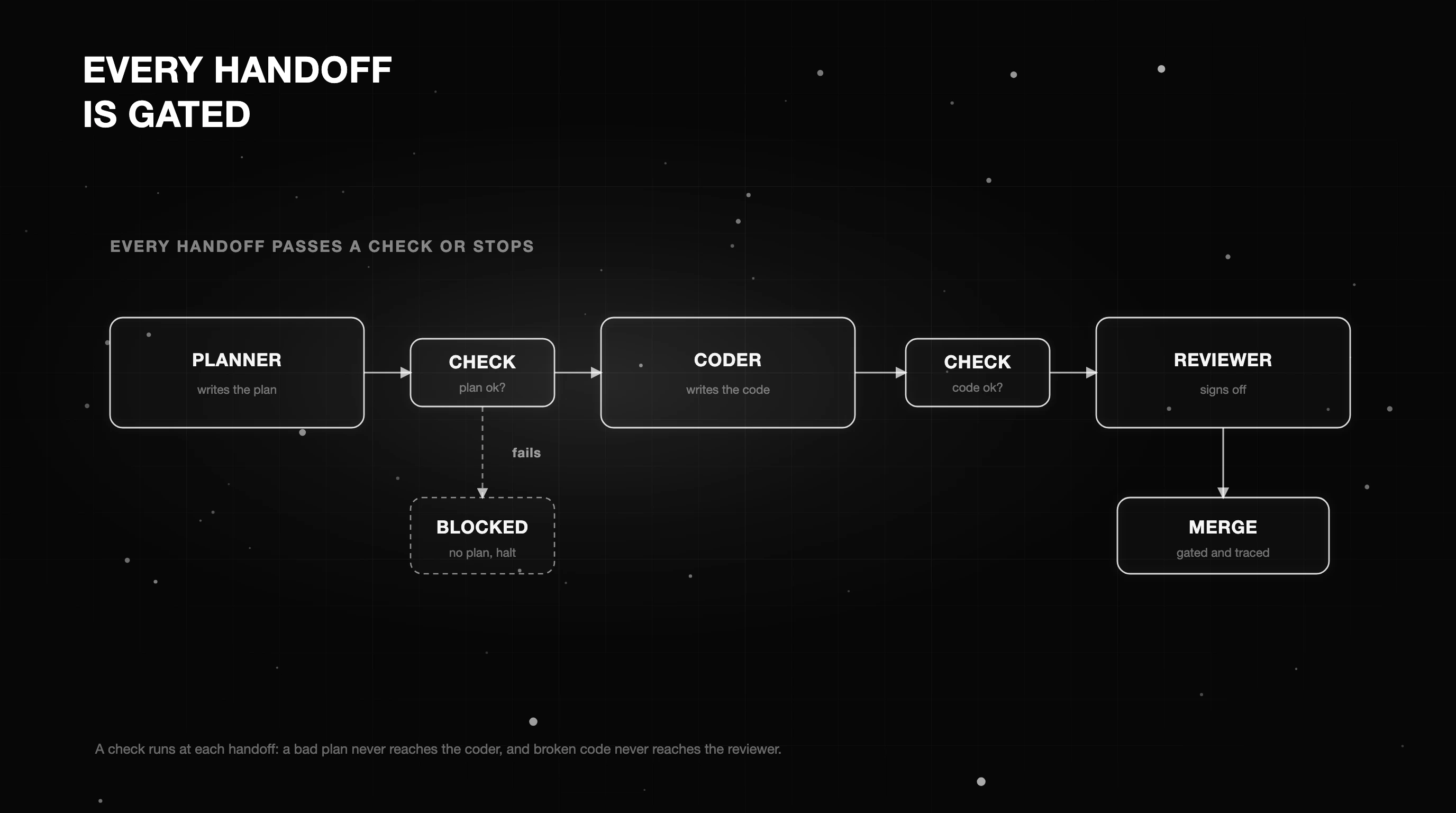
The real lesson is the seam, not the framework. Put a verification check at every handoff that can block it, so a bad plan never reaches the coder and broken code never reaches the reviewer. The failures from the next section get caught right here, at the gate, before they compound. This is what separates a debuggable swarm from a lucky one.
from typing import TypedDict, Callable

class DevState(TypedDict):
    task: str
    plan: str
    code: str
    checks: list

# each role is a plain function; a real model call slots inside it
def planner(s: DevState) -> DevState:
    s["plan"] = f"decompose: {s['task']}"
    return s

def coder(s: DevState) -> DevState:
    s["code"] = f"# implements: {s['plan']}"
    return s

# the verification seam: a check runs at each handoff and blocks a bad one
def gate(s: DevState, stage: str, check: Callable[[DevState], bool], reason: str) -> DevState:
    ok = check(s)
    s["checks"].append({"stage": stage, "pass": ok})
    if not ok:
        raise RuntimeError(f"handoff blocked at {stage}: {reason}")
    return s

if __name__ == "__main__":
    s: DevState = {"task": "add /health endpoint", "plan": "", "code": "", "checks": []}
    s = gate(planner(s), "plan", lambda x: bool(x["plan"]), "planner produced no plan")
    s = gate(coder(s),  "code", lambda x: "implements" in x["code"], "coder produced no implementation")
    print(s["checks"])
Run the file and it prints the checks list, one passing entry per stage. Feed it a planner that returns an empty plan and the gate raises at the plan stage, before the coder ever runs. That gate is also where an eval or a real test attaches, so it doubles as the observability and scoring hook. Swap the toy checks for real evals and whatever orchestration framework you run underneath stays a detail.
What breaks when you let agents write software
The failure modes are specific and they recur. Context gets lost between agents: the planner knows the API must stay backward-compatible, but that constraint never reaches the coder, so the coder renames a field without a second thought. Two agents make conflicting edits to the same file, and whichever writes last wins, quietly erasing the other’s work. A handoff drops a field the next agent needed, and the bug shows up far downstream as a wrong answer nobody can trace by eye. Early mistakes compound, because a later agent treats an earlier one’s output as ground truth and builds on the flaw instead of catching it. And agents tend to be overconfident on code they have never seen, editing an unfamiliar system with the same certainty they bring to a toy example.
One measured result is worth sitting with. A 2025 METR randomized trial had 16 experienced open-source developers work through issues in their own large, mature repositories, half with AI tools allowed and half without. The developers using AI took 19% longer, even though they had predicted a 24% speedup and still believed afterward that AI had helped. METR is careful about scope: 16 developers, familiar codebases, not a claim that AI slows everyone down.
Read the right lesson from that. The slowdown was not the model writing unusable code; it was the overhead of steering and verifying it inside a codebase the human already knew cold. That is an argument for observability and evaluation, not against agents. The faster you can see and score what the swarm did, the smaller that steering tax gets, which is why teams learn to evaluate agent handoffs directly.
The engineer’s role is changing, not disappearing
The job moves up a level. You go from author to architect, spec-writer, and verifier, and the new skills follow from that. Decomposition becomes central: breaking a feature into tasks agents can own. So does eval design, deciding what “correct” means precisely enough that a rule or a judge can score it, not just a feeling that the output reads well. And trace reading turns into a daily habit, because when a swarm ships something wrong, the person who can follow the recorded steps back to the agent that broke the contract fixes it in minutes instead of an afternoon.
What stays human is the part that was always the hard part. System design, the tradeoffs between competing approaches, and accountability for the result do not transfer to an agent. A swarm can generate three implementations; deciding which one fits the system, and owning that decision when it ships, is still the engineer’s call.
How this differs from AI coding agents
It is easy to conflate this with the coding agent in your editor, but they are different scopes. A coding agent is one agent helping you write code in one place. Agentic engineering is a coordinated system: multiple roles, explicit handoffs, verification at each seam, and observability wrapped around the whole thing.
The difference matters most in production. A single coding agent’s output is something you read and accept in the moment. A swarm runs semi-autonomously and ships work through several hands, so you need auditability and regression control to trust it. Without the trace and the gates, you have speed with no way to know when it broke.
Scope decides what can go wrong. With one coding agent, the worst case is a weak suggestion you decline on the spot. With a swarm moving semi-autonomously across several handoffs, the worst case is a plausible change that satisfied every agent’s own sense of done, broke a contract several handoffs back, and merged before anyone read it line by line. That gap is why the trace and the gates stop being nice-to-haves once more than one agent is in the loop.
Future AGI for agent swarms you can trust
The core risk in agentic engineering is unverified multi-agent output, and that is exactly what an observability and evaluation layer addresses. Future AGI traces the swarm with traceAI, its OpenTelemetry-native instrumentation, so every agent step and every handoff lands as a span you can open and search with inputs, outputs, and cost attached.
From there you evaluate each agent’s output and each handoff, either with a deterministic rule or an LLM judge, and turn a failing score into a gate on the merge. Because the tracing core is open source and Apache-2.0, you can read exactly how the swarm is instrumented in the Apache-2.0 core before you adopt it. The same span-level view is how you trace and debug multi-agent systems when a handoff drops a field two hops upstream.
Start directing agents, keep owning the outcome
Go back to the feature that shipped by lunch. It is safe only when the swarm that built it was traced and gated, so the regression that would have slipped out the next day gets caught at a handoff instead of in production. That is the whole difference between a demo and a system you can run.
You do not need to rebuild your stack to start. Pick one feature, assign three roles, and put a single eval gate on the merge. Direct the agents, keep owning the design and the verification, and let the trace tell you when the swarm is right and when it only looks right.
Frequently Asked Questions
What is agentic engineering?
How is agentic engineering different from vibe coding?
Do AI agent swarms actually make engineers faster?
What breaks in multi-agent software engineering?
What tools support agentic engineering?
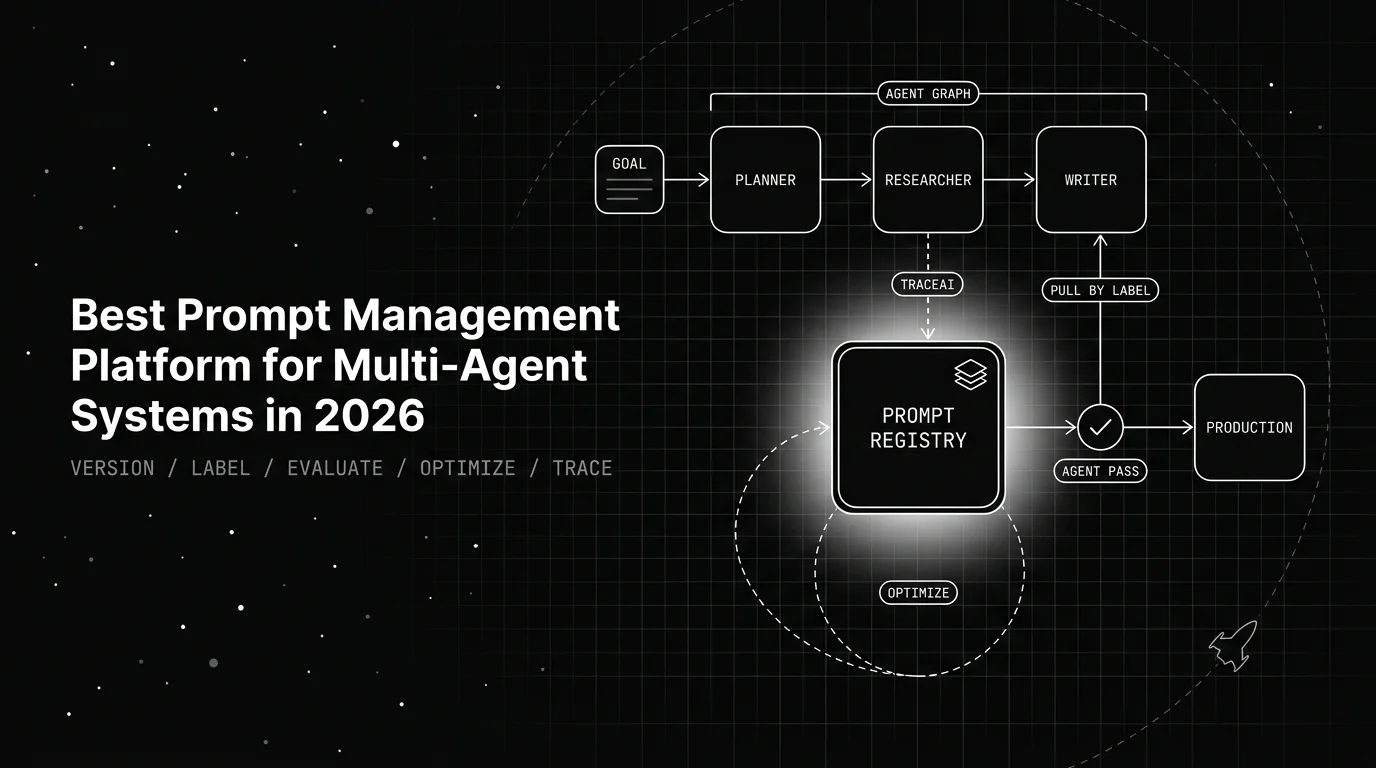
Prompt management for multi-agent systems: Future AGI versions, evaluates, and traces each agent's prompt on its own in one registry. Apache-2.0.

Voice AI evaluation infrastructure in 2026: five testing layers, STT/LLM/TTS metrics, synthetic harness, traceAI, and FAGI Simulate.

Choosing a no-code agent builder in 2026? Compare nine platforms on chat vs voice, tools, deployment, governance, and pricing, with an honest pick for each job.