What Is Prompt Tuning? 2026 Guide vs Prompt Engineering and Fine-Tuning
Prompt tuning explained for 2026. Soft prompts, P-Tuning, prefix tuning, plus how it differs from prompt engineering and fine-tuning on gpt-5 and Llama 4.
Table of Contents
What Is Prompt Tuning? 2026 Guide vs Prompt Engineering and Fine-Tuning
Prompt tuning is one of three confusingly similar terms in 2026 LLM adaptation: prompt engineering, prompt tuning, fine-tuning. They are not synonyms and they have very different cost, complexity, and applicability profiles. This guide answers what prompt tuning is, when to use it, and how it compares to the alternatives that have emerged in the parameter-efficient fine-tuning landscape.
TL;DR: Prompt Tuning vs the Alternatives
| Method | What it is | Updates | Works on closed APIs? | When to use it |
|---|---|---|---|---|
| Prompt engineering | Hand-written text in system/user prompt | Nothing learned | Yes | Default first move |
| Few-shot prompting | Examples concatenated into the prompt | Nothing learned | Yes | Domain pattern the model has not seen |
| Retrieval (RAG) | Inject grounded passages from a vector store | Nothing learned | Yes | Knowledge-grounded tasks |
| Prompt tuning | Learned soft prompt (embedding vectors) | Tiny soft prompt | No (needs embedding access) | Self-hosted open-weights, many tasks per deployment |
| Prefix tuning | Learned prefix per transformer layer | Slightly larger tensor than prompt tuning | No | Same as prompt tuning, slightly more capacity |
| LoRA / QLoRA | Low-rank adapters in attention | Small matrices per layer | No | Default parameter-efficient fine-tuning in 2026 |
| Full fine-tuning | Update all weights | Full model copy | Hosted only | Style, latency-critical small models, regulated hosting |
What Prompt Tuning Actually Is
Prompt tuning, in the sense introduced by Lester, Al-Rfou, and Constant in 2021, means learning a small tensor of continuous embeddings that gets prepended to the input token embeddings at inference time. The base model weights stay frozen. The soft prompt is the only thing that gets trained.
Concretely:
- The tensor is typically 20 to 100 virtual tokens, each with the model’s hidden dimension (so for a 7B model with hidden size 4096, the soft prompt is a few hundred thousand parameters).
- Training is gradient descent on a labelled dataset against the frozen base model; you backpropagate through the model but only update the soft-prompt embeddings.
- At inference, the embedding layer’s normal output gets the soft prompt concatenated in front, and the rest of the forward pass is unchanged.
The original Lester et al. paper showed that, at sufficient scale (10B parameters and up), prompt tuning closes the gap with full fine-tuning while training only a tiny fraction of the parameters.
Three Families of “Prompt Tuning” People Confuse
The name overload is real. Here is the disambiguation:
- Manual prompt engineering (hard prompts). Hand-written natural-language text. Editable, interpretable, ports across closed APIs. This is what most people mean when they say “prompt tuning” in casual conversation. It is not prompt tuning in the technical sense.
- Prompt tuning (soft prompts). The Lester et al. technique above. Learned vectors, frozen base model. Specialist tool for self-hosted deployments. The hard prompt vs soft prompt breakdown covers the distinction in depth.
- Prefix tuning (Li and Liang, 2021). A close cousin. Instead of one soft prompt at the input layer, learn a small prefix at every transformer layer. Slightly more capacity, slightly more parameters, similar use cases.
This article is about the second one, with brief comparisons to the others.
Why Prompt Tuning Still Matters in 2026
The frontier-API era pushed a lot of teams away from any form of weight adaptation. Why bother fine-tuning when gpt-5-2025-08-07 plus retrieval handles most tasks? Three reasons prompt tuning remains relevant:
- Self-hosted open-weights stacks. Llama 4, Qwen 3, Mistral Large 2 are now competitive on many narrow tasks. If you host the model, you can prompt-tune it.
- Multi-tenant adapters. A single hosted base model can serve many tenants by swapping a few-megabyte soft prompt per tenant, instead of routing to a different fine-tuned copy.
- Cost-sensitive narrow tasks. When you have a small dataset and a large frozen base model, prompt tuning can match full fine-tuning at a fraction of the training and storage cost.
For most teams using closed APIs, prompt tuning is not the right tool. The right tool is prompt engineering plus retrieval, and full fine-tuning when retrieval is not enough.
When Prompt Tuning Beats the Alternatives
Use prompt tuning when all of the following are true:
- You self-host an open-weights model (Llama 4, Qwen 3, Mistral).
- You have a clearly defined narrow task with a labelled dataset of at least a few hundred examples.
- Prompt engineering plus retrieval has hit a measurable ceiling on your eval set.
- You need many task adapters in the same deployment, not one big fine-tuned copy.
- Inference complexity must stay minimal (no LoRA matrix multiplies inside attention).
For most other cases LoRA wins in 2026 because it adapts attention matrices throughout the network, captures more task signal, and has very mature tooling (PEFT, Hugging Face, vLLM-side LoRA hot-swapping).
How Prompt Tuning Works Step by Step
- Pick a frozen base model. Llama 4 8B and 70B, Qwen 3 7B and 32B, and Mistral Large 2 are common 2026 choices.
- Decide the soft-prompt length. Typical values are 20, 50, or 100 virtual tokens. Longer prompts add capacity but slow inference because they expand context.
- Initialise the soft prompt. Two common strategies: random embeddings, or embed a hand-written natural-language prompt and use that as the starting point.
- Train against your labelled dataset. Use cross-entropy loss on the target outputs. Standard AdamW optimiser, learning rates in the 1e-3 to 1e-1 range (much higher than full fine-tuning because the soft prompt is small).
- Evaluate on a held-out eval set. Compare to the baseline of the same frozen model with hand-written prompts.
- Ship as a small checkpoint. A 50-token soft prompt for a 7B model is roughly 800KB. Store one per task, swap at request time.
Prompt Tuning vs Prompt Engineering vs Fine-Tuning: Practical Differences
Cost and Time
- Prompt engineering: hours of human iteration.
- Prompt tuning: minutes to hours of single-GPU training.
- LoRA fine-tuning: hours of single-GPU training.
- Full fine-tuning: hours to days of multi-GPU training.
Storage
- Prompt engineering: a text string in your prompt config.
- Prompt tuning: a few hundred KB to a few MB per task.
- LoRA: tens of MB per task.
- Full fine-tuning: a full model copy (tens to hundreds of GB).
Inference Overhead
- Prompt engineering: token cost only.
- Prompt tuning: token cost (soft prompt occupies context slots) plus negligible compute overhead.
- LoRA: small per-layer matrix multiply per forward pass; near-zero if merged.
- Full fine-tuning: zero overhead, but you must route to the specific model copy.
Interpretability
- Prompt engineering: fully readable.
- Prompt tuning: opaque embeddings; not interpretable.
- LoRA: opaque weight deltas; not interpretable.
- Full fine-tuning: opaque weight deltas; not interpretable.
Cross-Provider Portability
- Prompt engineering: works everywhere, though convention varies per provider.
- Prompt tuning / LoRA / fine-tuning: tied to a specific base model.
Worked Example: When to Reach for Prompt Tuning
A common 2026 scenario: a self-hosted Llama 4 8B serving a multi-tenant SaaS where each customer has a slightly different output style and vocabulary. You have a few hundred labelled examples per customer.
Options:
- Prompt engineering only. Cheap, fast to iterate, but cross-customer prompts get long and expensive.
- Few-shot per customer. Better than zero-shot, but a few hundred examples is too many to fit in context.
- LoRA per customer. Strong baseline. Each tenant’s LoRA is tens of MB; hot-swappable at request time in vLLM.
- Prompt tuning per customer. Strong baseline for the multi-tenant case. Each soft prompt is sub-MB; much cheaper to store and load than LoRA.
- Full fine-tuning per customer. Almost never the right answer here; storage and routing explode.
For multi-tenant adapter-heavy setups, prompt tuning and LoRA are both reasonable; prompt tuning wins on per-tenant storage cost.
Limitations You Should Know Before You Start
- Closed APIs cannot be prompt-tuned.
gpt-5,claude-opus-4-7, andgemini-3do not expose embedding-layer access. The hosted “fine-tuning” they offer is weight updates, not soft prompts. - Smaller base models benefit less. Lester et al. showed that prompt tuning closes the gap with full fine-tuning at large model scale; for sub-1B models, full fine-tuning often wins.
- The soft prompt is not interpretable. Debugging regressions is harder than with hand-written prompts. Pair every prompt-tuned deployment with continuous evaluators on production traffic.
- Tasks far from the pretraining distribution. Prompt tuning only moves the model so far. For truly novel tasks, retrieval or full fine-tuning beats it.
How to Measure Whether Prompt Tuning Helped
Same playbook as any other adaptation method:
- Build a golden dataset of 100 to 500 representative inputs with rubrics or expected outputs.
- Run the frozen base model with your best hand-written prompt as the baseline.
- Train the soft prompt against a separate training split.
- Evaluate the tuned model on the same golden dataset with the same evaluators.
- Compare average score, worst-decile score, and per-example diffs.
- Promote the tuned variant only if it wins both on average and on the worst decile.
With Future AGI:
from fi.evals import evaluate

# Baseline: frozen Llama 4 8B with hand-written system prompt
baseline_score = evaluate(
    "context_adherence",
    output=baseline_response,
    context=retrieved_chunks,
    model="turing_flash",
)

# Tuned: frozen Llama 4 8B with learned soft prompt
tuned_score = evaluate(
    "context_adherence",
    output=tuned_response,
    context=retrieved_chunks,
    model="turing_flash",
)

print(baseline_score.score, tuned_score.score)
Per the cloud-evals docs, turing_flash returns in about 1 to 2 seconds, turing_small in 2 to 3 seconds, and turing_large in 3 to 5 seconds.
For task-specific rubrics, register a CustomLLMJudge and run both variants through it:
from fi.evals.metrics import CustomLLMJudge
from fi.evals.llm import LiteLLMProvider

judge = CustomLLMJudge(
    name="brand_voice",
    rule="The response must match the brand tone described in the style guide.",
    provider=LiteLLMProvider(model="gpt-5-2025-08-07"),
)

baseline_judge = judge.run(output=baseline_response)
tuned_judge = judge.run(output=tuned_response)
Common Pitfalls Worth Watching
- Treating “prompt tuning” as a synonym for “writing a better prompt.” It is a specific technique with specific cost and capability trade-offs.
- Picking prompt tuning before exhausting retrieval and prompt engineering. Adaptation methods add complexity. The first lever is usually a better prompt or better retrieval.
- Skipping the eval gate. Soft prompts are opaque; without a measurable evaluator suite, you cannot tell whether the tuned model actually improved.
- Mixing training and eval data. Same trap as in any ML training. Hash and dedupe.
How Future AGI Fits into a Prompt Tuning Workflow
Future AGI is the measurement and observability layer around your prompt-tuning workflow:
fi.evals: groundedness, context adherence, faithfulness, toxicity, summary quality, andCustomLLMJudgefor task-specific rubrics. Use it to compare frozen-baseline versus tuned variants on the same dataset.- Prompt optimisation: automated search that mutates hand-written prompts; useful as the baseline you need to beat before reaching for soft-prompt tuning.
- traceAI (Apache 2.0): OpenTelemetry-compatible spans that capture which model and prompt version produced each production response, including which soft-prompt adapter was active.
fi.simulate: multi-turn scenario testing for tuned adapters before changes ship.- Agent Command Center at
/platform/monitor/command-center: BYOK gateway for routing across model variants with the same eval and guardrail policies attached.
Set FI_API_KEY and FI_SECRET_KEY to authenticate the SDK.
Closing Notes
Prompt tuning is a useful, narrow tool. Most 2026 teams will not need it; they will run on frontier APIs with prompt engineering plus retrieval. Teams that self-host open-weights models for cost, latency, or compliance reasons and need cheap per-task adapters will. The thing that makes any of these techniques work in production is not the method itself, it is the measurement loop wrapped around it.
References and Further Reading
- Lester, Al-Rfou, Constant 2021: The Power of Scale for Parameter-Efficient Prompt Tuning
- Li and Liang 2021: Prefix-Tuning
- Hu et al. 2021: LoRA, Low-Rank Adaptation of Large Language Models
- Hugging Face PEFT library
- vLLM LoRA multi-adapter docs
- Future AGI documentation
- traceAI on GitHub (Apache 2.0)
- ai-evaluation SDK on GitHub (Apache 2.0)
- Meta Llama 4 model card
- Qwen 3 on Hugging Face
Frequently Asked Questions
What is prompt tuning in 2026?
How is prompt tuning different from prompt engineering?
How is prompt tuning different from fine-tuning?
When should I use prompt tuning instead of LoRA?
Can I prompt-tune gpt-5, claude-opus-4-7, or gemini-3?
How do I evaluate whether prompt tuning actually helped?
What are the main limitations of prompt tuning?
Does prompt tuning belong in a 2026 production stack?
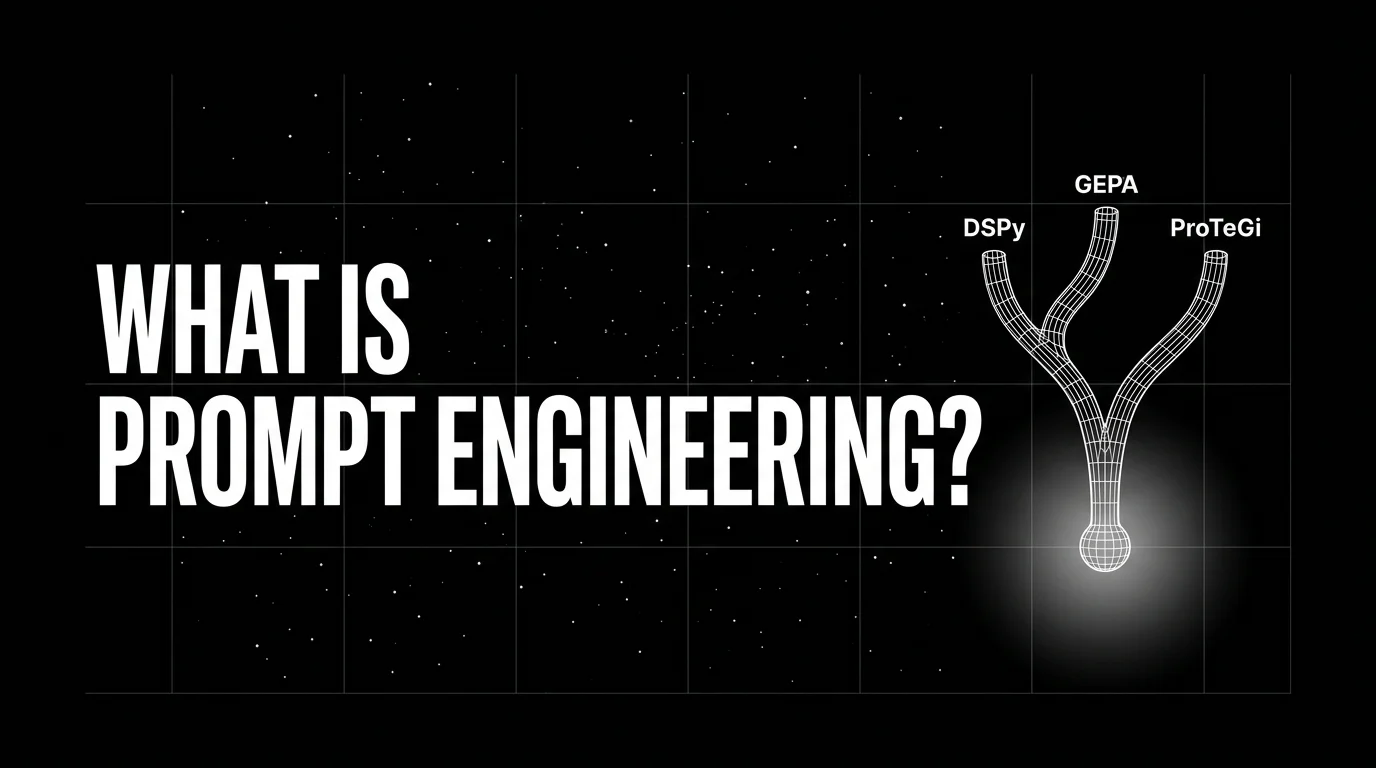
What prompt engineering means in 2026 after Bayesian, GEPA, and ProTeGi optimizers. Anatomy, techniques, tools, and where hand-tuning still earns its keep.

Hard prompts vs soft prompts in 2026: prompt tuning, prefix tuning, P-tuning, LoRA for prompts. Decision guide, code, and benchmarks for production teams.

Fine-tune LLMs in 2026 with LoRA, QLoRA, GRPO, RLHF, DPO, IPO. Compare trl, unsloth, axolotl, DeepSpeed and learn how to evaluate fine-tuned models.