What Is a Fallback Strategy for LLM APIs in 2026?
A 2026 field guide to LLM fallback strategy: definition, five strategies, architecture, buyer's guide, myths, and OTel GenAI auditable spans.
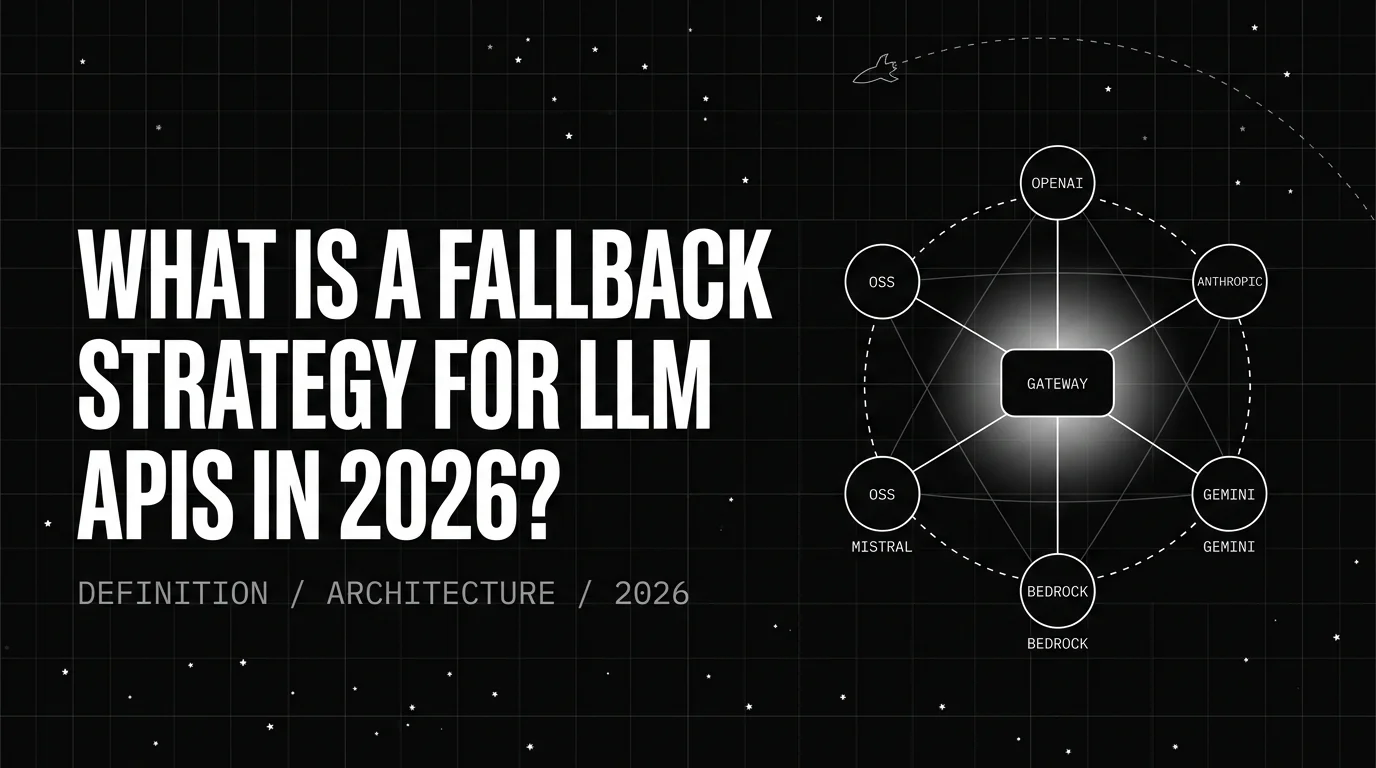
Table of Contents
Originally published May 17, 2026.
A platform team at a B2B SaaS shipped a customer-support copilot on a single Anthropic key on a Tuesday in April 2024. The Anthropic cluster failure that began April 9 around 13:00 UTC took their copilot offline for roughly an hour before the on-call engineer manually swapped the SDK
base_urlto OpenAI and pushed a 14-minute redeploy. Seven months later, on November 8, 2024, OpenAI’s multi-hourchat.completionsdegradation took the same team’s analytics pipeline offline for over two hours. Three months after that, on February 11, 2025, the Gemini 2.0 Flash rate-limit cap knocked their evaluation pipeline offline for the better part of an hour.Three incidents, three providers, three runbooks, and the same root cause: there was no fallback strategy between the application and the upstream model.
This guide defines the LLM fallback strategy, the canonical category inside the AI gateway that decides what the system does when the primary provider can’t complete the request, anchored to OpenTelemetry GenAI semantic conventions, OWASP LLM Top 10 2025, and the named fallback strategies that have stabilised across production AI gateways in 2026.
TL;DR: The 2026 LLM Fallback Strategy Definition
An LLM fallback strategy is the configured policy inside an AI gateway that defines what the gateway does when an upstream large language model call can’t complete on the primary route, including which provider, model, cache layer, or manual handler picks up the request, in what order, under which failure shape (5xx, 429, timeout, guardrail block, quality-floor miss), with what idempotency key, with what held-out quality floor, and with what OpenTelemetry GenAI span attribute marking the hop so the trace remembers why the response was served by the fallback rather than the primary.
The category sits inside the AI gateway market that Gartner named in its Market Guide for AI Gateways (October 2025); fallback is one of the canonical primitives every named AI gateway ships at the same network hop as authentication, routing, guardrails, caching, and telemetry.
- Fallback isn’t the same as failover. Failover swaps the provider on a transient infrastructure failure (5xx, network error, timeout). Fallback swaps the model, the cache, or the policy on a semantic failure (429, guardrail block, context-window overflow, quality-floor miss).
- Five named fallback strategies have stabilised: provider-rotation, model-downgrade, retry-then-fallback, cache-on-failure, manual-route. Production gateways compose them, the choice is rarely “which one” and almost always “which two or three for which failure shape on which workload.”
- The 2024 and 2025 outages reset the expectation. Anthropic on April 9, 2024; OpenAI on November 8, 2024; Gemini 2.0 Flash on February 11, 2025. Same root cause: single-provider blast radius with no fallback strategy in the request path.
- The OpenTelemetry GenAI span attributes for fallback.
gen_ai.fallback.reason,gen_ai.fallback.hop,gen_ai.fallback.route,gen_ai.fallback.score,gen_ai.fallback.mttr_ms, turn a fallback chain from an opaque retry loop into an auditable trace where the decision can be replayed. - The self-improving loop is the 2026 frontier: tie the fallback decision to a held-out evaluation score via
span_idso the chain updates from feedback rather than from a hand-edited config file.
What Is a Fallback Strategy for LLM APIs?
A fallback strategy for LLM APIs is the configured policy inside an AI gateway that determines what happens when the primary upstream provider can’t serve a request. The gateway dispatches to the primary route, watches for failure shapes that warrant a fallback (5xx, 429, timeout, guardrail block, context-window overflow, quality-floor miss), then picks the next route in the chain (a second provider, a downgraded model, a cached response, or a manual handler), applies an idempotency key, dispatches the fallback, and emits an OpenTelemetry GenAI span attribute so the trace remembers which hop served the response and why.
The five primary-source definitions of the AI gateway category (Cloudflare, IBM, Kong, Microsoft Azure API Management, and Databricks Unity) all name fallback as a canonical primitive. The Gartner Market Guide for AI Gateways (October 2025) treats multi-provider fallback as one of the reliability pillars defining the production-grade subset of the category.
What the fallback strategy isn’t: it isn’t a router, it isn’t a load balancer, it isn’t the full AI gateway. It’s one block inside the gateway, next to the cache check, the guardrail layer, the routing engine, and the cost meter. The router picks the first provider; the fallback strategy picks the second, third, and fourth when the first can’t complete the work.
The LLM Fallback Architecture
The architecture of a production LLM fallback strategy has four blocks: the failure-signal classifier on the way in, the policy engine in the middle, the dispatch chain with idempotency on the way out, and the eval-feedback loop on the way back. Each block is a place where the gateway emits a span attribute.
1. Failure-signal classifier. Reads the upstream response and maps the failure to one of seven canonical shapes: transient 5xx, rate limit 429, hard timeout, connection error, guardrail block, context-window overflow, and quality-floor miss. Each shape maps to a different fallback strategy.
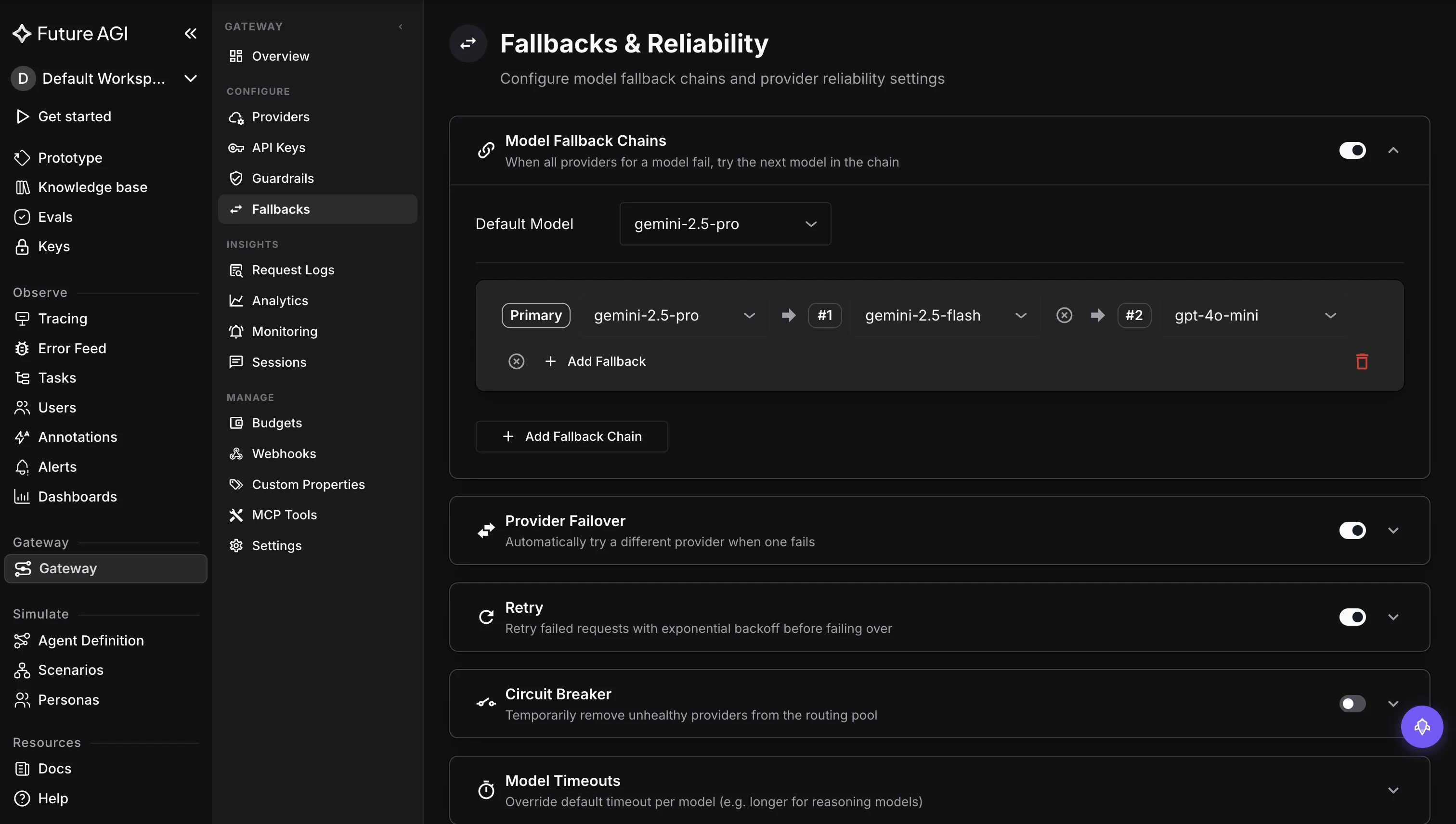
2. Fallback policy engine. Reads the configured chain for the virtual key (the per-tenant identity carrying rate limits, budget caps, and routing rules) and applies it against the classified failure signal. The engine emits a single decision, one route name, an idempotency key, a hop counter, a hop budget, recorded on the span. The chain is configurable per workload: a chat copilot might have [openai/gpt-4o, anthropic/claude-3-5-sonnet, bedrock/claude-3-haiku, cache]; an agent inner loop might have [anthropic/claude-3-5-sonnet, openai/gpt-4o-mini, anthropic/claude-3-haiku, cache, manual].
3. Dispatch chain with idempotency. Translates the request to the next route’s schema, swaps in the provider key, and forwards. The idempotency key (typically SHA-256 of the canonicalised request body plus the virtual key plus the tenant ID) makes a fallback hop safe even if the primary actually completed the call before the disconnect. On fail, the chain advances until the response succeeds or the hop budget is exhausted.
4. Eval-feedback loop. The held-out evaluator scores the served response against the workload’s quality dimensions (tool-call correctness, RAG groundedness, summarisation faithfulness, code compilability) and writes the score back to the span by span_id. The policy engine reads the rolling score per route per workload and downweights routes scoring below the floor.
The four blocks compose. A retry-then-fallback chain with no classifier and no eval feedback is a one-block fallback; a five-route chain with classified failure shapes, idempotency keys, quality gating, and span telemetry is the four-block production shape.
The 5 Problems an LLM Fallback Strategy Solves
Production teams adopt an LLM fallback strategy for one of five reasons, in roughly this order of frequency in 2026.
1. Single-provider blast radius
A single upstream provider going dark takes the entire LLM-dependent feature offline. The three canonical examples: Anthropic’s claude.ai cluster failure on April 9, 2024 (apps on a single Anthropic key offline for roughly an hour); OpenAI’s chat.completions degradation on November 8, 2024 (over four hours); the Gemini 2.0 Flash rate-limit incident on February 11, 2025 (around 40 minutes). Teams with a fallback strategy watched the chain pick up traffic on a secondary provider in under a minute; teams without one watched their P99 latency flatline. The fix treats the second, third, and fourth upstream providers as first-class routes rather than emergency hand-deploys, with the failover emitting gen_ai.fallback.reason = "upstream_5xx" for the postmortem.
2. Rate-limit ceilings and tier exhaustion
Upstream providers throttle. OpenAI tier-1 orgs hit RPM and TPM caps; Anthropic’s per-org caps on Claude 3 Opus and 3.5 Sonnet trigger 429s under burst load; Gemini 2.0 Flash carries per-project caps that interact with billing tier. A single tenant on a free tier or a sudden traffic spike consumes the cap and starves every other tenant. Model-downgrade fallback routes the rate-limited request to a cheaper, less-throttled model (claude-3-5-sonnet down to claude-3-haiku, gpt-4o down to gpt-4o-mini) with a held-out quality floor gating the downgrade.
3. Quality regression on a model version flip
Model providers ship updates. The same prompt against gpt-4o in February 2026 and gpt-4o in May 2026 isn’t the same model; the named version moved underneath the API. Quality regressions show up as slow degradation in customer-visible metrics the engineering team can’t trace to a deploy because they didn’t deploy. Quality-floor fallback scores every response against a held-out eval set and triggers a retry-then-fallback when the score drops below the floor.
4. Guardrail-block downstream rescue
Input and output guardrails block requests for good reasons, prompt injection, PHI leakage, jailbreak, tool-permission violation, content moderation. The block is the right call from a safety standpoint; the user still needs an answer. A static “request blocked” response is the wrong UX for a paying customer who asked a legitimate question the guardrail misclassified. Guardrail-fallback routes the blocked request to a different model with different alignment, to a more conservative template, or to a manual handler, emitting gen_ai.fallback.reason = "guardrail_block".
5. Latency-budget exhaustion
P99 latency is a graveyard for chat copilots, voice agents, and any sub-second user-facing path. Tail-heavy upstream providers (cold-start latency, regional autoscaler lag, congestion) blow through the per-route latency budget under load. A response three seconds late is functionally a failure even if the upstream returned 200 OK. Timeout-based fallback sets a hard per-route latency budget and triggers a fallback hop when the primary can’t complete within it. The race pattern (parallel dispatch, first to respond wins) is the latency-extreme variant, cost doubles, latency benefit is real for sub-800-millisecond voice agents and high-tier RAG.
Every named production AI gateway in 2026 cites at least three of these problems, and the Future AGI failover and fallback scorecard ranks the gateways against all five.
The 5 Named LLM Fallback Strategies
Five fallback strategies have stabilised across production AI gateways in 2026. They appear under slightly different names in different vendor docs (Portkey calls model-downgrade “content-policy fallback” when paired with a guardrail signal; LiteLLM calls retry-then-fallback “fallback after retries”; Bifrost groups provider-rotation and retry under “Cluster mode failover”) but the underlying primitives are stable.
Provider-rotation
Cycles through a numbered list of upstream providers on a transient 5xx, network error, or hard timeout. The canonical 2026 chain is two or three providers deep with mixed tiers: [openai/gpt-4o, anthropic/claude-3-5-sonnet, bedrock/anthropic.claude-3-5-sonnet] covers the OpenAI degradation, the Anthropic cluster failure, and a regional AWS outage simultaneously.
Provider-rotation requires an idempotency key, without one, a partial completion on the primary that fails on egress gets retried and double-billed against the second provider. The hop emits gen_ai.fallback.reason = "upstream_5xx" (or "connection_error", "timeout") and gen_ai.fallback.hop = 1. The strategy fails when every provider shares a regional dependency or when the chain depth exceeds the latency budget; the fix is a regional diversification rule and a hop-budget cap with a final cache-on-failure or manual-route hop.
Model-downgrade
Swaps to a cheaper or smaller model on a 429, context-window overflow, or budget-cap hit. The target is typically same-provider-cheaper (gpt-4o to gpt-4o-mini, claude-3-5-sonnet to claude-3-haiku) or different-provider-equivalent. The held-out quality floor gates the downgrade so the user doesn’t get a worse answer on a hard prompt.
Model-downgrade is the right answer for the rate-limit shape because a 429 carries no information about whether the request was hard or easy, the prompt that hit the cap was the next-in-line, not the next-hardest. With a quality floor, it returns a usable answer on easy prompts and triggers a retry-then-fallback against the higher tier on hard prompts. The hop emits gen_ai.fallback.reason = "rate_limit_429".
Retry-then-fallback
Runs an exponential-backoff retry against the primary first and only fails over after the retry budget is exhausted. The canonical 2026 budget is two to three attempts with backoff intervals of 100ms, 500ms, and 2000ms; each retry emits gen_ai.retry.attempt and gen_ai.retry.backoff_ms.
Right for transient failures where the primary is likely to recover faster than a fallback dispatch, a single-flight 5xx that resolves on retry is one round-trip. The retry budget is the binding constraint: too aggressive and the user waits seconds for a fallback that fires after the retry; too conservative and a recovering upstream gets unnecessary traffic on the secondary. Typical 2026 MTTR targets: 15 to 45 seconds for provider-rotation with retry, 200 to 800 milliseconds for model-downgrade with no retry.
Cache-on-failure
Returns a cached response (exact-hash or semantic) when no live provider can serve the request within the latency budget. The cache layer doubles as cost optimisation on the happy path (cache-first) and reliability on the failure path (cache-on-failure). The 2026 production pattern runs the cache check before the upstream dispatch and again as the final fallback hop after every upstream route has failed.
Exact-hash returns the cached response on identical input, useful for deterministic prompts and inner-loop agent calls. Semantic embeds the prompt and returns a cached response above a cosine similarity threshold, useful for paraphrased queries and FAQ workloads. The hop emits gen_ai.fallback.reason = "upstream_total_failure" and gen_ai.fallback.route = "cache". The application should attach a UI hint (“this answer may be out of date”). The eval loop scores cache responses against the same held-out floor as live responses.
Manual-route
Hands the request to a human operator, a rule-based answer, or a degraded UI mode when every automated path has failed. The hop is the floor of the chain, the response of last resort. Three canonical shapes: a static degraded-mode UI (“we’re experiencing a temporary issue”) with no LLM call at all; a rule-based answer (knowledge-base lookup, templated response, hardcoded FAQ); a human-in-the-loop handoff to a support agent, a Slack channel, or a pager, right for high-stakes workloads (medical, legal, regulated decisioning) where the LLM was advisory rather than authoritative. The hop emits gen_ai.fallback.reason = "automation_exhausted" and gen_ai.fallback.route = "manual". MTTR is typically minutes rather than seconds.
Implementation Patterns
An LLM fallback strategy ships in three implementation patterns in 2026.
1. Dedicated gateway service (the default). The chain runs inside a standalone AI gateway process in front of the upstream providers. Every application calls the gateway on an OpenAI-compatible endpoint; the gateway runs the routing, the chain, the cache, the guardrails, and the cost meter at the same network hop. Future AGI Agent Command Center, Portkey, Maxim Bifrost, Cloudflare AI Gateway, and Databricks Unity all ship in this shape. The 10 to 50 millisecond overhead is the price of the centralised control plane.
2. Sidecar deployment. The chain runs as a sidecar container inside each application pod. Right when per-pod isolation is required (NYDFS 500.11 segmentation, regulated multi-tenant SaaS). The trade-off is per-pod state: the rolling latency window, eval feedback, and idempotency-key store are local unless sidecars share a Redis. Rare in 2026, most teams that need isolation also need centralised observability.
3. Library SDK (in-process). The chain runs in-process as a library. Canonical implementation is LiteLLM as a Python import. Zero network-hop overhead, no centralised control plane: every instance learns the same chain, telemetry is per-process, idempotency is per-process. Right starting point for single-application, single-tenant fallback; promote to a network-hop gateway once the chain crosses two providers or any regulated workload lands on the LLM path.
The production chain rarely runs a single strategy. Canonical 2026 compositions:
- Retry-then-fallback on top of provider-rotation on top of cache-on-failure. Retry the primary twice; on retry exhaustion, rotate to the second provider; on full chain exhaustion, return the semantic-cache hit; on cache miss, return the degraded UI.
- Model-downgrade for 429s, provider-rotation for 5xxs. A 429 means cap-hit, downgrade to
gpt-4o-mini. A 5xx means infrastructure failure, rotate to Anthropic. - Guardrail-fallback to a conservative template, then to manual-route. A block triggers a retry against a more aligned model; on a second block, the user gets a static rule-based answer.
- Cache-first on the happy path, cache-on-failure on the failure path. Same cache layer; cost optimisation inbound, reliability floor outbound.
Teams that ship “we have fallback” without naming the composition rarely ship a working fallback.
Buyer’s Guide: When to Adopt an LLM Fallback Strategy
LLM fallback has a clear adopt-now signal in 2026. Two checklists to self-diagnose.
Adopt an LLM fallback strategy today if
- You depend on a single LLM provider in the request path and a single-provider outage takes the feature offline. The Anthropic April 2024, OpenAI November 2024, and Gemini February 2025 incidents are the canonical cautionary tales.
- Your application serves a paying customer with a measurable SLA on response latency or availability. A 200 OK from a fallback hop is a better experience than a 503 from an exhausted primary.
- You operate in a regulated environment. HIPAA, NYDFS, PCI-DSS, EU AI Act Annex III, DORA, that demands centralised audit logging, idempotency-keyed retries, and per-request span attributes.
- Your LLM line item is more than $5,000 a month or your cost-per-request variance across providers is more than 3x. Model-downgrade fallback pays back the engineering investment in weeks above that threshold.
- You ship agent workloads with tool calls and MCP traffic. Agent inner loops are the most cost-sensitive and failure-sensitive surface in 2026, a single hallucinated retry can 10x the token spend.
- You have a finance team asking why the LLM line item is a single opaque number. OpenTelemetry GenAI-native cost metrics per provider, per fallback hop are the deliverable; the chain is the source.
Wait if
- You have one provider on a generous SLA, one product, one tenant, no regulatory pressure, and a latency budget that can’t absorb the 10 to 50 millisecond fallback-decision overhead.
- You have no observability surface yet. No OpenTelemetry collector, no Grafana, no Prometheus. Build observability first, promote to a fallback chain second.
- You have no team to operate it. A self-hosted chain on a single-product team degrades into unowned shadow infrastructure. Either commit a named owner or start with a managed gateway.
- You’re still pre-launch. A fallback chain pre-launch is premature optimisation; ship a single-provider stack with a degraded-mode UI floor, add the chain once you have production traffic and a postmortem.
Most teams shipping LLM features for more than six months end up in the adopt-now column on at least three signals.
Common LLM Fallback Strategy Myths
Five myths show up repeatedly in 2026 conversations about LLM fallback strategy.
Myth 1: “Fallback is the same as failover.” Failover swaps the provider on a transient infrastructure failure (5xx, network error, timeout). Fallback swaps the model, the cache, or the policy on a semantic failure (429, guardrail block, context-window overflow, quality-floor miss). Conflating them is a common architecture mistake; treating them as complementary primitives in the same chain is the production-correct pattern.
Myth 2: “A retry loop is a fallback strategy.” A retry loop against the same provider on the same model is the first hop in a retry-then-fallback chain, not the chain itself. A fallback strategy needs a second route, a different provider, a downgraded model, a cached response, or a manual handler, to be more than a retry. Teams that ship “we have fallback” and mean “we retry three times on 5xx” rediscover this on the first multi-hour upstream outage.
Myth 3: “If I have a gateway, I have fallback solved.” The gateway is the network hop. The fallback chain is one block inside it. A gateway with five providers configured and no fallback policy is a router with five primary routes; a gateway with a composed chain, idempotency keys, held-out quality gating, and span attributes on every hop is the production shape. The difference shows up in the postmortem after the first cost spike or silent quality regression.
Myth 4: “Fallback to a cheaper model always saves money.” Model-downgrade without a quality floor degrades output silently on hard prompts. The cheaper fallback model is the right answer on the median prompt and the wrong answer on the tail. The right pattern attaches a held-out eval set per workload, computes a per-model quality score on the rolling window, and lets the policy downgrade only when the score is above the floor.
Myth 5: “Cache-on-failure replaces a fallback chain.” A cache layer is the floor of the chain, not the chain itself. Workloads where small wording changes don’t change the right answer (FAQs, deterministic prompts, inner-loop agent calls) get most of their value from cache-on-failure; workloads where the same question needs a fresh answer (live data, personalised responses, novel prompts) need a live provider in the chain, with the cache as the last hop rather than the only hop.
The 2026 LLM Fallback Strategy Landscape Snapshot
Seven AI gateways ship production-grade LLM fallback strategies in 2026. The Future AGI Failover and Fallback Scorecard ranks them across seven reliability dimensions; the summary below is the fallback-strategy slice.
- Future AGI Agent Command Center ships a numbered fallback chain with all five named strategies in one Apache 2.0 Go binary. Active health probes detect degradation within 5 to 15 seconds; idempotency keys deduplicate retries; per-stream sequence numbers preserve SSE continuity through a mid-stream failover; the held-out quality-floor evaluator gates each hop; OpenTelemetry GenAI spans emit
gen_ai.fallback.reason,gen_ai.fallback.hop,gen_ai.fallback.route,gen_ai.fallback.score, andgen_ai.fallback.mttr_ms. The Future AGI Protect model family runs on the same hop as the inline guardrail layer at 65 ms text / 107 ms image median time-to-label (arXiv 2510.13351). FAGI’s own fine-tuned Gemma 3n adapters across content moderation, bias detection, security/prompt-injection, and data privacy/PII, multi-modal across text/image/audio, a model family rather than a plugin chain.traceAIinstruments 50+ AI surfaces across Python / TypeScript / Java / C# (including Spring Boot starter, Spring AI, LangChain4j, Semantic Kernel) OpenInference-natively, and Error Feed sits alongside as part of the eval stack (the clustering and what-to-fix layer that feeds the self-improving evaluators): auto-clusters related failover and fallback failures into named issues (50 traces → 1 issue), auto-writes the root cause plus a quick fix plus a long-term recommendation, and tracks rising/steady/falling trend per issue. Self-hostable in Docker, Kubernetes, AWS, GCP, Azure, or air-gapped atgateway.futureagi.com/v1.
- Portkey ships three composable named fallback types (general, content-policy, context-window) with
$and/$ormetadata conditionals. Source-available core (MIT for the gateway under Portkey-ai/gateway); commercial control plane consolidating under Palo Alto Networks following the April 30, 2026 acquisition close. - LiteLLM ships three documented fallback types (general, context-window, content-policy) tied to the routing layer; MIT. Pin commit hashes after the March 24, 2026 PyPI compromise of
1.82.7and1.82.8by the TeamPCP threat actor, documented in the Datadog Security Labs writeup; verify Sigstore signatures fromv1.83.0-nightlyonward. - Maxim Bifrost ships a 4-state health machine (Healthy, Degraded, Failed, Recovering) with cluster-mode failover, approximately 23 providers, 1,000+ model integrations. Apache 2.0 Go; vendor-published 11 microsecond range overhead at 5,000 RPS on
t3.xlarge. - Cloudflare AI Gateway ships edge fallback tight to the Cloudflare stack; the Universal Endpoint deprecation in 2026 moved fallback to Dynamic Routing as the canonical pattern.
- Kong AI Gateway ships LLM fallback as another upstream service plugin; the right pick for teams already running Kong for REST APIs.
- Databricks Unity AI Gateway ships fallback as a first-class managed primitive for MCP-routed agents inside the Databricks lakehouse.
The 2026 trust cohort matters in procurement: Helicone joined Mintlify on March 3, 2026 and is in maintenance mode; Portkey announced its Palo Alto Networks acquisition on April 30, 2026; LiteLLM’s PyPI compromise reshaped supply-chain hygiene expectations. Apache 2.0 single-binary alternatives with no pending acquisition collapse most of these questions.
How Future AGI Thinks About LLM Fallback Strategy
An LLM fallback strategy is one half of the production AI reliability loop. The other half is the evaluation layer that uses fallback traces plus eval scores to update the chain itself. Future AGI ships both as one runtime so the chain gets better at its job over time, more than smarter at logging.
The shape of the loop:
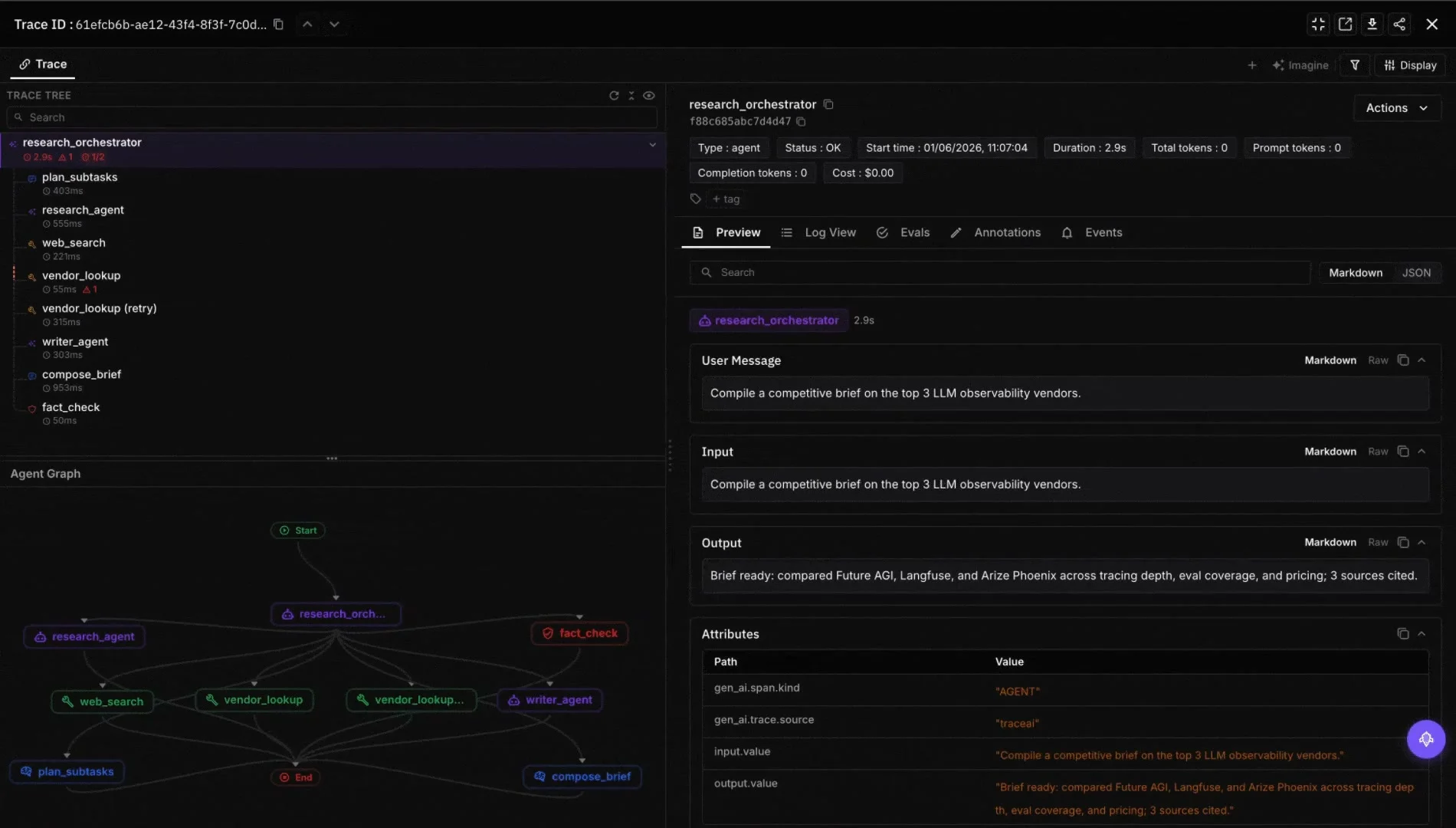
- Every routed request emits an OpenTelemetry GenAI span via
traceAI(Apache 2.0). On a fallback hop, the span carriesgen_ai.fallback.reason,gen_ai.fallback.hop,gen_ai.fallback.route,gen_ai.fallback.score, andgen_ai.fallback.mttr_ms.
- The
ai-evaluationpipeline (Apache 2.0) scores the response against a held-out eval set tied to the workload (tool-use accuracy, code correctness, RAG groundedness, summarisation faithfulness, JSON-schema validity) and writes the score back byspan_id. Fallback responses get scored on the same eval set as primary responses, so the dashboard surfaces “fallback hop 2 served 18% of traffic in 24 hours with a 0.81 quality score versus 0.94 on the primary”. - The
agent-optoptimiser (Apache 2.0; ProTeGi, Bayesian, GEPA) reads the scored spans and emits a policy diff with math attached: “for finance-squad on agent inner-loop workloads, downgradeclaude-3-5-sonnettoclaude-3-haikuon 429s when input tokens are under 4K and the rolling quality score is above 0.88; regression 0.4 percent; estimated monthly saving $3,840.” - Inline Protect guardrails, 65 ms text median time-to-label text per arXiv 2510.13351, sit on the routed path so the guardrail check doesn’t eat the latency budget when the chain fires. A guardrail-block hop emits
gen_ai.fallback.reason = "guardrail_block". - The whole loop ships inside Agent Command Center: Apache 2.0 single Go binary, OpenAI-compatible drop-in across 20+ providers via six native adapters (OpenAI, Anthropic, Gemini, Bedrock, Cohere, Azure) plus OpenAI-compatible presets and self-hosted backends, 18+ guardrail scanners, exact plus semantic caching, per-virtual-key budgets, MCP plus A2A, OpenTelemetry GenAI-native traces. Self-hostable in Docker, Kubernetes, AWS, GCP, Azure, or air-gapped.
A static fallback chain is a configuration file. A self-improving fallback chain is a control plane that responds to model drift, workload drift, and cost drift without a human in the loop. The eval signal is the binding constraint; the runtime is where the loop closes.
Try Agent Command Center free. OpenAI-compatible fallback across 20+ providers via six native adapters (OpenAI, Anthropic, Gemini, Bedrock, Cohere, Azure) plus OpenAI-compatible presets and self-hosted backends with all five named strategies, 18+ PII and PHI guardrails, per-key budgets, MCP plus A2A, and OpenTelemetry GenAI-native fallback spans in one Apache 2.0 Go binary at gateway.futureagi.com/v1.
Related Reading
- What Is an AI Gateway? The 2026 Definition, Architecture, and Buyer’s Guide, the canonical anchor post for the AI gateway category, with the 12-step request flow and the four open-source picks.
- What Is LLM Routing? A 2026 Field Guide, the routing companion: the five named routing strategies and the self-improving loop that ties routing decisions to eval scores.
- Best 5 AI Gateways for LLM Failover and Fallback in 2026, the seven-axis reliability scorecard with detection latency, streaming continuity, idempotency, MTTR, and fallback-route quality ranked across the production-grade gateway set.
- Future AGI Protect: Sub-100ms LLM Guardrails, the arXiv paper documenting the Protect guardrail latency (65 ms text median time-to-label text) that sits on the fallback path.
- OpenTelemetry GenAI Semantic Conventions, the canonical span and metric names every production AI gateway should emit on the fallback path.
- OWASP Top 10 for LLM Applications 2025, the fallback chain is the natural enforcement point for LLM05 (improper output handling) and LLM10 (unbounded consumption).
Frequently Asked Questions
What Is an LLM Fallback Strategy in Simple Terms?
What Are the Five Named LLM Fallback Strategies in 2026?
How Is Fallback Different From Failover?
Why Did Production LLM Apps Need a Fallback Strategy in 2025 and 2026?
Does a Fallback Strategy Need an Evaluation Loop?
How Do Idempotency Keys Interact With LLM Fallback?
Should I Build LLM Fallback In-Application or in a Gateway?
What OpenTelemetry GenAI Span Attributes Should the Fallback Hop Emit?
Can a Cache Layer Replace a Fallback Chain?
How Does Future AGI's Self-Improving Loop Improve Fallback Quality?
What Are the Failure Modes of an LLM Fallback Strategy?
When Should I Not Use an LLM Fallback Strategy?
Is an LLM Fallback Strategy Open Source?
How Do I Test My LLM Fallback Chain Before an Outage?
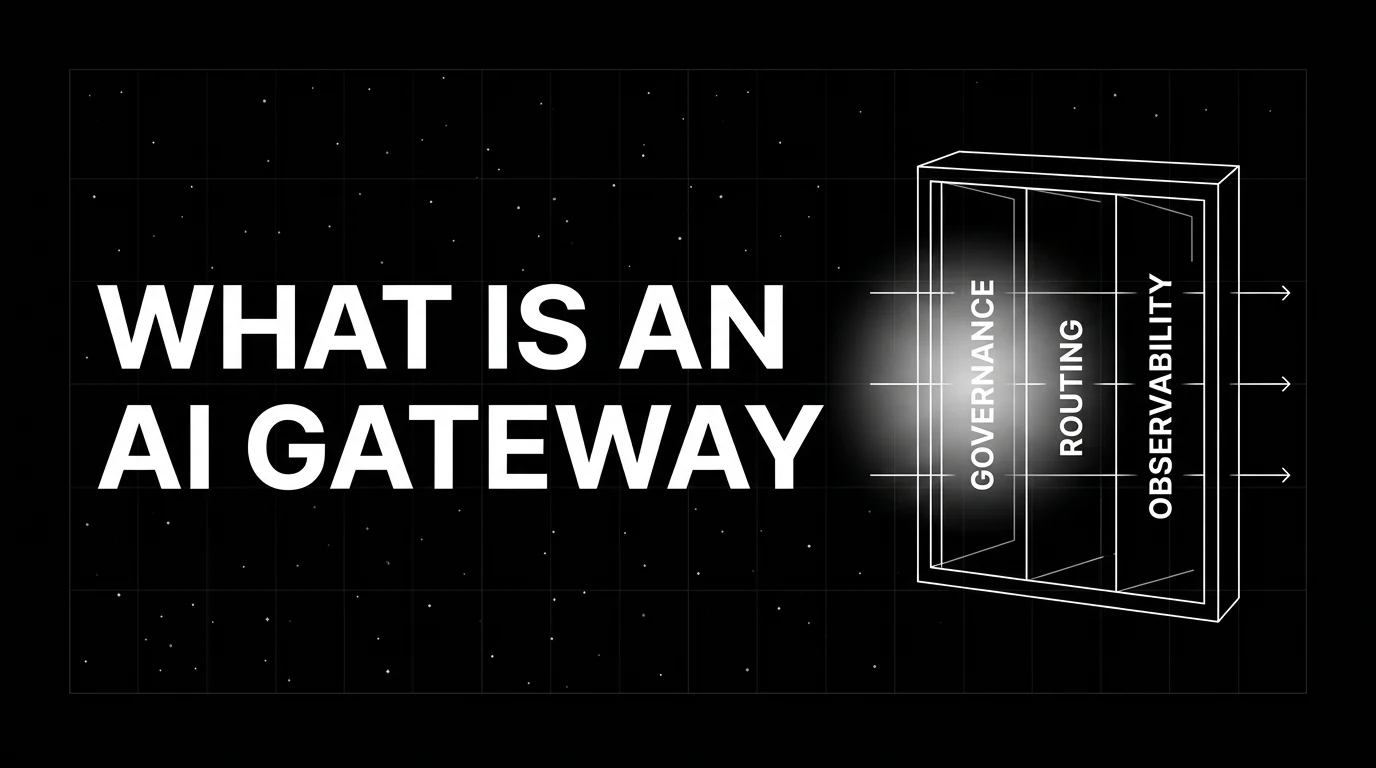
An AI gateway sits between apps and LLM providers for governance, routing, observability. What it is, how it differs from API gateways.

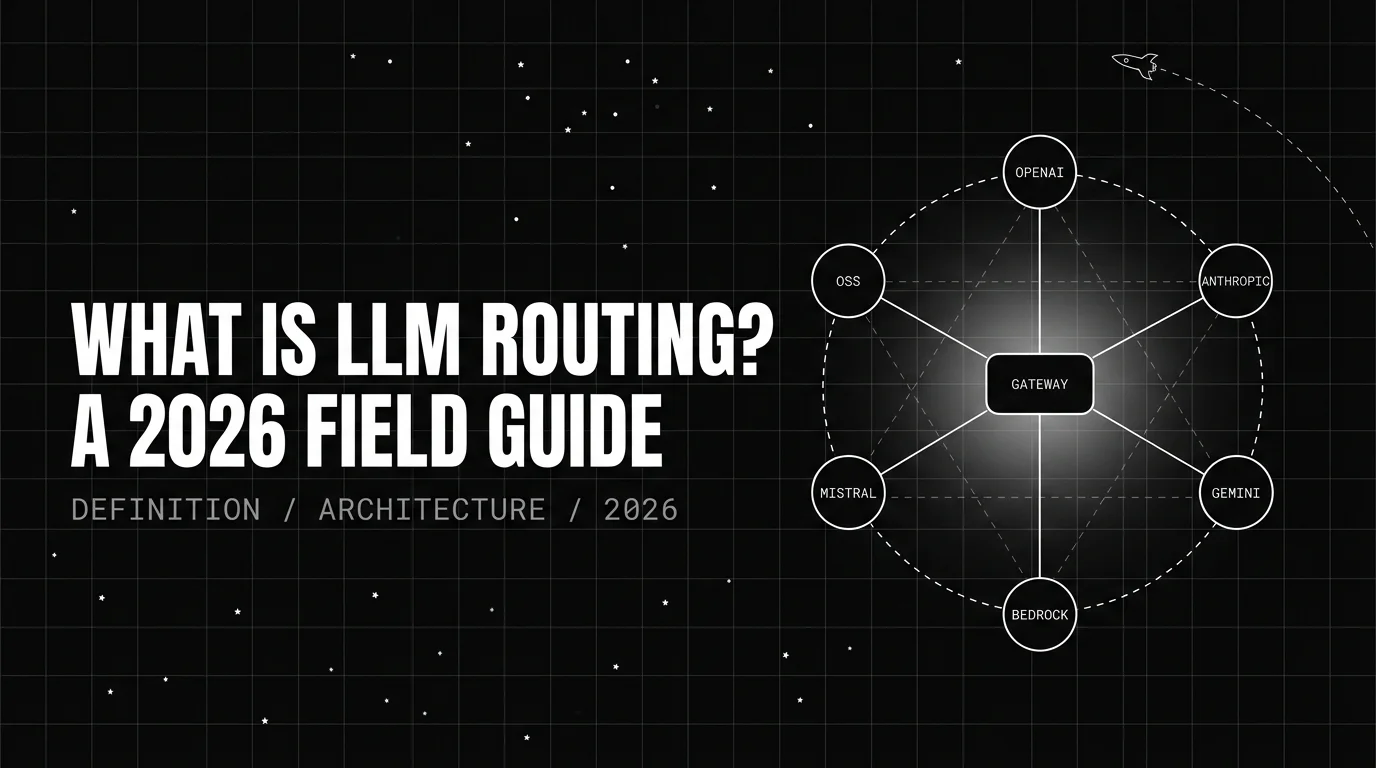
A 2026 field guide to LLM routing: definition, five strategies (round-robin, weighted, latency, cost, quality), architecture, myths.

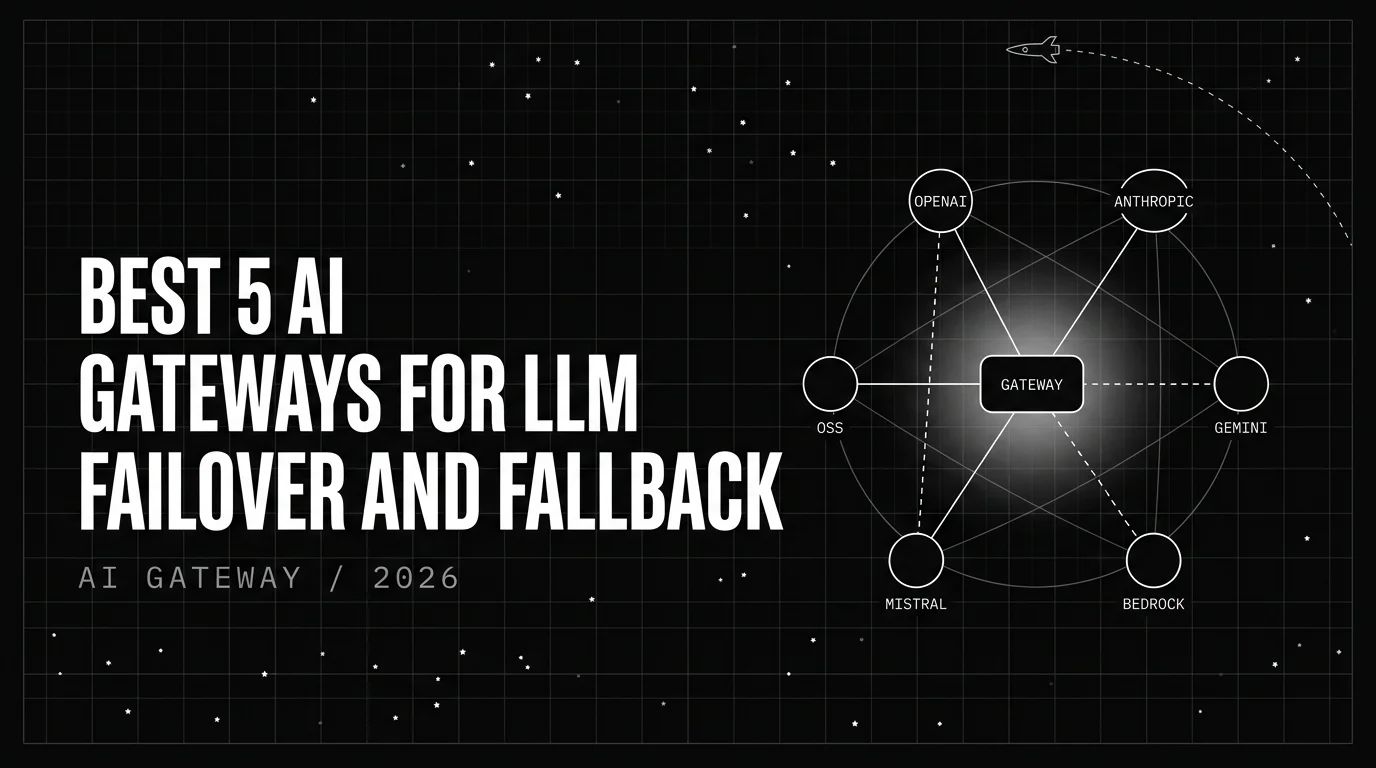
Five AI gateways for LLM failover and fallback in 2026 scored on health-detection latency, streaming continuity, idempotency, MTTR, fallback-route quality.