Perplexity AI Review: Where Its Citations Hold Up and Where They Break
A citation focused Perplexity AI review: what independent studies found about its sourcing, and a one minute check to run before you quote a linked source.
Table of Contents
You are reading an answer, and it looks well sourced. Every claim has a small numbered citation next to it. You click one to check a detail before you quote it, the page opens, and the sentence sitting beside that number is nowhere on it.
That moment is what this Perplexity AI review is about. It is a citation focused review rather than a feature tour, and it separates what holds up from what breaks. The product finds sources well. Whether a given citation supports its sentence is a separate question.
Most reviews on this term rate the interface, the pricing, and the vibe. Very few open the citations and check them against the pages they point to. This one leans on independent studies, court filings, and a crawling dispute, then hands you a check you can run in under a minute.
What This Perplexity AI Review Tests and How
This Perplexity AI review judges one thing, whether a citation supports the sentence it sits beside. The method is simple to state. Take an answer, open every cited page, and check the claim against the page. A citation passes when the page carries the claim, and fails when it does not.
The failures sort into four modes that the rest of this post reuses. First, the cited page does not exist or will not load, and second, the page loads but the claim is not on it. Third, the page is a syndicated copy rather than the original publisher. Fourth, the source is low quality or machine generated.
Two measurements run underneath the whole review. Citation precision asks how many of the citations given actually support their sentence. Citation recall asks how much of the answer is backed by any citation at all. Both matter, because an answer can cite a source for almost every sentence while attaching the wrong source to many of them.
Our guide to evaluating citation attribution breaks down how each one is scored.
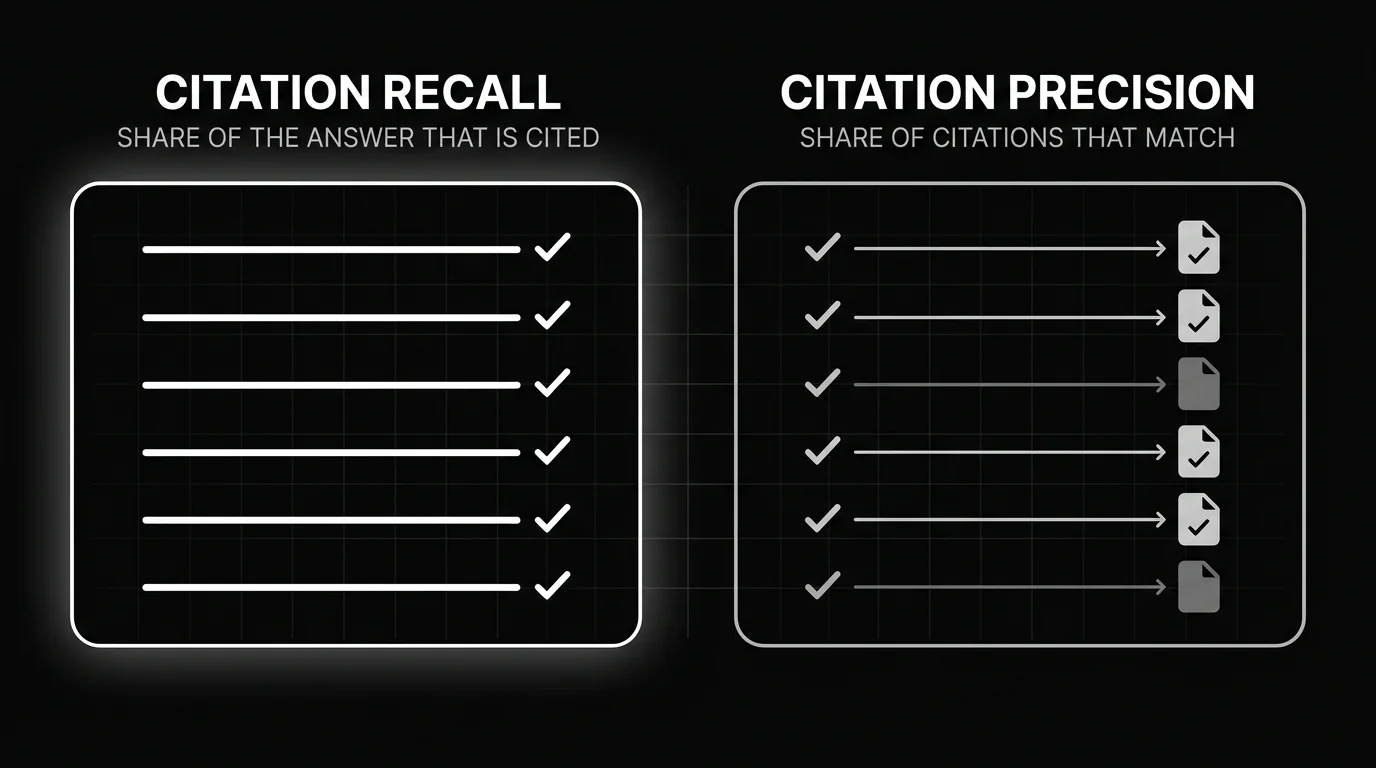
High recall with weak precision is the trap. It produces an answer where nearly every line has a number next to it, which reads as carefully sourced, while a share of those numbers point to pages that do not carry the claim. That combination is why the product can feel reliable and still mislead you.
How Perplexity Builds an Answer and Attaches Citations
Here is the pipeline in plain terms. You send a query, the system interprets it, searches the web, and retrieves a set of pages. It selects passages from those pages, and a language model writes an answer with numbered references attached to individual sentences. The reference points back to a document in that retrieved set.
The order of operations is the part that matters. The answer is composed first, then the citations are attached to it. So a number beside a sentence marks a document that informed the answer, rather than a checked quotation of that exact sentence. That single design choice is the root of the failure modes in the next few sections.
The model doing the writing is not fixed. Perplexity offers a choice of underlying models, and the default depends on your tier. If you want to see how the current crop compares on reasoning and accuracy, our best LLMs roundup tracks that. The model shapes tone and confidence more than it shapes sourcing.
The public documentation shows how much of this is built for programmatic use. It lists a Search API, Agent API, Embeddings, a Gateway API, an MCP Server, a CLI, an SDK, and a legacy Sonar section. That surface tells you citations are not only a reading feature. They feed downstream systems that inherit whatever a citation got right or wrong.
What the Independent Studies Measured
Three independent studies give this review its spine, and every number below comes straight from the primary source. Columbia Journalism Review’s Tow Center is the anchor. In March 2025 it tested eight AI search engines against 20 publishers, pulling 10 excerpts each from 200 articles for 1,600 queries in all.
The Tow Center result for Perplexity was 37% of responses incorrect. For context, the eight tools collectively answered more than 60% of queries incorrectly, and Grok 3 reached 94%, so Perplexity was the best of a weak field. If you are weighing it against other tools, our best free AI search engines guide compares the wider set.
A 2023 paper by Liu, Zhang, and Liang measured verifiability across engines with 34 annotators. Across all engines only 51.5% of generated sentences were fully supported by their citations, and only 74.5% of citations supported their sentence. Read those as a 2023 snapshot of a stack that has since been replaced.
In that paper Perplexity led on citation recall at 68.7 against Bing Chat’s 58.7, so more of its answer carried a citation. It trailed on precision at 72.7 against Bing Chat’s 89.5, so more of those citations were off.
Perplexity’s own scores swung by question type, its recall from 58.1 to 74.6 and precision from 61.7 to 77.4.
A 2026 paper, Cited but Not Verified, makes the structural version of the same point across deep research agents generally: citations these systems produce cannot be reliably verified, because retrieval-augmented generation does not check whether a cited source actually supports the claim attached to it. That is this review’s thesis, stated for the whole category rather than one product.
The most recent study is the EBU and BBC report on news integrity from October 2025, covering 22 organisations across 18 countries and 14 languages with over 3,000 responses.
It found 45% of responses had at least one significant issue, 31% had sourcing problems, and 20% had major accuracy issues. About a third of Perplexity’s responses carried a significant issue.
| Study | Date | Sample | Headline finding for Perplexity | What it does not tell you |
|---|---|---|---|---|
| CJR Tow Center | 2025-03 | 8 engines, 20 publishers, 1,600 queries | 37% of responses incorrect, worse on the paid tier | How it does outside news citation |
| Liu, Zhang, Liang | 2023 | Several engines, 34 annotators | Perplexity recall 68.7, precision 72.7; all-engine average 51.5 / 74.5 | Anything about the current model stack |
| EBU and BBC | 2025-10 | 22 orgs, 3,000+ responses | About a third of responses had a significant issue | Perplexity specific citation precision |
Where Perplexity’s Citations Hold Up
A one sided review is not worth trusting, so start with what works. Recall is the real strength. In the 2023 study Perplexity carried a citation on more of its answer than its peers, leading on average recall at 68.7 against Bing Chat’s 58.7. In plain terms, fewer sentences were left hanging with no source at all.
That strength shows up most on mainstream, well indexed topics. When the subject is widely covered and recently published, the retrieval has good material to work with, and the answer usually points you to real, relevant pages. For getting oriented on an unfamiliar area quickly, that is useful.
It also works well as a finding tool. If your goal is to learn that a source exists so you can go read it yourself, Perplexity surfaces candidates fast, especially when the answer is really a list of documents rather than a woven argument. Discovery is the job it does well.
Practitioners back this up. A June 2026 comment on Hacker News credited it with doing much better at citing its sources and providing accurate quotes than the alternatives the writer had tried.
Hold onto one distinction though. Finding a source and verifying a claim are two different jobs, and Perplexity is built for the first. It will reliably put a stack of relevant links in front of you, and it will get the broad shape of a well covered topic right most of the time.
The pattern to take away is where recall pays off. Broad questions, current events with heavy coverage, and any task that ends with you opening the links all play to its strengths. The weakness starts when you trust the citation instead of opening it, which is where we go next.
Where Perplexity’s Citations Break
This is where the review earns its title. The breaks follow the four failure modes from the method rather than appearing at random, and each one comes with a documented instance. Taking them in order keeps the picture honest, because each mode fails in its own way and needs its own fix.
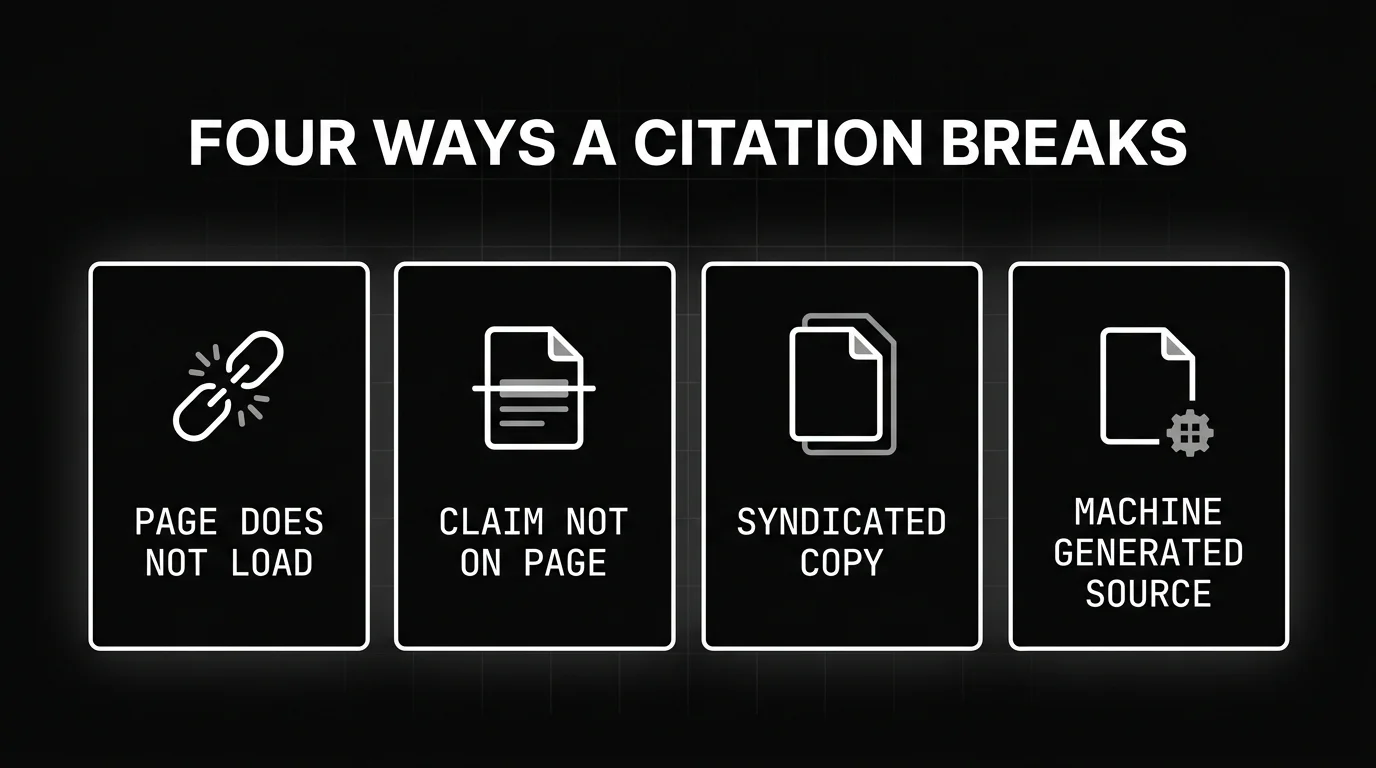
Mode one is a page the tool could not actually reach, yet cited as though it had. The Tow Center found the free version of Perplexity correctly named all 10 National Geographic excerpts that sat behind a paywall it was blocked from, attaching a citation to a page it could not have read.
The words came from somewhere other than the page the citation implied, so access and citation had quietly come apart.
Mode two is a page that loads but does not carry the claim. The clearest example is a lawsuit.
Dow Jones and the New York Post sued Perplexity in New York’s Southern District in October 2024, alleging it produced statements it attributed to the Wall Street Journal and the Post that they never ran. Read it as a filed allegation.
Mode three is a syndicated copy standing in for the original. The Tow Center found Perplexity Pro cited republished copies of Texas Tribune articles in 3 of 10 cases. The words can be right while the wrong site gets the credit, which strips the original publisher of attribution and quietly sends you to a second hand version of the reporting.
Mode four is a low quality or machine generated source. In June 2024 Futurism and GPTZero reported Perplexity citing AI generated pages, with no percentage attached, so none is claimed here. Around the same time Forbes reported answers citing aggregator rewrites instead of the original Forbes reporting they were based on.
The mechanism under these breaks is consistent. When the crawler cannot reach a page, or the retrieved material is thin, the model still writes fluently and fills the gap with text that reads like a citation backed claim even though no page carried it.
That is the same outcome the lawsuit above alleges, quotes attributed to publications that never ran them.
Why Perplexity Pro Is Not Automatically More Accurate
The second big purchase question is whether Pro is more accurate, and the honest answer is that paying does not buy accuracy. The Tow Center found paid tiers answered more questions, with more confidence, while producing more incorrect citations than their free counterparts. More answers came out, and more of them were wrong.
The mechanism is not mysterious. A free tier that declines the hard questions looks cautious, and a premium tier that answers them looks capable. Hard questions are exactly where citations break, because the material is thinner and the retrieval is shakier. Answering more of them means walking into more of the failures above.
The Tow Center gave a sharp example. Where the free version stayed near what it could actually access, Perplexity Pro confidently identified nearly a third of 90 excerpts it should not have been able to see at all. Confident retrieval of blocked material is not a quality you want anywhere near a citation you plan to trust.
So draw the line clearly before you upgrade. Paying for Pro buys capability and speed, and it buys more answers to more questions. It does not buy verification, and on the citation accuracy this review cares about, the paid tier tested worse than the free one. Upgrade for throughput, and keep verifying either way.
The Crawling Dispute and What It Does to Citations
An infrastructure fight sounds like industry gossip, but it lands directly on the citations you get. If a site blocks crawling, the answer about that site gets built from thinner or second hand material. That is the same condition that produced the invented quote cases, so access rules are a citation issue.
In August 2025 Cloudflare published its account of Perplexity’s crawling, and what follows is Cloudflare’s side. It said the declared crawler ran at 20 to 25 million requests a day, alongside an undeclared crawler at 3 to 6 million daily across tens of thousands of domains, rotating IP addresses and networks to keep going.
Cloudflare also reported that brand new domains carrying a block everything robots file were still described in Perplexity’s answers, and it removed Perplexity from its list of verified bots. Perplexity’s public rebuttal returned an error during research and was not read, so only one side is represented here. That gap is stated on purpose.
For your answers, the effect is concrete. When a publisher blocks the crawler, Perplexity does not always go quiet about that publisher. Sometimes it still writes about the page from whatever thin signal it has, and that is precisely the setup that turns a citation into a guess dressed up as a source.
The money changes the incentive too. In August 2025 Perplexity announced Comet Plus, a 5 dollar a month tier that routes 80% of its revenue to publishers from a 42.5 million dollar pool, paid across human visits, search citations, and agent actions. Once a citation can trigger a payout, it becomes a payment record as well as a claim.
How Should You Use Perplexity When Citations Matter?
So how should you use Perplexity when the citations actually matter? Treat it as a source finder, not a source of truth. Use it to gather candidate links, then open every one you plan to lean on. The tool gets you to the doorstep, and your own reading confirms whether the claim is really inside.
Four habits catch almost every failure mode. Confirm the specific sentence you want appears on the page, not just the topic. Prefer the original publisher over any syndicated repost. Check the publication date on the page itself rather than trusting the summary’s framing. Each habit maps to one of the four modes.
Match the effort to the stakes. For casual curiosity, a quick scan is fine, and the recall strength does most of the work. For anything you will publish, quote, or make a decision on, run the full check, because that is where a wrong citation costs you. The table turns it into a ten second routine.
| Failure mode | How to spot it in 10 seconds | What to do instead |
|---|---|---|
| Page does not load | The link 404s or hangs | Find the claim on a source that opens |
| Claim not on the page | Skim for the sentence, it is absent | Drop the claim or replace the source |
| Syndicated copy, not the original | Byline or domain is a reposter | Trace back to the original publisher |
| Low quality or machine generated | Thin page, no author, filler text | Swap for a named, primary source |
| Confident answer on a blocked site | Answer is sure, page bars crawlers | Verify on a source that allows access |
| Stale page shown as current | Date on the page is old | Reconfirm against a current source |
What This Perplexity AI Review Means for Your Research Workflow
Go back to the answer that looked well sourced. The citation seemed right because a citation points to a document, not to the sentence beside it, and the two only sometimes line up. Once you see that gap, the little numbers stop reading as proof and start reading as leads.
The verdict is plain. Perplexity is strong at finding sources and weaker at guaranteeing that a given sentence is supported by the source next to it. The independent studies point the same way, and paying for Pro does not close the gap. Strong discovery with softer verification is the honest summary.
The single habit worth keeping is small. Open the link before you quote it. That was always good practice, and it matters more now that citations can carry publisher payouts, which gives the numbers a second job beyond being correct.
If you need that same check at scale rather than one link at a time, a groundedness evaluation like Future AGI’s scores whether an answer is actually supported by the source it cites. Find with the tool, verify with your own eyes, and this review takes care of itself.
Frequently Asked Questions
Are Perplexity's citations accurate?
Does Perplexity hallucinate sources?
Is Perplexity Pro more accurate than the free version?
Is Perplexity good for research?
What does this Perplexity AI review recommend checking first?
Inside Future AGI open source in Q2 2026: the platform shipped under Apache 2.0, Error Feed and the Agent Command Center went live, traces hit billions.

Gemini 3.5 Flash dropped today at Google I/O 2026. The 8 benchmark numbers that matter, $1.50/$9 pricing breakdown, and what to instrument before you swap.

Voice AI evaluation infrastructure in 2026: five testing layers, STT/LLM/TTS metrics, synthetic harness, traceAI, and FAGI Simulate.
