MCP vs A2A in 2026: Which Agent Protocol Should You Adopt for Tool Access and Multi-Agent Coordination?
MCP vs A2A in 2026. MCP is the Anthropic, OpenAI, Google, Microsoft backed standard. A2A is Google's peer-to-peer standard. Which to adopt and when.
Table of Contents
MCP vs A2A in 2026: TL;DR
| Question | Answer |
|---|---|
| Which is the default protocol for LLM tool access? | MCP. Adopted by Anthropic, OpenAI, Google, Microsoft, and the major IDE and agent vendors. |
| Which protocol covers agent-to-agent coordination? | A2A. Open-sourced by Google in April 2025, donated to the Linux Foundation in June 2025. |
| Are they competing or complementary? | Complementary. MCP is client-to-server for tools. A2A is peer-to-peer for agents. |
| Latest spec versions (May 2026) | MCP 2025-06-18 (current), A2A 0.3.x. |
| Top risk in production | Prompt injection through tool outputs (MCP) and impersonation through forged Agent Cards (A2A). |
| Recommended gateway pattern | Route every MCP and A2A call through Future AGI Agent Command Center for allowlists, OAuth, guardrails, and traceAI. |
By May 2026, MCP went from an Anthropic experiment to a multi-vendor default. OpenAI added MCP support to the Agents SDK in March 2025. Google announced MCP support for Gemini models in April 2025. Microsoft shipped MCP in Windows Copilot, Visual Studio Code, and the Azure AI stack across 2025. A2A travelled a different path: launched by Google in April 2025 with about 50 partners, donated to the Linux Foundation in June 2025, with a 1.0 spec stabilization underway.
This guide explains what each protocol does, where they overlap, where they do not, and how to operate both in production through a single gateway.
What Is MCP? How Anthropic’s Standard Became the Default for LLM Tool Access
Model Context Protocol (MCP) is an open protocol for connecting LLM-powered applications to external tools and data sources. Anthropic announced MCP in November 2024. Within six months it was supported by OpenAI, Google DeepMind, and Microsoft, making it the closest thing the industry has to a default agent-to-tool interface in 2026.
MCP uses JSON-RPC 2.0 over multiple transports. The two officially supported transports are stdio (for local processes) and Streamable HTTP (for remote servers, which uses HTTP POST plus optional Server-Sent Events for server-to-client streaming). The current revision is 2025-06-18, which adds:
- Structured tool output: tools return validated JSON instead of opaque strings.
- OAuth 2.0 resource indicators (RFC 8707): tokens are bound to specific MCP servers, blocking confused-deputy attacks.
- Elicitation: servers can request additional input from the user mid-call instead of failing.
- Removal of JSON-RPC batching: simpler transport semantics.
MCP Core Components
- MCP server: hosts tools, resources, and prompts. Implements authentication, rate limits, and structured schemas.
- MCP client: lives inside an LLM-powered app. Lists available servers, negotiates capabilities, and calls tools.
- MCP host: the user-facing app (Claude Desktop, VS Code, Cursor, a custom agent). Holds one or more clients.
MCP Communication Flow
- Initialize: client and server exchange protocol version, capabilities, and client info.
- List tools / resources / prompts: client queries the server for what it exposes.
- Call tool: client invokes a tool with arguments. Server returns structured content plus optional resources.
- Sampling (optional): server can call back to the client to request an LLM completion, enabling agent-like servers.
MCP Key Features in 2026
- Model-agnostic: works with Claude, GPT-5, Gemini 3, Llama 4, Mistral, and any other LLM that wires up a client.
- Capability tokens: per-server OAuth or API key, scoped and rotatable. The 2025-06-18 spec requires MCP clients implementing OAuth to include RFC 8707 resource indicators on token requests.
- Wide SDK support: official SDKs for Python, TypeScript, C#, Java, Kotlin, Rust, and Go.
- Streaming and elicitation: support for long-running tools and interactive flows.
What Is A2A? Google’s Peer-to-Peer Protocol for Agent Collaboration
Agent2Agent (A2A) is a peer-to-peer protocol introduced by Google in April 2025 with about 50 launch partners including Atlassian, LangChain, ServiceNow, and Salesforce. In June 2025 Google donated A2A to the Linux Foundation to ensure neutral governance, with Microsoft joining as a steering member.
A2A is designed for agents talking to other agents across vendors, not for an agent calling tools. It runs over HTTP plus JSON-RPC 2.0 plus Server-Sent Events.
A2A Core Primitives
- Agent Card: a public JSON document at
/.well-known/agent.jsondescribing the agent’s name, skills, endpoints, and auth requirements. Discovery happens via standard HTTP GET per RFC 8615. - Tasks: a task is the unit of work between agents. Tasks carry inputs, intermediate state, and final artifacts.
- Messages: structured chat-style payloads that can include text, files, or tool results.
- Artifacts: completed outputs, returned as JSON payloads or file references for downstream agents.
A2A Communication Flow
- Discovery: agent A fetches agent B’s Agent Card.
- Task negotiation: agent A sends a
message/send(or the streamingmessage/stream) JSON-RPC request with the desired skill and inputs. The receiving agent returns a Task with a unique ID that subsequent calls reference. - Progress events: agent B streams status updates over SSE as the task progresses.
- Artifact exchange: when work is done, agent B returns artifacts that agent A can store or hand to the next peer.
A2A Design Principles
- Framework-independent: built on HTTP, JSON-RPC, and SSE. No SDK lock-in.
- Capability discovery: Agent Cards advertise what each agent can do, enabling dynamic matching.
- Authentication: OAuth2, API keys, and mutual TLS supported per-call. Scoped tokens limit each agent’s surface.
MCP vs A2A: Side-by-Side Comparison in 2026
| Dimension | MCP | A2A |
|---|---|---|
| Primary use | LLM client calling tools and data sources | Agent calling another agent |
| Topology | Client-to-server | Peer-to-peer |
| Transport | JSON-RPC 2.0 over stdio or Streamable HTTP (with optional SSE) | JSON-RPC 2.0 over HTTP with optional SSE for streaming |
| Discovery | Server list (config or registry) plus tool listing on connect | Agent Card at /.well-known/agent.json |
| Auth | Scoped OAuth tokens with RFC 8707 resource binding | OAuth2, API keys, mTLS |
| Long-running ops | Streaming via SSE, elicitation, sampling | message/stream with task status events over SSE |
| Governance (2026) | Maintained by Anthropic plus core spec contributors (OpenAI, Google, Microsoft) | Donated to Linux Foundation in June 2025 |
| Primary adopters | Anthropic, OpenAI, Google, Microsoft, plus the broader IDE and SaaS ecosystem | Google Cloud, Atlassian, LangChain, ServiceNow, Microsoft (steering) |
| Spec version (May 2026) | 2025-06-18 | 0.3.x trending to 1.0 |
Table 1: MCP vs A2A side-by-side.
When to Use MCP vs When to Use A2A
Use MCP When
- A single agent needs structured access to tools, files, databases, or APIs.
- Compliance requires per-tool audit trails and tight permission scopes.
- You want to plug into the existing ecosystem of MCP servers. The community server index and registries like Smithery list hundreds of servers across categories including Linear, Slack, GitHub, Notion, Postgres, and most major SaaS products.
- You need to reach the latest models without writing model-specific tool-calling glue. MCP support is shipped or available through SDK adapters across Claude, ChatGPT, Gemini, and other major model platforms via Anthropic, the OpenAI Agents SDK, and Google’s Gemini MCP integration.
Use A2A When
- Multiple agents from different vendors must coordinate on a shared task.
- You are integrating a partner’s hosted agent and do not want to embed their tools as MCP servers.
- Tasks are long-running (minutes to days) and you need progress streaming plus artifact handoff.
- Cross-organization workflows are involved, where each side runs its own agents and exposes a public Agent Card.
Use Both When
- An A2A agent internally needs tools. The agent runs an MCP client to call its own tools, then participates in A2A workflows with peers.
- A workflow has a tool-heavy phase (MCP) followed by an agent-handoff phase (A2A).
Notable MCP Servers in 2026
The MCP ecosystem ships hundreds of servers. A non-exhaustive set you can run today:
- Linear, Slack, GitHub, Notion: first-party servers from the vendors.
- Postgres, SQLite, BigQuery: read and parameterized-write database access.
- Filesystem: local file access for desktop agents.
- Cloudflare Workers AI MCP: hosted MCP servers running at the edge.
- Lightdash, DataWorks: analytics and BI access.
- mcp-local-rag: privacy-preserving local RAG search.
The official MCP servers repo is the canonical index.
Notable A2A Reference Implementations in 2026
- Google’s A2A reference server and client in Python and TypeScript.
- LangChain A2A adapter for exposing LangGraph agents.
- Atlassian’s Rovo agents speak A2A natively.
- ServiceNow Now Assist exposes an A2A endpoint for cross-platform workflows.
Securing MCP and A2A in Production
Both protocols ship per-call authorization, but production deployments need more. The 2025-2026 incident reports consistently show three classes of failure:
- Prompt injection through tool output (MCP). A malicious or compromised MCP server returns content that hijacks the agent. The related indirect prompt injection guide walks through XPIA and tool-poisoning patterns.
- Cascading tool failures (MCP). One tool returns malformed data and the agent confidently proceeds. See tool chaining cascading failures.
- Agent impersonation (A2A). A forged Agent Card or hijacked endpoint masquerades as a trusted peer.
A gateway in front of MCP and A2A traffic mitigates all three:
- Allowlist verified servers and Agent Cards.
- Enforce OAuth 2.0 with RFC 8707 resource indicators on every MCP call.
- Run prompt-injection and jailbreak guardrails on tool outputs and inbound agent messages.
- Capture every call to a tracing backend for forensics and replay.
How Future AGI Agent Command Center Operates MCP and A2A Together
Future AGI Agent Command Center is a BYOK gateway that sits in front of MCP servers and A2A endpoints. It supports the 2025-06-18 MCP spec including OAuth resource indicators and elicitation, plus the current A2A 0.3.x revision. Capabilities include:
- Server and Agent Card allowlists with version pinning.
- OAuth 2.0 enforcement including RFC 8707 resource indicators on outgoing MCP calls.
- Prompt-injection and tool-poisoning guardrails running on tool outputs and inbound A2A messages.
- traceAI integration to attach every call to an OpenTelemetry span with input, output, latency, and evaluation scores.
- Evaluation gates that score tool outputs against
groundedness,faithfulness, and custom judges before returning to the agent. See the step-by-step guide to MCP evaluation for the full scoring pattern.
Minimal example wiring traceAI around an MCP tool call using the official Python MCP SDK. traceAI works as an OpenTelemetry-compatible wrapper around the call:
import asyncio
from fi_instrumentation import register, FITracer
from fi_instrumentation.fi_types import ProjectType
from mcp import ClientSession
from mcp.client.streamable_http import streamablehttp_client

tracer_provider = register(
    project_name="agent-prod",
    project_type=ProjectType.OBSERVE,
)
tracer = FITracer(tracer_provider.get_tracer(__name__))

async def call_linear():
    async with streamablehttp_client("https://mcp.linear.app/mcp") as (
        read,
        write,
        _,
    ):
        async with ClientSession(read, write) as session:
            await session.initialize()
            with tracer.start_as_current_span("mcp.call") as span:
                span.set_attribute("mcp.server", "linear")
                span.set_attribute("mcp.tool", "create_issue")
                result = await session.call_tool(
                    "create_issue",
                    arguments={"title": "Bug", "team_id": "ENG"},
                )
                span.set_attribute("mcp.result_size", len(str(result)))
                return result

asyncio.run(call_linear())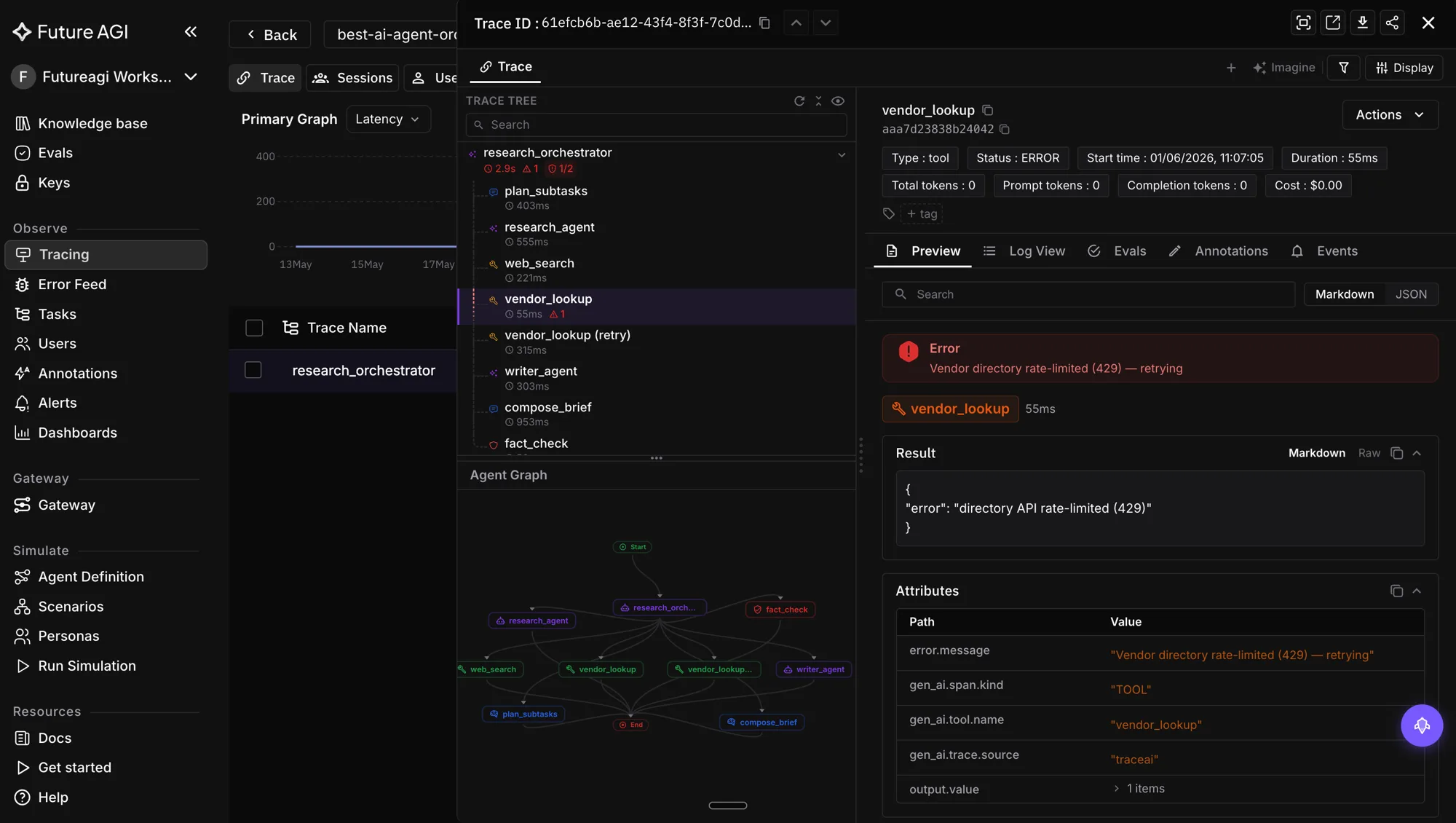
Inline evaluation of an MCP tool output before passing it to the next step:
from fi.evals import evaluate

verdict = evaluate(
    "groundedness",
    output=mcp_result["text"],
    context=user_request,
)
if verdict.score < 0.7:
    raise ValueError("MCP output ungrounded; blocking handoff")
Both the ai-evaluation package and the traceAI SDK ship under Apache 2.0. Set FI_API_KEY and FI_SECRET_KEY in the environment.
How MCP and A2A Will Coexist Beyond 2026
The protocols are settling into clear lanes. MCP is the universal answer to “how does my agent call a tool” and the answer no longer depends on which LLM vendor you picked. A2A is the answer to “how does my agent talk to a partner’s agent” and the Linux Foundation handoff gives it the neutral governance enterprises wanted. Teams that adopt both, behind a gateway with guardrails and traceability, get the contextual richness of MCP and the cross-vendor collaboration of A2A without giving up audit, evaluation, or security.
Frequently Asked Questions
What is the Model Context Protocol (MCP) in 2026?
What is the Agent2Agent (A2A) protocol and how does it differ from MCP?
When should I use MCP vs A2A in production AI systems?
Are MCP and A2A interchangeable or competing standards?
How do MCP and A2A handle authentication and security?
What are the most common security risks when deploying MCP and A2A?
Which gateway products support both MCP and A2A in 2026?
LLM tool chaining in 2026. Cascading failure modes, real traceAI patterns, frameworks compared. Stop silent corruption, context loss, and timeout cascades.

Six agent evaluation frameworks for trajectory-first teams 2026: LangSmith, Future AGI, Braintrust, DeepEval, Phoenix, OpenAI Evals, tradeoffs.

Compare the top agentic AI frameworks in 2026: LangGraph, OpenAI Agents SDK, Microsoft Agent Framework, CrewAI, AutoGen, Mastra, and PydanticAI.
