Loop Engineering vs Prompt Engineering: Why the Shift Matters
Prompt engineering shapes one request. Loop engineering designs the system that decides what to request next. Here is what actually changed, and what didn't.
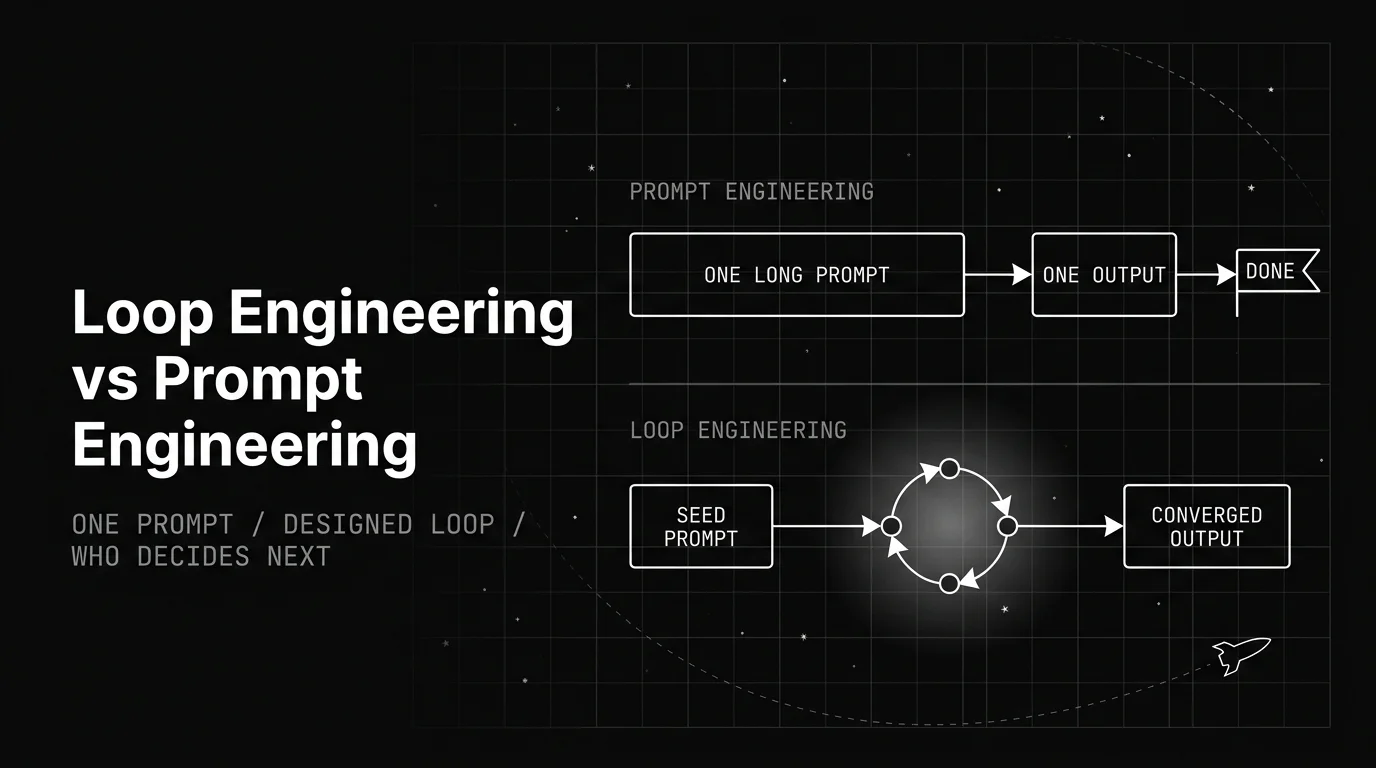
Table of Contents
You spend twenty minutes writing the perfect prompt for a coding agent, get a good result, then retype something close to it again tomorrow for a nearly identical task. That repeat trip is exactly what the loop engineering vs prompt engineering conversation is about.
Prompt engineering got you a good answer to one question. It never promised to handle the fortieth nearly-identical question without you typing it in again. That is the job a loop is built for, and it is a different job, not a better version of the same one.
TL;DR: Prompt engineering shapes the wording of a single request to a model. Loop engineering designs the system that decides what to request next, checks the result, and repeats until a goal is met. The shift is from crafting one good turn to designing a process that runs many turns on its own.
What prompt engineering actually means
Prompt engineering is the practice of crafting the words you send a model to get a better output. One request goes in, one response comes back, and if the response is off, you rewrite the request and try again.
MindStudio’s own comparison of the two terms puts it plainly: prompt engineering is “the practice of crafting the inputs you send to a language model to get better outputs.” That is the whole scope. It is about wording, structure, examples, and context inside a single turn. The prompt engineering glossary entry covers the term on its own.
This is a real, useful skill, and it did not stop mattering. Clear instructions, the right examples, and a well-scoped request still produce a better answer than a vague one.
That holds whether the request comes from a person typing it or a system generating it automatically. A deeper breakdown of prompt engineering itself covers the technique in more depth than fits here.
What prompt engineering does not cover is what happens after the answer comes back. Deciding whether the result was actually good enough, and what to do next if it wasn’t, sits outside a single prompt’s scope entirely. That gap is exactly where loop engineering starts.
What loop engineering actually means
Loop engineering is the practice of designing the system that decides what to ask a model next, instead of a person deciding it turn by turn. Developer Addy Osmani gave the practice its name in a June 2026 essay: “Loop engineering is replacing yourself as the person who prompts the agent. You design the system that does it instead.”
Firecrawl’s own writeup of the term frames the contrast in almost the same terms this post is built around: “Prompt engineering optimizes a single turn: one input, one output, one human in the chair. Loop engineering optimizes a system that runs many turns without you.”
That running system is what people mean by an agent loop: several steps chained together instead of one turn typed by hand. Both writeups land on the same dividing line.
The full breakdown of what a working loop actually contains, the specific pieces Osmani names and how they fit together, is its own topic and worth reading on its own rather than repeating here. This post’s job is narrower: showing exactly what shifts when you move from one to the other.
Loop engineering vs prompt engineering: the real shift
The clearest way to see the shift is to ask who decides what happens next. With prompt engineering, that answer is always you. You read the output, judge it, and type the next instruction yourself.
With a loop, that decision moves into the system. A rule you wrote once, a check the loop runs on its own, decides whether the result is good enough, needs a retry, or should stop and flag a person. You are no longer in that decision every single time.
Osmani’s essay is direct about what this costs, not just what it saves. The conclusion is his own: “That’s what makes loop design harder than prompt engineering, not easier.” He reaches it by way of Boris Cherny, who leads Claude Code at Anthropic, and he reads Cherny narrowly: “Cherny’s point isn’t that the work got easier. It’s that the leverage point moved.”
That line matters more than it first sounds. A good prompt earns you one good answer. A good loop earns you a system that keeps producing good answers on its own, but only if you got the stop conditions, the checks, and the retry rules right up front, which is a different kind of work than wording a request well.
| Prompt engineering | Loop engineering | |
|---|---|---|
| What you’re shaping | The wording of one request | The system that decides what to request next |
| Who judges the result | You, each time | A check you designed once |
| What repeats | Nothing automatically | Discovery, action, and verification, on their own |
| Where the skill shows up | In the phrasing, examples, and context of a single call | In the stop conditions, retry rules, and checks around many calls |
The table above is the shortest way to see it: nothing in the left column disappears, it just stops being the whole job once a loop is running on top of it.
Same task, two approaches: writing product descriptions
Picture a batch of two hundred product descriptions that need writing by end of day. The prompt-engineering approach is one very long, carefully tuned prompt: tone rules, length limits, banned phrases, formatting instructions, all stacked into a single request, run two hundred times with different product data pasted in.
That prompt can be genuinely well written and still produce a handful of bad outputs, a description that ignores the length limit, one that slips into a banned phrase, one that reads like every other one before it. With this approach, catching those means a person scanning all two hundred outputs by hand afterward.
The loop-engineering approach starts from a shorter prompt, one focused on the actual writing task. It pairs that prompt with a loop that checks each output against the rules before moving on: is it under the length limit, does it avoid the banned phrases, does it read differently from the last one.
A failed check triggers a retry on that one item. A passed check moves the loop to the next product, and the person who would have scanned two hundred outputs by hand now only sees the handful that failed twice.
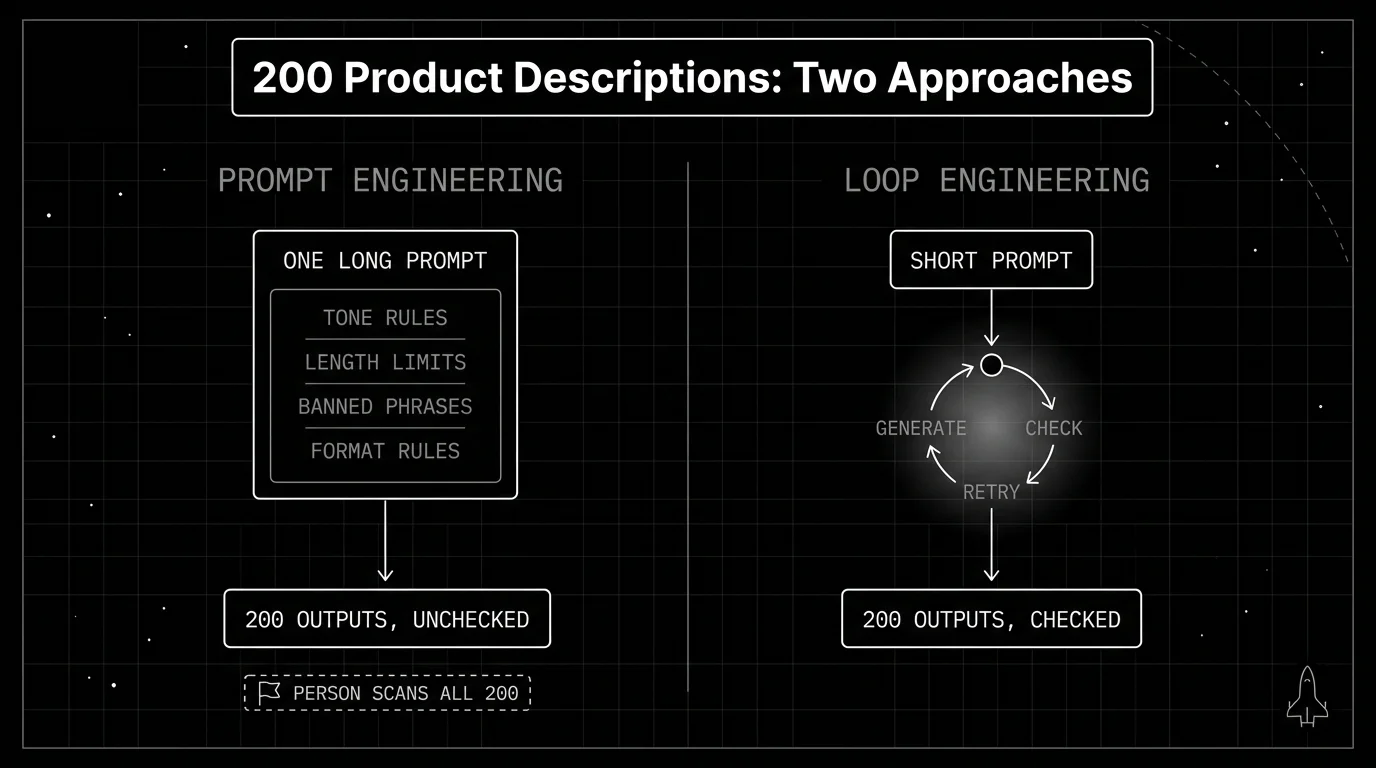
Notice what didn’t change: both approaches still need a well-written prompt for the actual writing step. The loop just adds a second layer on top, one that catches the failures a single long prompt has no way to catch on its own.
What prompt engineering still does inside a loop
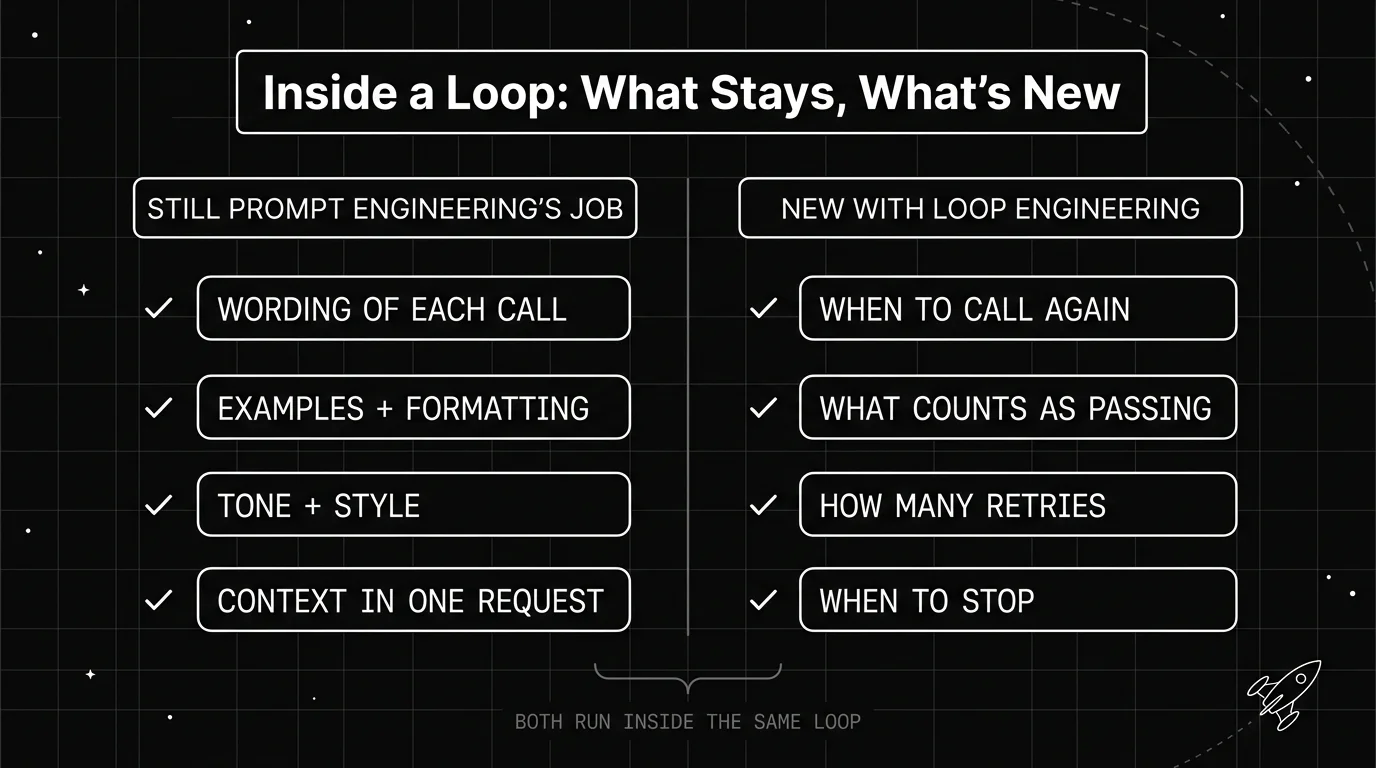
It helps to say plainly what does not go away, since the two terms sometimes get framed as if one replaces the other outright. Inside every loop, each individual call to the model is still a prompt, and it still needs to be a good one.
The wording of that call, the examples you give it, the format you ask for, the tone instructions: none of that is loop engineering’s job. That work is still prompt engineering, just running inside a system instead of being typed by hand each time.
What changes is everything around that single call. Deciding when to make the next call, what counts as a passing result, how many retries are allowed, and when to give up and flag a person, all of that is new, and none of it existed as a concern back when every call was typed by hand.
| Still prompt engineering’s job | New with loop engineering |
|---|---|
| Wording of each individual call | Deciding when to make the next call |
| Examples and formatting instructions | What counts as a passing result |
| Tone and style guidance | How many retries are allowed |
| Context included in a single request | When to stop and flag a person |
Osmani makes this point himself, and it is worth taking at face value rather than reading past it: “go ahead and set up your loops, but don’t forget that prompting your agents directly is also effective.” The two skills stack. They do not compete.
Where this differs from harness engineering
One more distinction is worth a single line, since it comes up in the same conversations: loop engineering is the decision layer, when to retry, when to stop, what counts as done, while harness engineering is usually described as the execution layer underneath it. That is its own topic, though a bloated coding-agent harness carries a cost of its own regardless of how the loop above it is designed.
When you still just need one good prompt
None of this means every task deserves a loop. If something happens once, and you can judge the result yourself in a few seconds, building a system to check it is more setup than the job is worth.
The clearest signal for whether a loop pays off is repetition plus a describable stop condition. If the same kind of request comes up often, and you can say in advance what “correct” looks like, a loop can check for that automatically instead of you checking it by hand every time.
If “correct” is a judgment call that shifts with context each time, a loop has nothing solid to check against, and you are better off staying the one making that call directly. A one-off email, a single piece of creative writing, a request you’ll only ever run once: these stay squarely in prompt-engineering territory, and that is fine.
The honest answer to “which one should I learn” is both, in that order. Prompt engineering is the skill a loop’s individual steps still depend on, and it is faster to pick up on its own.
Loop engineering is what you reach for once the same prompt is something you’d otherwise be retyping for the tenth time this week. Named agent-loop shapes and patterns are a natural next read once you’re past the “should I build one” question and into the “how” of it.
Frequently Asked Questions
What is the difference between loop engineering and prompt engineering?
Does loop engineering replace prompt engineering?
Do I still need to write good prompts if I build a loop?
Is loop engineering harder than prompt engineering?
When should I use a single prompt instead of a loop?
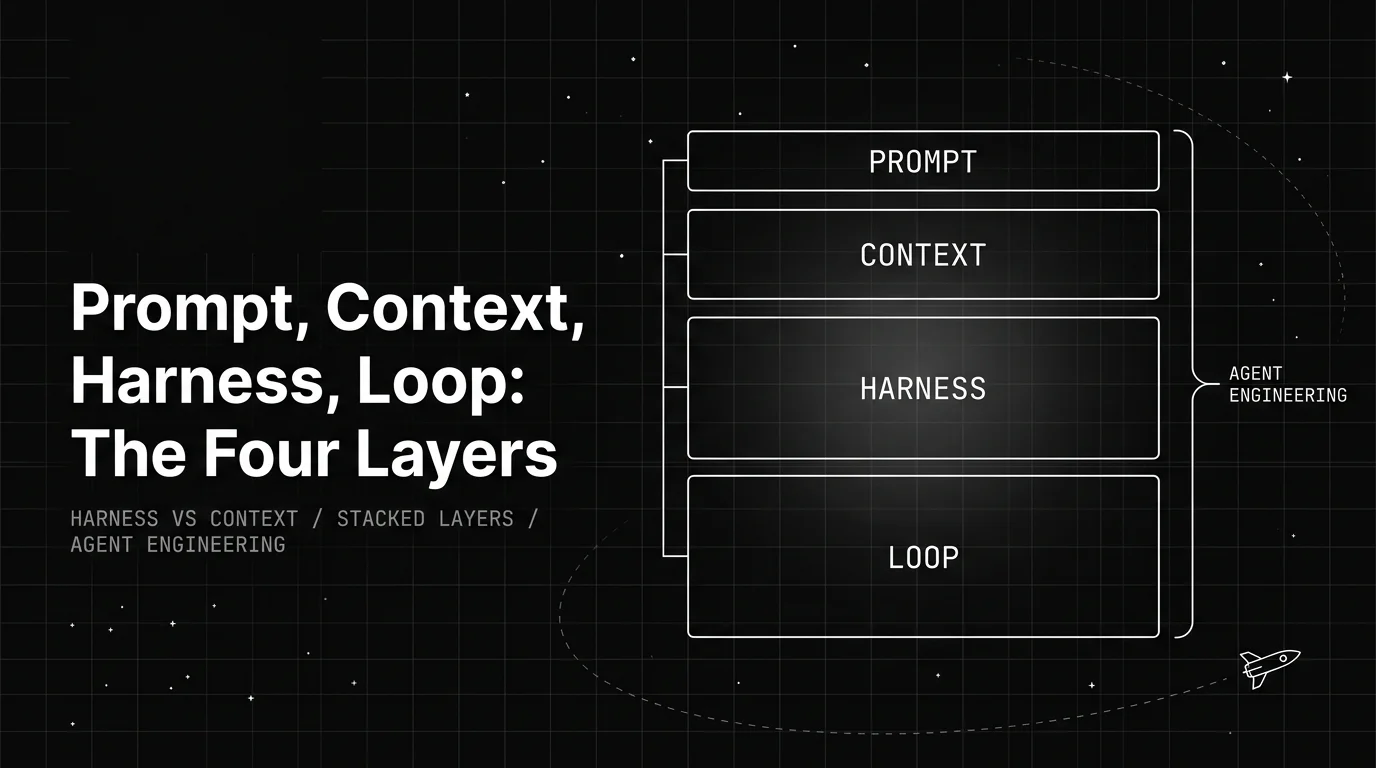
Prompt, context, harness, and loop engineering explained as four layers of one agent stack, including where harness engineering vs context engineering actually differ.

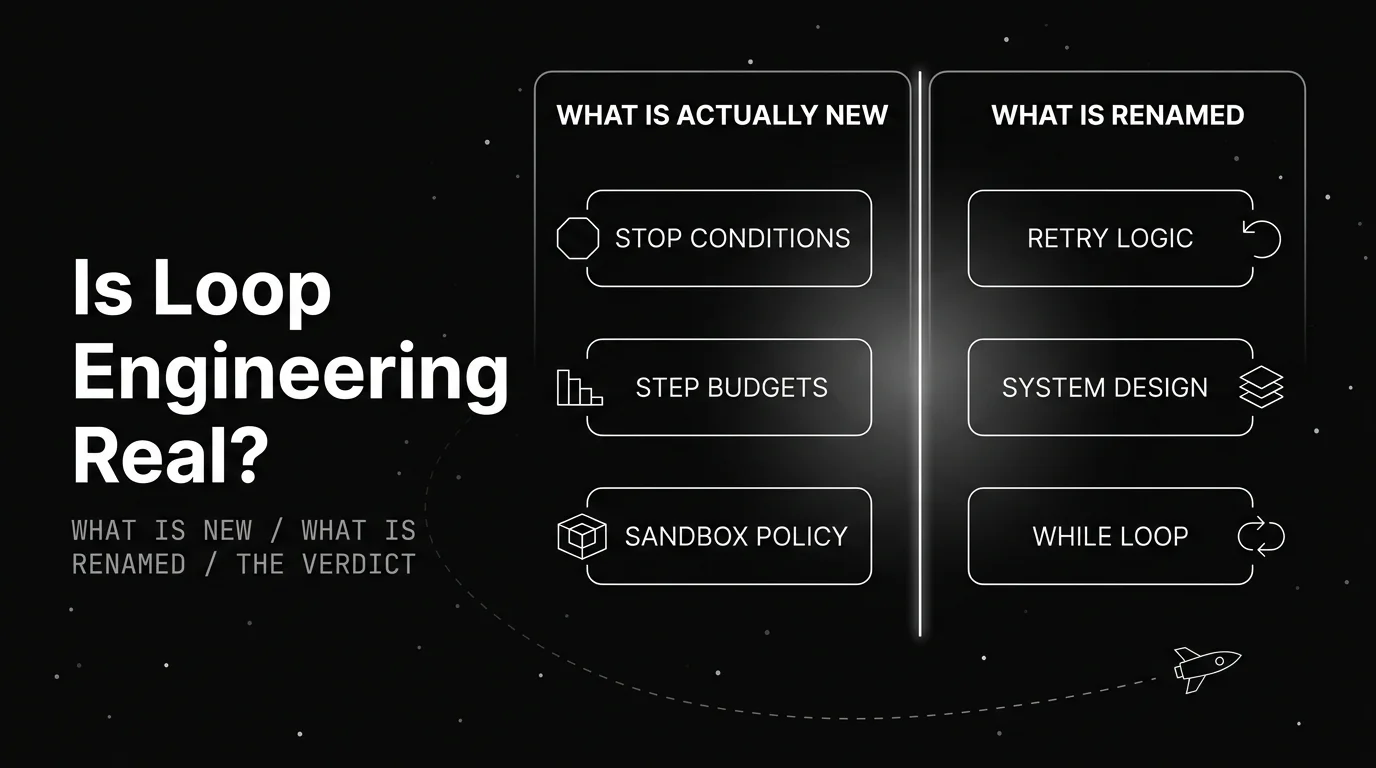
An honest look at the loop engineering debate: the real case that it's a genuinely new practice, the real case that it's renamed orchestration, and a clear verdict.

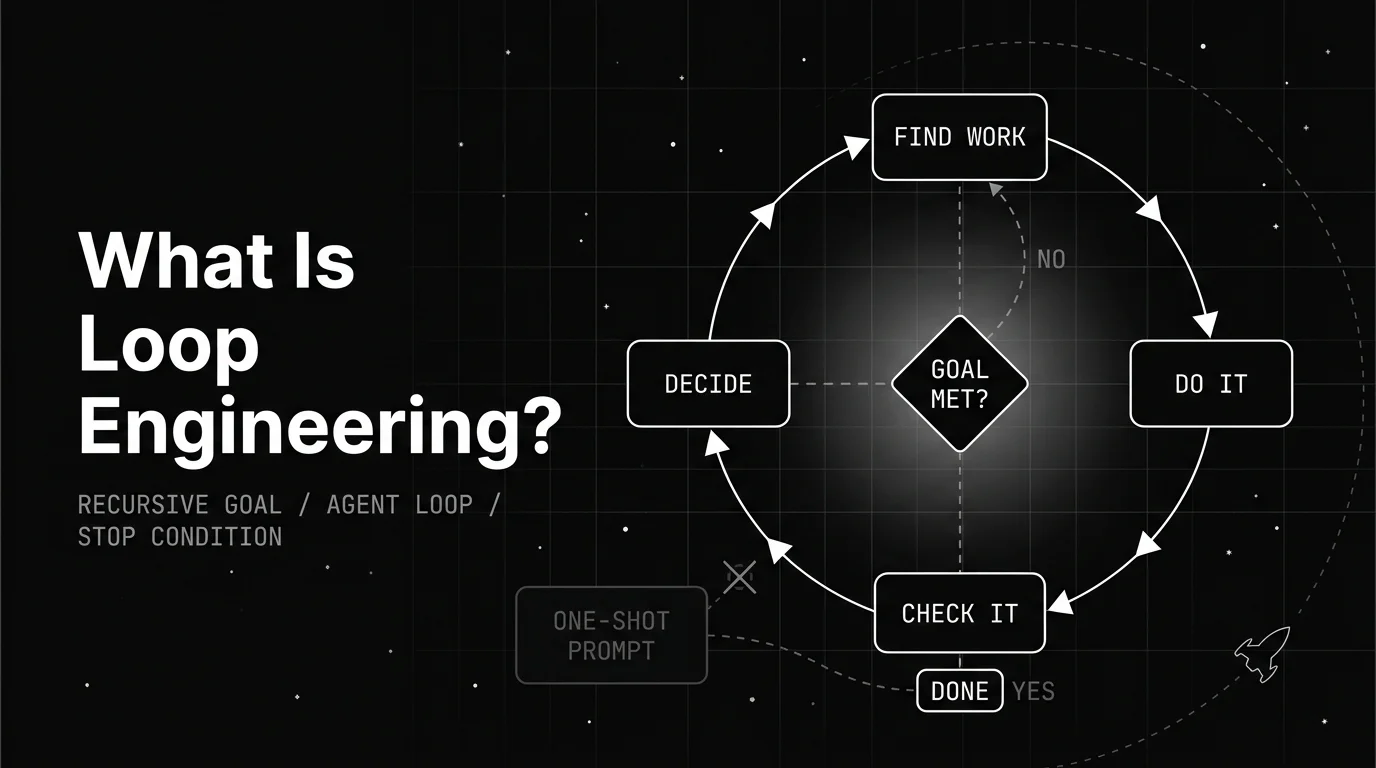
A plain-language definition of loop engineering: who coined it, what a working loop actually contains, and when building one is worth the effort.