LLM vs GPT: Key Differences and Use Cases
Explore the distinctions between LLM vs GPT, their unique features, & practical applications. Learn how FutureAGI leverages these models to drive AI innovation.
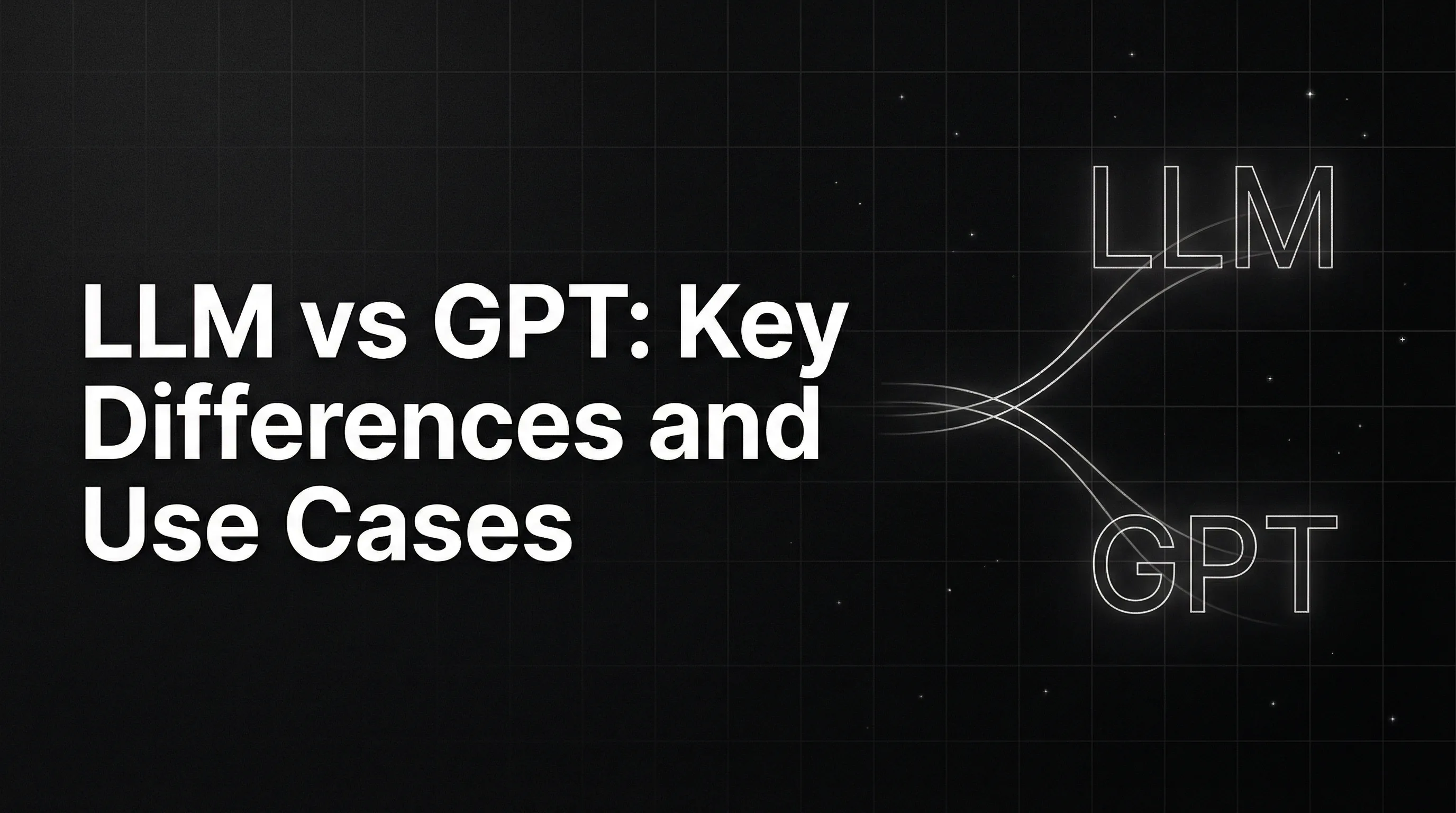
Table of Contents
Overview
In the world of Artificial Intelligence (AI), the terms Large Language Models (LLMs) and Generative Pre-trained Transformers (GPT) often surface as game-changers. While both are built on the principles of transformer models, their applications and underlying architecture set them apart. This article dives into LLM vs GPT, exploring their unique features, advantages, and how they’re reshaping industries. Let’s uncover why understanding these technologies is critical for the future of AI and companies like FutureAGI, where innovation thrives.
Importance of Language Models in AI
Language models are the backbone of conversational AI, content generation, and data analysis. They mimic human language processing, enabling breakthroughs in healthcare, education, and beyond. Whether it’s summarizing complex data or crafting a marketing campaign, large language models and GPT models are pivotal.
What Are Large Language Models (LLMs)?
Definition of LLMs
Large Language Models are deep learning systems trained on vast datasets to perform language-related tasks. They utilize transformer architectures to process and generate text with astonishing accuracy. Think of them as the Swiss Army knife of AI, designed to understand nuanced contexts and deliver human-like interactions.
How LLMs Work
At their core, LLMs leverage transformer models with multi-head attention mechanisms to analyze relationships between words in a sequence. This allows them to predict the next word, phrase, or sentence, generating coherent and contextually relevant outputs. Their training involves billions of parameters, enabling them to scale across diverse tasks.
What Is GPT (Generative Pre-trained Transformer)?
Definition of GPT
GPT stands for Generative Pre-trained Transformer, a subset of LLMs designed specifically for text generation tasks. Known for their pre-training on diverse datasets, they excel in generating creative, contextually aware outputs.
How GPT Works
GPT (Generative Pre-trained Transformer) models are pre-trained on extensive and diverse text corpora to learn underlying linguistic patterns, grammar, and context through unsupervised learning. This involves processing vast amounts of text to predict the next word in a sequence, enabling the model to understand syntax, semantics, and relationships between words.
After pre-training, the model undergoes fine-tuning using supervised learning on labeled datasets specific to tasks like summarization, translation, or code generation. This step enhances task-specific performance, aligning the model’s output with desired objectives by optimizing parameters for accuracy and relevance.
Unlike general LLMs, GPT is optimized for generative tasks, excelling at creating human-like content. Whether it’s crafting narratives, composing poetry, or writing code, GPT leverages its contextual understanding and token-based probability predictions to generate coherent and meaningful outputs. For tech enthusiasts, this involves a Transformer architecture that uses mechanisms like attention layers, embeddings, and positional encodings to process and generate text efficiently.
GPT’s Architecture
Built on transformer technology, GPT employs an encoder-decoder structure that optimizes attention layers for contextual understanding. This allows it to generate natural language responses with unparalleled fluency.
Versions of GPT
The evolution of GPT includes several groundbreaking versions:
- GPT-2: Introduced impressive text generation capabilities.
- GPT-3: Revolutionized applications with 175 billion parameters.
- GPT-4: Further refined with multimodal inputs, enhancing interactivity and precision.
Key Differences Between LLMs and GPT
1. Scope:
LLMs (Large Language Models) are designed as broad-spectrum models capable of performing diverse NLP tasks such as text classification, sentiment analysis, summarization, and more. They aim to provide a comprehensive toolkit for general-purpose language understanding and generation. On the other hand, GPT (Generative Pre-trained Transformer) is specifically optimized for generative tasks like creative writing, dialogue systems, and code generation. GPT’s architecture prioritizes generating coherent and contextually relevant text over a wide range of prompts, making it highly suitable for conversational AI and content creation.
2. Architecture:
GPT emphasizes a transformer-based approach with a strong focus on pre-training using massive amounts of data and subsequent fine-tuning for specific tasks. This enables GPT to adapt quickly to domain-specific requirements while retaining generative capabilities. LLMs often integrate advanced techniques like Retrieval-Augmented Generation (RAG), where external knowledge bases or databases are queried during the inference stage. This hybrid approach enables LLMs to combine deep generative abilities with real-time factual accuracy, making them more versatile for tasks requiring up-to-date or domain-specific information retrieval.
3. Applications:
GPT excels in creative fields, offering state-of-the-art performance in tasks like storytelling, poetry, technical documentation, and programming assistance. It leverages its fine-tuned generative capabilities to produce detailed, human-like outputs that align with specific instructions. LLMs, however, are better suited for analytical and summarization tasks, such as processing large datasets, extracting key insights, or generating concise reports. By incorporating retrieval systems and focusing on contextual comprehension, LLMs shine in enterprise applications like knowledge management and customer support automation.
Advantages and Disadvantages
Advantages of LLMs
- Versatility: Handles diverse language tasks efficiently.
- Data Insights: Excels in summarizing and analyzing datasets.
- Scalability: Adapts to multiple domains.
Disadvantages of LLMs
- Resource-Intensive: Requires high computational power.
- Bias Risks: Training data biases may reflect in outputs.
Advantages of GPT
- Creativity: Generates compelling stories and design concepts.
- Accuracy: Excels in contextual tasks like coding and translation.
- Ease of Use: Pre-trained capabilities make it ready for deployment.
Disadvantages of GPT
- Task-Specific Limitations: Less efficient in non-generative tasks.
- Ethical Concerns: Potential misuse for creating misinformation.
Use Cases and Real Applications
LLMs (Large Language Models)
Knowledge Management:
- Use Case: Automating the process of summarizing lengthy documents, extracting actionable insights, and organizing unstructured information for corporate workflows.
- Technical Context: Leveraging fine-tuned LLMs on domain-specific corpora to ensure accuracy and relevance in summarization and insight extraction.
Chatbots and Virtual Assistants:
- Use Case: Building more interactive and intelligent conversational agents to handle customer queries, complaints, and personalized recommendations.
- Technical Context: Utilizing pre-trained transformer models for natural language understanding (NLU) and generation (NLG) to enhance user engagement.
Content Generation:
- Use Case: Creating high-quality articles, reports, product descriptions, and other textual content at scale.
- Technical Context: Employing LLMs with temperature and max-token parameters fine-tuned for creativity and coherence in text output.
Data Analysis:
- Use Case: Analyzing vast datasets, identifying trends, and providing predictive insights for informed business decisions.
- Technical Context: Combining LLM capabilities with structured data processing libraries and visualization tools to translate raw data into human-readable summaries.
GPT Models
Creative Applications:
- Use Case: Writing compelling stories, brainstorming ideas, and generating persuasive marketing content.
- Technical Context: Fine-tuning GPT models for specific creative domains and adjusting model parameters like repetition penalties to maintain originality.
Code Generation:
- Use Case: Assisting developers by generating code snippets, debugging, and automating repetitive coding tasks.
- Technical Context: Incorporating GPT-based tools into IDEs (e.g., Copilot) to provide real-time, context-aware code suggestions and error handling.
Language Translation:
- Use Case: Enabling context-aware translations between multiple languages, considering nuances and cultural relevance.
- Technical Context: Using transformer architectures to overcome common translation challenges like idioms, regional phrases, and grammar inconsistencies.
Education:
- Use Case: Powering personalized AI tutors to provide tailored lessons, quizzes, and explanations for learners at different levels.
- Technical Context: GPT models integrated with educational datasets and learning management systems (LMS) for adaptive learning paths.
Healthcare:
- Use Case: Summarizing patient histories, suggesting diagnostic tests, and providing insights for clinical decision-making.
- Technical Context: Integrating GPT-based tools with Electronic Health Records (EHRs) while ensuring compliance with HIPAA and other healthcare standards.
Shared Applications
Search Engines:
- Use Case: Enhancing search results by integrating Retrieval-Augmented Generation (RAG) techniques for better contextual answers.
- Technical Context: Combining vector embeddings and knowledge databases to align query intent with accurate and rich content.
Virtual Training:
- Use Case: Simulating professional scenarios, like customer interactions or emergency responses, for immersive training experiences.
- Technical Context: Using GPT models with reinforcement learning from human feedback (RLHF) to create realistic and adaptive training scenarios.
Future Outlook
-
**Evolving Architectures: Hybrid models combining LLM and GPT features: -**Emerging architectures aim to combine the broad language understanding capabilities of large language models (LLMs) with the specialized, fine-tuned capabilities of smaller generative models like GPT. This approach promises to enhance efficiency, enabling modular designs where smaller components focus on specific tasks while maintaining overall coherence and performance. Such systems could reduce computational costs and make AI more adaptable to a wider range of applications.
-
Domain-Specific Models: Customization for healthcare, finance, and other industries: - Generic AI models often lack the depth required for specialized industries. The future lies in fine-tuning LLMs for domain-specific knowledge, such as diagnosing diseases in healthcare or compliance analysis in finance. These models will incorporate industry-specific datasets and terminology, ensuring they align with regulatory standards while maintaining precision and reliability in high-stakes environments.
-
Multimodal Expansion: Integrating text, images, and audio: - As users increasingly demand richer interactions, AI is moving toward seamless multimodal processing. Future systems will integrate text, images, audio, and even video data to enhance understanding and generation capabilities. For example, an AI could analyze radiology images alongside patient histories or generate interactive presentations combining visuals, narratives, and soundtracks. This will involve advances in cross-modal embeddings and data fusion techniques.
-
Ethical AI: Addressing biases and ensuring fairness: - Ethical AI development will be a cornerstone of future innovation. Efforts will focus on identifying and mitigating biases in training datasets, creating transparent algorithms, and ensuring equitable outcomes. For tech practitioners, this means integrating fairness frameworks, bias detection tools, and rigorous testing protocols into the development lifecycle to build trust and meet regulatory requirements.
-
Real-Time Capabilities: Enhancing dynamic applications:- The demand for real-time AI applications, such as adaptive conversational agents and live monitoring systems, requires optimization of inference speeds without compromising model accuracy. Technologies like edge computing, low-latency architectures, and efficient quantization techniques will play a pivotal role in achieving these capabilities. These innovations will unlock opportunities in areas like autonomous vehicles, gaming, and dynamic decision-making systems.
Summary
Understanding LLM vs GPT is crucial in today’s AI landscape. While large language models provide versatility, GPT models shine in specialized generative tasks. By leveraging these technologies, businesses like FutureAGI can drive innovation, automate processes, and reshape industries. Whether it’s crafting engaging content or analyzing complex datasets, the possibilities are boundless with these transformer models.
Related Articles
View all
Understanding Stimulus Prompts in AI: A Complete Guide
Discover the impact of stimulus prompts in guiding LLM behavior, improving AI accuracy, and optimizing large language model responses for better results.

Understanding Prompt Caching for Faster AI Responses
Learn how prompt caching improves AI response times, reduces latency, and enhances LLM efficiency. Discover key techniques for faster AI performance.

How to Build LLM Agents for Real-World Applications
Learn how to build LLM agents for AI automation. Explore key concepts, tools, and best practices to create intelligent, efficient AI-powered workflows.