Practical Guide to Setting Up LLM Guardrails for Engineering Leaders
Discover how to set up effective LLM guardrails to ensure safe, compliant, and reliable AI deployments. Learn strategies for governance, security & more.

Table of Contents
-
Introduction
Large-language models (LLMs) are quickly weaving themselves into day-to-day workflows, yet their power comes with pitfalls. LLM guardrails are therefore no longer optional. After all, a single hallucinated statistic, a biased recommendation, or a cleverly crafted prompt-injection attack can snowball into compliance headaches, brand-damage headlines, and-worst of all-lost user trust. Consequently, engineering and product teams have placed LLM guardrails at the very top of their to-do lists. Well-designed LLM guardrails rein in errant behaviour, reinforce ethical boundaries, and give organisations a solid, scalable foundation for responsible AI.
This guide tackles three practical questions:
- Exactly what are LLM guardrails?
- Why do they matter so much right now?
- How can you set them up without throttling innovation?
Let’s dig in.
-
What Exactly Are LLM Guardrails?
For large-language models, think of LLM guardrails as the seat belt and the speed limiter. In essence, by combining technical defences with policy regulations, they keep outputs safe, dependable, and brand-consistent.
Typical guardrail layers include:
- First, input- and output-filtering that captures text that is harmful, off-topic, or violates policy.
- Second, prompt-injection shields that prevent attempts to hijack system instructions.
- Third, fairness and factual limitations hard-coded to enforce ethical standards.
- Fourth, role-based access control so that only authorised users reach sensitive features.
- Finally, explainability hooks and logging that track every complex question and response.
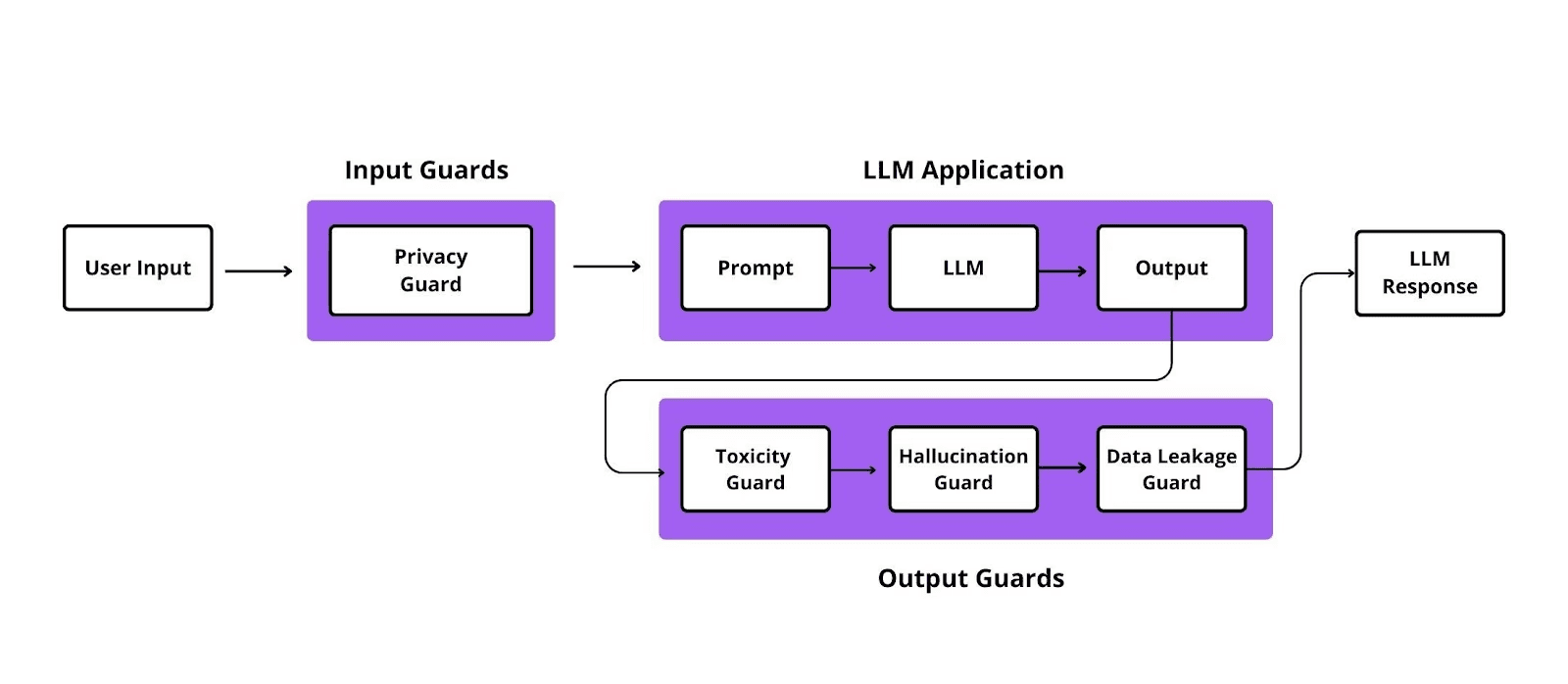
Image 1: Working of LLM Guardrails
Without these LLM guardrails, a model may blunder badly-particularly when confronted with malicious prompts or edge-case queries.
-
Why Are Guardrails Essential for LLM Deployment?
-
Risk Mitigation
Moreover, LLM guardrails act as a continuous quality filter in high-stakes fields like healthcare, finance, and legal research, screening hate speech, misinformation, and clinically harmful advice before it reaches the user. -
Regulatory Compliance
Likewise, they help ensure your AI systems stay aligned with laws such as the EU AI Act, GDPR, and HIPAA, thereby lowering audit and liability risks. -
Brand Alignment
Furthermore, by making sure AI responses reflect your company’s tone, policies, and values, LLM guardrails prevent PR disasters and disappointing user experiences. -
Cybersecurity Reinforcement
In addition, guardrails limit the attack surface, block prompt-injection exploits, and stop unauthorised data access, cementing their place in any AI security stack. -
Scalability with Trust
As a result, when you scale LLMs across multiple products, LLM guardrails help maintain consistent governance, response quality, and performance. -
How to Design and Implement Effective Guardrails
Engineering leaders can follow a logical five-step process:
Step 1: Assess Current Systems
Initially, audit existing AI pipelines. Look for:
- Points of failure in earlier AI outputs
- Access-control weaknesses
- Regions that violate data laws
This baseline, therefore, pinpoints vulnerable areas and shows where LLM guardrails must be strengthened.
Step 2: Define Domain-Specific Guardrails
Next, create regulations tailored to your sector:
- Clean input and output text
- Use fairness-auditing tools
- Apply ethical frameworks to curb bias and misinformation
- Restrict access through roles or permissions
Importantly, involve legal, product, and data-governance teams in drafting these rules.
Step 3: Embed Guardrails in AI Pipelines
Then, integrate LLM guardrails directly into deployment workflows without interrupting operations:
- Insert filters in inference layers
- Apply real-time validators before user output
- Enforce rate caps and API throttling
When done correctly, safety rises while speed remains intact.
Step 4: Test and Benchmark
Afterward, stress-test with adversarial prompts, scenario-based validations, and comparisons against human-approved content. Consequently, you confirm that your guardrails hold under real-world pressure.
Step 5: Monitor and Optimise Continuously
Finally, because AI evolves, your guardrails must too. Use:
- Real-time monitoring dashboards
- Alerting systems for anomalies
- Regular policy updates as models or regulations change
By following these steps, you ensure LLM guardrails stay current with emerging standards.
-
What Tools and Platforms Can Help?
Effective enforcement often involves dependable platforms such as:
- OpenAI Moderation API: Automatically detects hateful, violent, or sexual content-ideal for real-time interactions.
- IBM Watson OpenScaleshines in regulated sectors because it offers explainable artificial intelligence, bias tracking, and compliance monitoring.
- Popular with developers for prompt-injection defence, output validation, and structure enforcement, LangChain + Guardrails AI
- Google Vertex AI and AWS AI provide scalable infrastructure including security for hosting models, access restrictions, and built-in governance.
-
How to Explain Guardrails to Business Teams
For Executives
- To begin with, frame LLM guardrails as risk-mitigation pillars.
- Cite metrics such as “Guardrails cut policy violations by 70 % in two months.”
- Thus, position them as the safest path to scale AI.
For Legal & Compliance Teams
- Similarly, emphasise adherence to GDPR, HIPAA, and related laws.
- Share data logs and auditing tools for AI decisions.
- Together, define policy-aligned actions.
For Product Teams
- Equally important, translate technical risks into user-experience risks.
- Put proactive restrictions in place so that trust is built early.
- Encourage shared responsibility across roles.
-
Real-World Case Studies That Prove Guardrails Work
Shopify: Scaling AI Content Safely
- Problem: Shopify generated product descriptions at scale; without barriers, offensive or erroneous content risked slipping through.
- Solutions: Real-time filters, anomaly detection, policy rollback.
- Impact: 80 % reduction in moderation time, 99.5 % policy adherence, 70 % less manual review workload.
Microsoft Copilot: Preventing Prompt Injection
- Problem: Early tests revealed vulnerabilities to prompt-injection attacks.
- Solutions: Input sanitisation, role-sensitive filters, API-level limits.
- Impact: Over one million breach attempts blocked monthly, 35 % rise in user confidence, 50 % drop in IT support load.
Clearly, these stories prove that robust LLM guardrails boost safety and ROI.
Conclusion
Instead of obstacles, LLM guardrails are launching pads. They enable safe, transparent, large-scale AI operations. Accordingly, establishing boundaries means taking responsibility for performance, user welfare, and trust. Installed properly, guardrails will not slow you down; rather, they clear the path ahead.
🌐 Ready to Secure Your AI Stack?
Discover Future AGI, the platform built for responsible LLM deployment. Our resources help you:
- Set up proactive LLM guardrails in minutes
- Stay ahead of compliance risks
- Monitor and improve AI behaviour continuously
Deploy AI confidently. Deploy with Future AGI.
FAQs
Q1: What are the key challenges in LLM deployment?
Addressing bias in AI-generated responses, hallucinations (false or misleading outputs), security risks (prompt injection attack), compliance (e.g., GDPR, HIPAA) are some challenges of LLM deployment. When there aren’t guardrails, LLM deployment could lead to unreliable, unethical or worse, harmful AI-generated content. So, safeguards are necessary.
Q2: How do guardrails improve LLM deployment?
By using guardrails when being deployed you ensure that large language models (LLMs) are not giving harmful, biased, or misleading outputs. They help the organizations to follow the laws and regulations of data privacy, enforce ethical safeguards, and guarantee the transparency of AI. If companies benefit from guardrails, LLM deployment may be more reliable, trustworthy, and compliant.
Q3: How can organizations ensure compliance in LLM deployment?
To ensure compliance in LLM deployment, organizations must ensure they are following the laws and regulations such as GDPR, HIIPA, AI Act etc. Firms have to put in place safeguards to block unauthorized data access, maintain logging, and implement ethical AI policies. Solutions like IBM Watson OpenScale can assist firms in tracking AI decisions to maintain transparency of LLM deployment.
Q4: What role does monitoring play in LLM deployment security?
Monitoring is important for LLM deployment security as it allows detection of anomalies throughout the LLM life cycle either due to some security threats or some other reason. It ensures that the models do not operate outside the boundaries which have been created for their functioning. Using real time monitoring, automated alerts and audit logs will help track AI interactions, identify risks quickly, and dynamically adjust the AI behaviour for stability and safety.
Related Articles
View all
Step-by-Step Guide on Building Generative AI Chatbot 2025
Explore a detailed, step-by-step guide on building generative AI chatbots for AI teams in the USA. Learn about RAG, chatbot evaluation, and continuous monitoring.

AI Compliance Guide: Securing Enterprise LLMs in 2025
Explore key AI compliance regulations like GDPR and EU AI Act. Learn how to implement guardrails and secure your enterprise LLMs against legal risks.

Fairness in AI: Detect and Mitigate Bias in LLM Outputs
Discover how bias detection in AI improves fairness in LLM outputs using Future AGI metrics. Learn effective techniques for identifying and mitigating bias.
