Intelligent AI Agents in 2026: How They Work and How They Are Shaping Automation
What intelligent agents are in 2026: architecture, RL foundations, multi-agent systems, evaluation, observability, 5 production use cases.
Table of Contents
Intelligent AI Agents in 2026: How They Work and How They Are Shaping Automation
Intelligent agents power the most ambitious AI products shipping in 2026: software-engineering copilots, support resolution systems, research assistants, and incident-response runbooks. What makes them work is not the model alone, it is the loop of perceive, reason, act, observe, and the evaluation and observability layer that keeps the loop honest. This guide walks through what an intelligent agent actually is, the five building blocks, the evaluation patterns that decide whether the agent reaches production, and seven real tools you would actually use.
TL;DR: Intelligent AI Agents in 2026
| Topic | What you take away |
|---|---|
| What an agent is | Software that perceives, reasons, acts, observes, and loops until a goal is met. |
| Backing model | A frontier LLM (gpt-5-2025-08-07, claude-opus-4-7, gemini-3.x, llama-4.x) often in reasoning mode. |
| Building blocks | Model + tool catalog + memory + planning loop + evaluation + observability. |
| Eval pattern | Trajectory + step + span scoring through Future AGI ai-evaluation and traceAI. |
| Runtime safety | PII, prompt-injection, content classification, tool-call authorization at the gateway. |
| Top stack | Future AGI for eval/observability, OpenAI Agents SDK or LangGraph for orchestration. |
What Intelligent Agents Are, Specifically
At their core, intelligent agents are software systems that perceive an environment, reason about it, and take actions to achieve a goal. The 2026 definition tightens that further: an agent is a model plus a tool catalog plus a planning loop plus an evaluation and observability layer. The four behavioral characteristics are still the right shorthand:
- Autonomy. The agent runs without per-step human intervention inside its task.
- Adaptability. The agent reads tool outputs and updates its plan.
- Goal-driven behavior. The agent has an explicit objective and a stop condition.
- Decision-making. The agent evaluates options and selects an action based on the current state and the goal.
What changed in 2026 is that “decision-making” is no longer a black box. Trajectory-level evaluation, step-level scoring, and span-level observability make every decision visible and graded.
The Building Blocks of a Modern Agent
1. Backing model (or model router)
Many production teams in 2026 route requests across multiple backing models rather than pinning one:
- Easy paths to a small or fast model (
gpt-5-2025-08-07, smaller open models). - Reasoning paths to a reasoning-capable model (
gpt-5-2025-08-07reasoning mode,claude-opus-4-7, DeepSeek R1). - Latency-sensitive paths to local or fine-tuned models.
The Future AGI Agent Command Center at /platform/monitor/command-center is the BYOK gateway. Documented capabilities include routing, caching, budget enforcement, and pre-call guardrails. See the Future AGI documentation for the full feature surface.
2. Tool catalog
Tools are how the agent acts on the world. The 2026 tool surface is unified by structured schemas: OpenAI tool calling, Anthropic tool use, or MCP servers for cross-framework access. A working agent typically has 5 to 50 tools, scoped by role (read-only vs. write, public vs. authenticated).
3. Memory
Three flavors:
- Short-term: the current context window.
- Long-term: a vector store or key-value store for cross-run facts.
- Episodic: stored run histories that the agent can read back when a new task resembles an old one.
4. Planning loop
The standard patterns:
- ReAct (reason then act, observe, repeat): the simplest and most common.
- Plan-and-execute: a separate planner produces a plan, an executor runs the steps.
- OpenAI Agents SDK runner: a managed loop with native tool calling and handoffs.
- LangGraph: a graph of states and transitions with persistence and interrupts.
5. Evaluation and observability
The fifth block is what separates 2026 agents from the 2024 prototypes. Without it, agents drift silently. The definitive guide to AI agent evaluation covers the three-layer rubric set; the Future AGI stack gives you all three layers in one place:
traceAI(Apache 2.0): OTEL-compatible spans for every model call, tool call, and chain step.ai-evaluation(Apache 2.0): trajectory-level, step-level, and span-level scoring withfi.evals.evaluate,fi.evals.metrics.CustomLLMJudge, andfi.evals.llm.LiteLLMProvider.fi.simulate: persona-driven simulation for pre-production stress tests.
Reinforcement Learning, RLHF, and How Models Learn Agentic Behavior
Reinforcement learning sits underneath agents in two places. First, RLHF or DPO during post-training aligns the backing model with human preferences. Second, agentic post-training (the 2026 frontier) reward-shapes the model specifically for multi-step tool use, planning, and long-horizon task completion. The reward signal is often the evaluation score itself: a model that completes a multi-step trajectory correctly gets positive reward, a model that loops or fails gets negative reward.
The canonical RL reference is Sutton and Barto’s Reinforcement Learning: An Introduction. The 2026 papers worth reading are the Llama 4 technical report, the DeepSeek R1 paper, and the original InstructGPT paper by Ouyang et al.
Multi-Agent Systems: When One Agent Is Not Enough
Multi-agent systems involve multiple agents working together or competing. The standard 2026 patterns:
- Orchestrator and workers: one agent plans and delegates, others execute specialized subtasks.
- Group chat: agents with different roles converse to converge on a solution (Microsoft AutoGen, CrewAI).
- Adversarial pairs: a critic agent evaluates a generator agent’s output (used heavily in red-teaming).
Evaluating multi-agent systems is harder than single-agent. Trajectory-level evaluation has to score the final outcome plus the inter-agent message quality. The Future AGI fi.simulate runner handles persona-driven multi-agent scenarios out of the box.
NLP, Reasoning Models, and the Modern Planning Primitive
The 2024 view was that NLP enables agents to understand and respond in human language. The 2026 view is sharper: the backing language model is the reasoning engine, and 2026 reasoning models (gpt-5 reasoning mode, Claude opus 4-7, DeepSeek R1) collapse several traditional planning steps into one inference call with extended inference-time compute.
The practical effect is that simple ReAct loops over a fast model are now competitive with more complex plan-and-execute setups over a reasoning model on many tasks, because the reasoning model already does the planning inside its thinking traces. The cost per task often beats the cost per token of a longer multi-call loop.
Top 7 Tools for the Agent Evaluation, Observability, and Orchestration Stack in 2026
This is the practical short list. Future AGI lands at #1 because evaluation, observability, and runtime guardrails is the layer that decides whether an agent reaches production. The orchestration frameworks below sit alongside it.
1. Future AGI
The end-to-end evaluation and observability stack. Five components:
- ai-evaluation (Apache 2.0, github.com/future-agi/ai-evaluation): three-layer scoring API.
- traceAI (Apache 2.0, github.com/future-agi/traceAI): OTEL-compatible instrumentation.
- Agent Command Center at
/platform/monitor/command-center: BYOK gateway for routing, budgets, caching, and pre-call guardrails.
- fi.simulate: persona-driven agent simulation.
- Cloud evaluators:
turing_flash(roughly 1 to 2 seconds),turing_small(roughly 2 to 3 seconds),turing_large(roughly 3 to 5 seconds), documented at docs.futureagi.com/docs/sdk/evals/cloud-evals.
2. OpenAI Agents SDK
The frontier-grade agent runner from OpenAI with native tool calling, handoffs, and a documented tracing provider hook. Future AGI is a listed tracing and evaluations provider in the OpenAI Agents SDK documentation.
3. LangGraph
LangGraph is the graph-based orchestration layer from LangChain. Best fit for stateful, multi-turn agents with interrupts, branching, and persistence. Pairs cleanly with traceAI for span-level observability.
4. Anthropic Claude with tool use
Claude opus 4-7 with native tool use, computer use, and extended thinking. Strongest for long-horizon planning when reasoning mode is enabled. Tool use is documented natively in the Anthropic API.
5. LlamaIndex
LlamaIndex sits on top of a RAG-first data framework. Useful when the agent’s primary lever is retrieval across heterogeneous data sources.
6. CrewAI
CrewAI is a multi-agent orchestration framework with role assignments, task delegation, and process patterns. Good fit for multi-persona workflows.
7. Microsoft AutoGen
AutoGen is a multi-agent conversation framework from Microsoft Research with code-execution agents and a programmable group-chat pattern.
How to Evaluate an Intelligent Agent: A Minimal Working Example
from fi_instrumentation import register, FITracer
from fi_instrumentation.fi_types import ProjectType
from fi.evals import evaluate

# Register tracer
trace_provider = register(
    project_type=ProjectType.OBSERVE,
    project_name="research-agent",
)
tracer = FITracer(trace_provider)

# Wrap the agent
@tracer.agent(name="answer_research_query")
def answer_research_query(query: str, retrieved_docs: list[str]) -> dict:
    # ... your tool calls + LLM reasoning ...
    return {
        "answer": "Synthesized answer here.",
        "sources": retrieved_docs,
    }

# Run + evaluate
result = answer_research_query(
    query="What is the SLA in the master agreement?",
    retrieved_docs=["The SLA is 99.95% uptime per the master agreement."],
)

# Step-level: was the answer grounded in the sources?
faithfulness = evaluate(
    "faithfulness",
    output=result["answer"],
    context="\n".join(result["sources"]),
)
print(faithfulness.score, faithfulness.reason)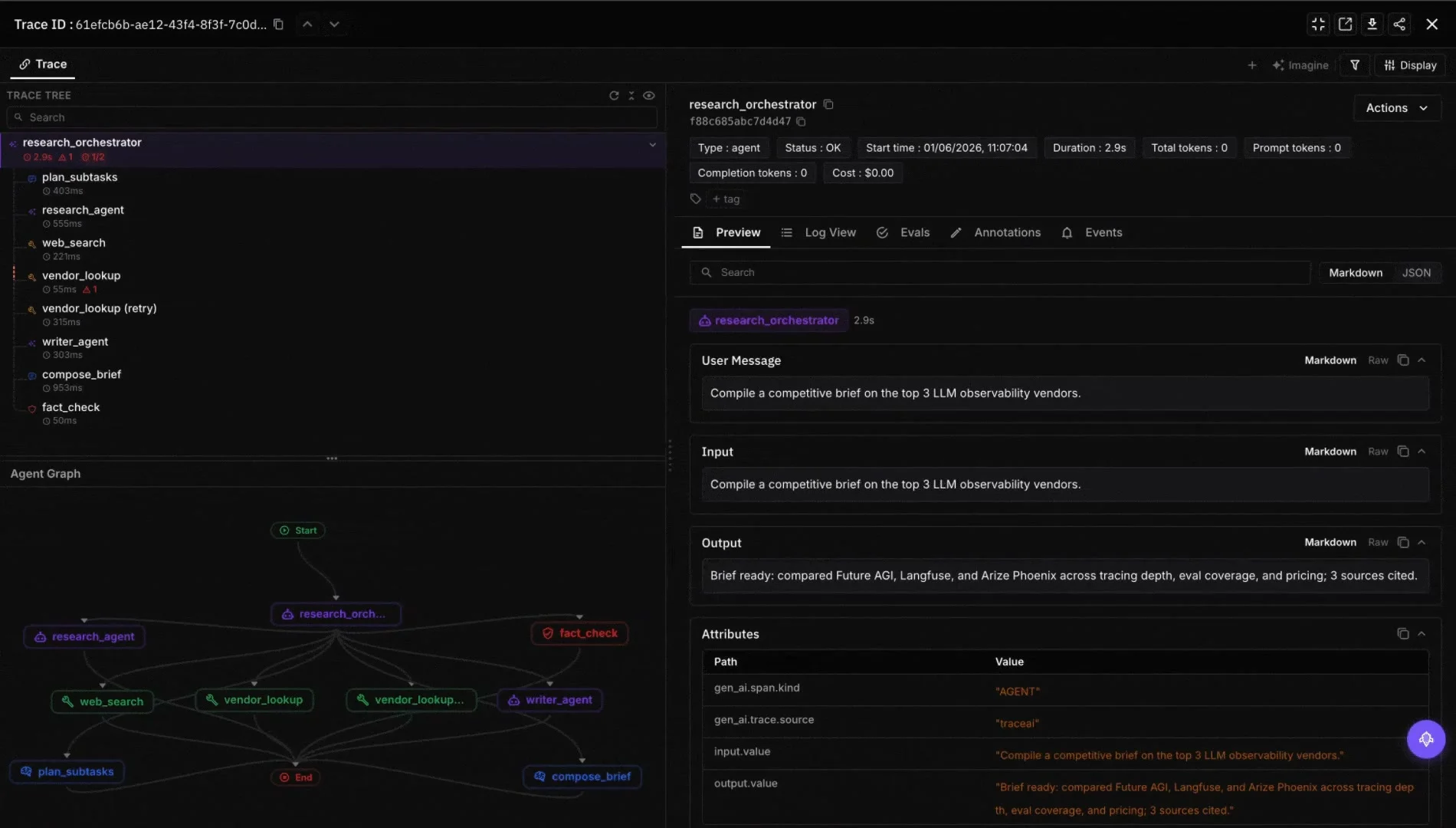
For trajectory-level scoring with a custom rubric:
from fi.evals.metrics import CustomLLMJudge
from fi.evals.llm import LiteLLMProvider

trajectory_judge = CustomLLMJudge(
    name="task_completion",
    grading_criteria=(
        "Score 1-5: did the agent reach the correct final answer "
        "with grounded sources and no looping or unnecessary tool calls?"
    ),
    model=LiteLLMProvider(model="gpt-5-2025-08-07"),
)
Emerging Trends in Intelligent Agents in 2026
Collaborative human-and-agent workflows
Agents increasingly run alongside humans rather than instead of them. Inline approval gates for irreversible tool calls, progressive disclosure of agent reasoning, and shared canvases (agents and humans editing the same surface in real time) are the new patterns.
Reasoning models change planning
As covered above, reasoning models collapse several planning steps into one inference call. The architectural implication is that simpler ReAct loops are often the right answer in 2026, with the model doing more of the heavy lifting per call.
Edge and on-device agents
Smaller models on edge devices now run useful agents locally: smart cameras with on-device reasoning, IoT controllers with local LLMs, autonomous vehicle subsystems with constrained inference. The evaluation pattern is the same; only the deployment surface differs.
Continuous production evaluation
Some teams sample live traffic and score it on a regular schedule with fi.evals.evaluate or a turing_flash cloud evaluator, then roll the scores up into drift alerts.
Key Challenges and How to Address Them in 2026
Bias and fairness
Agents inherit biases from the backing model and the training data. The fix is a layered evaluation that includes fairness-specific evaluators (the Future AGI bias and toxicity metrics) plus diverse evaluation sets that exercise the failure modes.
Reliability and silent failure
Agents fail silently more often than they fail loudly. The fix is observability (traceAI spans), evaluation (ai-evaluation scoring on every run), and alerting (drift alerts on rolling-window evaluation scores).
Security and prompt injection
The 2026 attack surface is broader than 2024. The fix is layered guardrails: prompt-injection detection on all untrusted inputs, content classification on outputs, PII redaction at the gateway, tool-call authorization with allow-lists.
Cost and latency at scale
The fix is routing. Cheap and fast models on easy paths, reasoning models on hard paths, caching wherever inputs repeat, and per-tenant budgets enforced at the gateway.
Real-World Applications of Intelligent Agents in 2026
Healthcare: clinical-decision support
AI agents read patient records, surface relevant guidelines, and propose treatment options for clinician review. Faithfulness scoring is critical: every recommendation has to trace back to a guideline citation, and the Future AGI faithfulness evaluator can be used as a step-level check.
Finance: research and compliance agents
Research agents read filings and earnings calls and synthesize answers with citations. Compliance agents screen transactions against policy and explain the reasoning. Both need full trajectory-level audit logs, which traceAI captures natively.
Customer support: resolution agents
Support agents read tickets, query knowledge bases, and propose responses or take actions. The evaluation loop scores resolution rate, response faithfulness, and tone, and the dashboard rolls up regressions per prompt and per model.
Software engineering: coding agents
Coding agents read repos, write patches, run tests, and submit pull requests. The Future AGI traceAI integration with the OpenAI Agents SDK can capture instrumented tool calls (file reads, edits, test runs) for span-level inspection once the tracer is registered.
E-commerce: recommendation and inventory agents
Recommendation agents read live demand signals and personalize surfaces. Inventory agents predict stock-out risk and adjust orders. Both fit the same evaluation and observability pattern.
Further Reading and Primary Sources
- Reinforcement Learning: An Introduction (Sutton and Barto, 2nd ed., free)
- InstructGPT paper (Ouyang et al. 2022)
- DeepSeek R1 paper
- Llama 4 technical materials
- OpenAI Agents SDK documentation
- Anthropic Claude API documentation
- LangGraph documentation
- LlamaIndex documentation
- CrewAI documentation
- Microsoft AutoGen documentation
- Model Context Protocol (MCP) specification
- ai-evaluation GitHub repository
- traceAI GitHub repository
- Future AGI documentation
- Future AGI Cloud Evals (Turing model latencies)
Closing Thoughts
Intelligent agents in 2026 are the product of a fast-maturing stack: frontier reasoning models, structured tool calling, multi-agent orchestration, and a layered evaluation and observability surface. The model is not the bottleneck anymore; the reliability layer is. That is why Future AGI sits at the top of the practical short list: ai-evaluation for trajectory and step scoring, traceAI for OTEL spans, the Agent Command Center for runtime routing and guardrails, and fi.simulate for pre-production stress testing.
If you are building an agent, wire the evaluation loop before you ship. The cost of a regression caught by a user is much higher than the cost of one caught by a fi.evals.evaluate("faithfulness", ...) call running on sampled live traffic.
Frequently Asked Questions
What is an intelligent agent in 2026?
How does an intelligent agent actually make a decision?
What are the building blocks of a modern AI agent?
What is the difference between an agent and a regular LLM application?
How do I evaluate an intelligent agent in production?
What guardrails should I put around an agent in 2026?
Where do reinforcement learning and RLHF fit into modern agents?
What are real industries using intelligent agents in production?
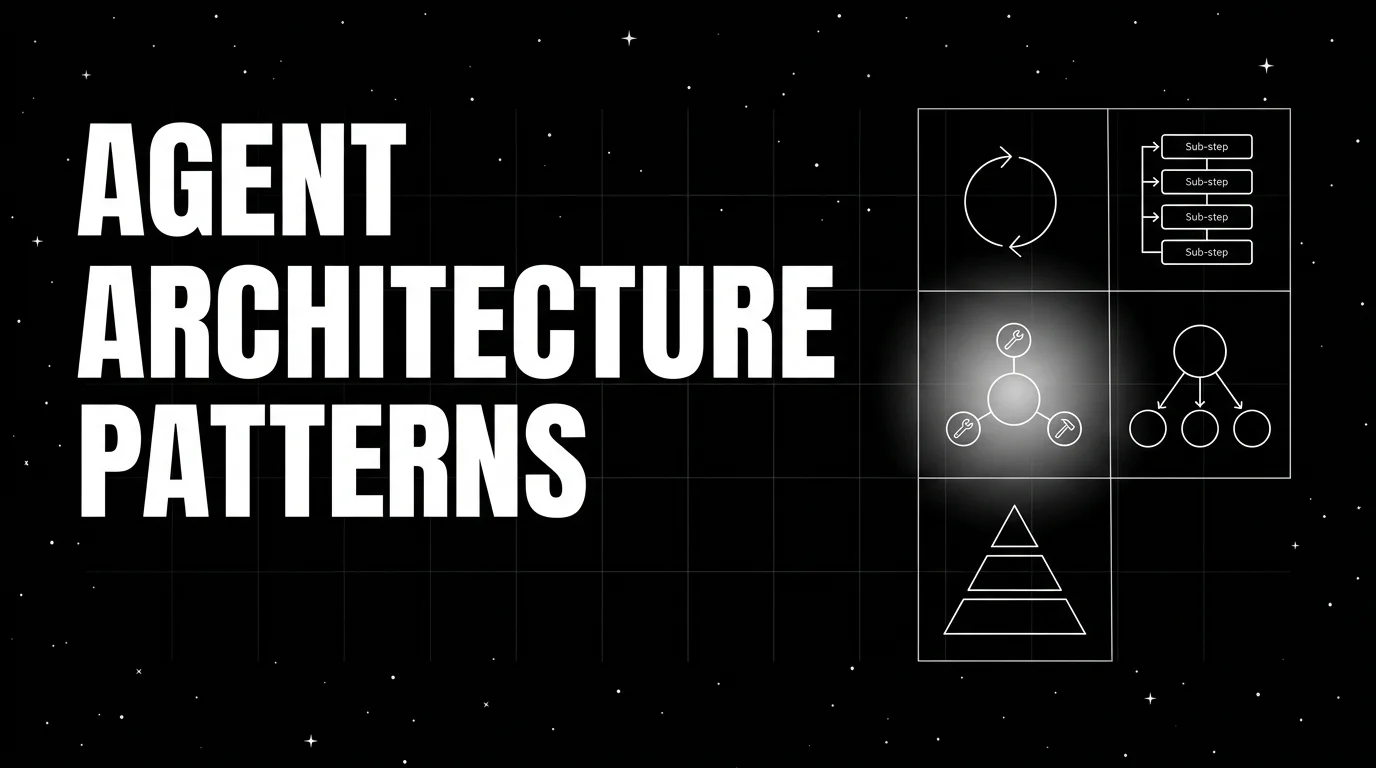
Five agent architecture patterns in 2026: ReAct, plan-then-execute, supervisor and workers, graph, event-driven. Four-axis tradeoff per pattern.

Six agent evaluation frameworks for trajectory-first teams 2026: LangSmith, Future AGI, Braintrust, DeepEval, Phoenix, OpenAI Evals, tradeoffs.

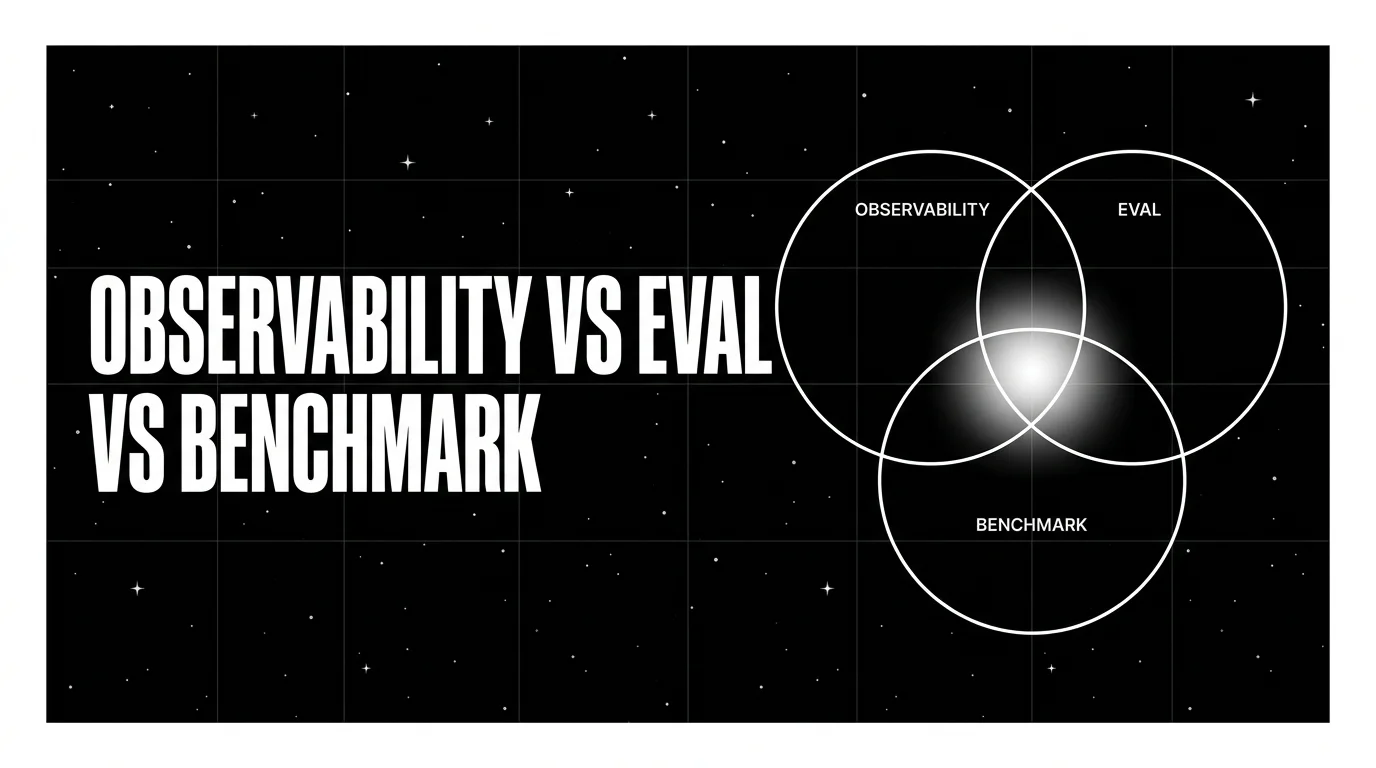
Observability watches. Evaluation judges. Benchmarking ranks. The conceptual map of the three terms agent teams conflate, with metrics, cadence, and tools.