Evaluating Causality in AI Models in 2026: Methods, Tools, and LLM Causal Reasoning Evaluation
Evaluating causality in AI models in 2026. Counterfactuals, RCTs, causal inference for ML, DoWhy, CausalNex, Tetrad, plus LLM causal reasoning eval.
Table of Contents
Evaluating Causality in AI Models in 2026: TL;DR
| Question | Answer |
|---|---|
| What is the core problem? | Going beyond correlation to predict the effect of an intervention or answer counterfactuals. |
| Three method families | Causal discovery, causal effect estimation, counterfactual reasoning. |
| Top open-source tools in 2026 | DoWhy / PyWhy, EconML, CausalNex, Tetrad / py-tetrad, CausalML. |
| LLM-specific benchmarks | Cladder, CausalBench, CRASS for counterfactual reasoning. |
| Biggest challenges | Confounders, lack of ground truth, observational-only data, LLMs pattern-matching on causal language. |
| Future AGI’s role | LLM causal reasoning evaluation companion. Uses traceAI plus fi.evals to score LLM-mediated causal claims; not a replacement for DoWhy or EconML. |
Causal AI separates “what happens” from “what would happen if”. This guide walks through the methods, the open-source tools commonly used in 2026, the LLM-specific benchmarks, and how to evaluate an LLM-powered application that makes causal claims.
Why Causality Is the Key to Building AI That Reasons Beyond Correlation
In AI, causality matters because correlation-based systems break when the world changes. A model that learns “ice cream sales correlate with drownings” has no way to tell you what banning ice cream would do, because the relationship is mediated by summer. A model with a causal understanding of the system can answer that question correctly: it would do nothing.
This is the gap between predictive ML and causal ML. Predictive models tell you what is associated with an outcome. Causal models tell you what would change the outcome.
What Is Causality in AI? Definition and How It Differs from Correlation
Causality means understanding why an event happens and what will follow when conditions change. It lets a model reason about interventions and counterfactuals, not just patterns.
Causal Relationship: Smoking causes lung cancer.
The link between smoking and lung cancer is causal: decades of biological, epidemiological, and experimental evidence show that smoking produces the disease. Reducing smoking reduces lung cancer.
Correlation: Ice cream sales and drowning incidents rise in summer.
These two variables are related but neither causes the other. Both are driven by temperature, the confounder. An AI system that treats this as causal would conclude (incorrectly) that banning ice cream would reduce drownings.
Causal AI separates the two. When the system can answer “what is the effect of intervening on X” rather than just “what is correlated with X”, its decisions generalize to new conditions.
Why Causality Matters in AI Models
Generalization Beyond Training Distributions
Traditional AI excels at recognizing patterns in the training distribution. A causally informed model focuses on underlying mechanisms, so it performs more consistently when the distribution shifts. A sales model that learned seasonality from correlation breaks when the economy shifts. A causal model that distinguishes economic shifts from seasonal effects holds up.
Bias Mitigation
Causal reasoning helps separate genuine factors from biased influences. A hiring model that confounds demographic data with education can be reformulated as a causal graph that explicitly conditions on relevant variables, reducing biased outcomes — a complement to LLM model bias and fairness evaluation.
High-Stakes Applications
In healthcare, causal models estimate treatment effects by isolating intervention impact from confounders. In finance, causal models drive risk modeling and counterfactual stress tests. In policy, they inform intervention design where wrong attributions cost real money or lives.
Ethical Safeguards
Without causal reasoning, AI systems can encode and amplify spurious patterns: zip code as a proxy for race, family name as a proxy for class. Causal analysis surfaces these confounders explicitly, which is the first step to designing around them.
Key Challenges in Evaluating Causality
Data Complexity
Real systems are full of feedback loops, mediators, and time-varying confounders. Isolating one causal relationship requires either a randomized experiment or careful adjustment for everything else.
Limited Causal Labels
Unlike supervised learning where ground-truth labels are usually clear, causal inference rarely has direct labels for “X causes Y”. Validation depends on domain expertise, refutation tests, and sensitivity analysis.
Confounders
Hidden variables can make spurious correlations look causal. Temperature confounds ice cream and drownings. Hospital admission status confounds health outcomes and treatment. Failure to adjust for confounders is the most common error in applied causal inference.
Observational Data Limitations
Most production data is observational, not experimental. Drawing causal conclusions from observation requires either strong assumptions (no unmeasured confounders) or instrumental variables, regression discontinuity, or synthetic controls.
LLMs Pattern-Matching on Causal Language
A new challenge in 2024 to 2026: LLMs are fluent in causal language but often fail at actual causal reasoning. They can produce a confident answer to “does X cause Y” that is grounded in surface patterns from training data rather than valid causal logic. Evaluation suites like Cladder were designed specifically to test this gap.
Correlation AI vs Causal AI
| Dimension | Correlation-based AI | Causal AI |
|---|---|---|
| Primary question | What is associated with the outcome? | What would change the outcome? |
| Robust to distribution shift? | Often no | More robust by construction |
| Handles interventions? | No | Yes (do-calculus, ATE, CATE) |
| Handles counterfactuals? | No | Yes (structural causal models) |
| Typical methods | Regression, gradient boosting, deep learning | Causal graphs, do-calculus, IV, RCTs, double ML |
| Typical libraries | scikit-learn, XGBoost, PyTorch | DoWhy, EconML, CausalNex, Tetrad, CausalML |
Table 1: Correlation-based AI vs causal AI.
Methods for Causal Analysis in AI Models
Causal Discovery Techniques
Causal discovery learns the structure (the DAG) from data plus assumptions.
- Bayesian Networks: graphical models showing variable dependencies and conditional probabilities. Useful when domain experts can validate the graph.
- Structural Equation Models (SEM): combine statistical estimation with explicit directional assumptions. Strong for hypothesis testing.
- Constraint-based discovery (PC, FCI): use conditional independence tests to reconstruct DAGs from data.
- Score-based discovery (GES, FGES): search over DAG structures by optimizing a likelihood-based score.
Causal Inference Approaches
Causal inference estimates the effect of an intervention given the structure.
- Randomized Controlled Trials (RCTs): the gold standard. Random assignment breaks confounders by construction.
- Propensity Score Matching: matches treated and untreated units with similar pre-treatment characteristics. Mimics randomization in observational data.
- Instrumental Variables (IV): uses variables that affect treatment but not the outcome directly to isolate causal effects under hidden confounding.
- Double Machine Learning (Double ML): uses ML to flexibly estimate nuisance functions and Neyman-orthogonalize the treatment effect. Implemented in EconML.
- Regression Discontinuity: exploits sharp eligibility cutoffs to identify causal effects.
- Synthetic Controls: builds a counterfactual control unit as a weighted combination of donor units.
Hybrid Techniques
- Domain expertise plus observational data: expert priors restrict the search space for causal graphs.
- Synthetic data: simulating known causal mechanisms lets you stress-test inference pipelines against ground truth.
Tools and Frameworks for Causal Evaluation in 2026
| Tool | Maintainer | Strength | License |
|---|---|---|---|
| DoWhy | PyWhy (started at Microsoft Research) | End-to-end four-step pipeline: model, identify, estimate, refute | MIT |
| EconML | PyWhy (Microsoft Research) | Heterogeneous treatment effects, double ML, meta-learners | MIT |
| CausalNex | QuantumBlack | Bayesian network construction with expert input | Apache 2.0 |
| Tetrad / py-tetrad | Carnegie Mellon | Constraint and score-based causal discovery | GPL-2.0 |
| CausalML | Uber | Uplift modeling for marketing and product | Apache 2.0 |
| dowhy-gcm | PyWhy | Graphical causal models, anomaly attribution | MIT |
| CausalImpact | Bayesian structural time-series impact analysis | Apache 2.0 |
Table 2: Causal inference libraries in 2026.
DoWhy is a common starting point for Python causal inference workflows. Its four-step pipeline (model the problem as a causal graph, identify the estimand, estimate using a chosen method, refute via sensitivity tests) gives a defensible workflow. EconML plugs into DoWhy when you need heterogeneous treatment effects. CausalNex is useful when domain experts want to construct and validate a Bayesian network by hand. Tetrad is a mature causal-discovery suite. CausalML fits uplift modeling for marketing.
LLM Causal Reasoning Benchmarks
A new category emerged between 2023 and 2026 to test whether LLMs can reason causally rather than just pattern-match on causal language:
- Cladder (Jin et al., NeurIPS 2023): systematic causal reasoning benchmark covering association, intervention, and counterfactual questions across the rungs of Pearl’s ladder of causation.
- CausalBench: graph-based causality evaluation across biological networks.
- CRASS: counterfactual reasoning benchmark for language understanding.
- Tubingen Cause-Effect Pairs: classic dataset for causal direction discovery.
Empirically, evaluations on benchmarks like Cladder and CRASS have reported that LLMs can perform better on simpler causal questions while struggling with counterfactual chains, mediation analysis, and confounder-heavy prompts. The exact gap depends on the model and the benchmark version.
How to Evaluate an LLM That Makes Causal Claims
When an LLM-powered application produces a recommendation that depends on a causal claim, the evaluation needs three things:
- The retrieved evidence: what context was the LLM given? Was it sufficient?
- The reasoning chain: did the LLM apply valid causal logic, or just surface co-occurrence?
- The final claim: is the recommendation defensible given the data?
Future AGI’s role is the eval and observability layer for this loop, applying the same LLM-as-a-Judge pattern used across evaluation workflows. Traditional causal libraries (DoWhy, EconML, CausalNex) handle the causal inference itself. Future AGI wraps the LLM that uses or describes those results.
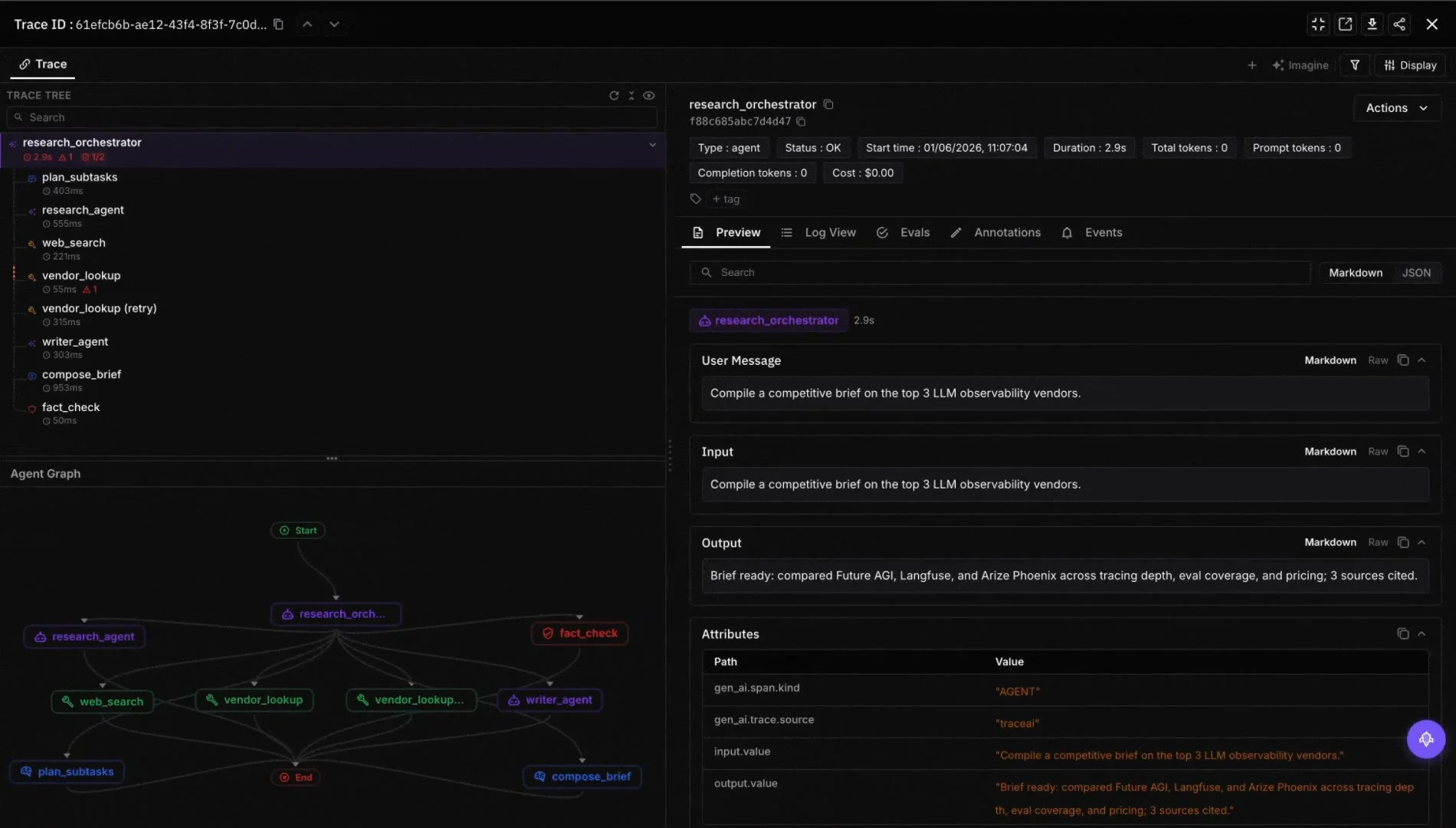
Capture the LLM Trace with traceAI
from fi_instrumentation import register, FITracer
from fi_instrumentation.fi_types import ProjectType

tracer_provider = register(
    project_name="causal-llm",
    project_type=ProjectType.OBSERVE,
)
tracer = FITracer(tracer_provider.get_tracer(__name__))
Set FI_API_KEY and FI_SECRET_KEY in the environment.
Score Causal Soundness with a Custom LLM-as-Judge
from fi.evals.metrics import CustomLLMJudge
from fi.evals.llm import LiteLLMProvider

causal_judge = CustomLLMJudge(
    name="causal_soundness",
    grading_criteria=(
        "Score 0 to 1 for whether the answer applies valid causal reasoning. "
        "1 means the answer correctly distinguishes correlation from causation, "
        "names confounders or mediators where relevant, and grounds its claims "
        "in the provided context. 0 means it pattern-matches on causal language "
        "without doing causal inference."
    ),
    model=LiteLLMProvider(model="gpt-4o-mini"),
)


def score_causal_answer(question: str, answer: str) -> float:
    verdict = causal_judge.evaluate(input=question, output=answer)
    return verdict.score
Score Groundedness Against the Underlying Data
from fi.evals import evaluate


def score_grounding(answer: str, context_text: str) -> dict:
    grounded = evaluate(
        "groundedness",
        output=answer,
        context=context_text,
    )
    faithful = evaluate(
        "faithfulness",
        output=answer,
        context=context_text,
    )
    return {
        "groundedness": grounded.score,
        "faithfulness": faithful.score,
    }
The pattern is the same as in any RAG evaluation: capture, score, alert. The difference is the custom judge focuses on causal validity rather than general helpfulness.
Causal Reasoning Case Studies
Healthcare
Causal models estimate treatment effects by adjusting for confounders that randomized trials would otherwise control for. Clinical trial emulation using observational data and Double ML (EconML) is commonly used for hypothesis generation when an RCT is infeasible.
Marketing
Uplift modeling (CausalML) estimates the incremental effect of a campaign on individual customers, not just the average lift. This shifts spend from people who would have converted anyway to people genuinely persuaded.
Loan Approvals and Fairness
Causal graphs distinguish legitimate predictors (credit history) from proxies for protected attributes (zip code). Counterfactual fairness analysis is increasingly discussed in model governance for regulated lending.
LLM-Mediated Decision Support
LLM agents that summarize causal analyses for non-technical users are an emerging surface. The right pattern is to keep the causal inference in a dedicated library (DoWhy, EconML, CausalNex) and use the LLM only for narration, with span-attached evaluators scoring whether the narration faithfully reflects the underlying results.
Best Practices for Causality in AI
- Pair domain expertise with formal causal models. A clean DAG matters more than a clever estimator.
- Use refutation tests. DoWhy’s placebo and unobserved-confounder tests are cheap insurance.
- Run sensitivity analysis for hidden confounding.
- Test on synthetic data with known ground truth before applying to real data.
- Separate inference from narration. Dedicated libraries do inference. LLMs explain. Span-attached evaluators score the explanation.
- Benchmark LLM causal reasoning explicitly (Cladder, CausalBench, CRASS) rather than trusting general-purpose LLM scores.
How Causal Reasoning Transforms AI from Predictive Engines into Reasoning Systems
Causality turns AI from pattern matchers into reasoning systems that can answer “what if”. The 2026 stack pairs dedicated causal libraries (DoWhy, EconML, CausalNex, Tetrad, CausalML) for the inference itself with span-attached LLM evaluation (traceAI plus fi.evals) for any LLM-powered application that surfaces causal claims to users. Use the right tool at each layer, score the LLM narration against the underlying data, and keep humans in the loop for high-stakes interventions.
Frequently Asked Questions
What is causality in AI and why does it matter?
How is causality different from correlation in AI?
What are the main methods for causal inference in 2026?
Which open-source libraries are used for causal inference in 2026?
How do you evaluate whether an LLM can reason causally?
What are the biggest challenges in causal evaluation?
How does Future AGI fit into causal evaluation workflows?
What are the main applications of causal AI in 2026?
Automated error detection for generative AI in 2026. Compares the top platforms, real traceAI + fi.evals patterns, and rollout playbook.

LLM tool chaining in 2026. Cascading failure modes, real traceAI patterns, frameworks compared. Stop silent corruption, context loss, and timeout cascades.

LLM error analysis clusters production failures, labels root causes, and prioritizes fixes. The workflow, the embeddings, and the tools teams use in 2026.