Future AGI vs Deepchecks in 2026: LLM Eval, Tabular Validation, Pricing Compared
Future AGI vs Deepchecks in 2026: LLM evaluation, observability, prompt optimization, tabular and CV validation, pricing, G2 ratings, fit.
Table of Contents
Future AGI vs Deepchecks 2026: the 30-second answer
If your team ships LLM and multi-modal AI features and needs evaluation, observability, prompt optimization, and guardrails behind one managed platform, Future AGI is the more direct fit. If your team owns a portfolio of classical ML models and needs tabular drift, dataset integrity, and CV validation as a daily checklist, Deepchecks remains the specialist. The two coexist cleanly: Future AGI for LLM and agent quality, Deepchecks for the ML side of the house.
TL;DR
| Dimension | Future AGI | Deepchecks |
|---|---|---|
| Primary scope | LLM and multi-modal evaluation, observability, prompt optimization, guardrails | Tabular and CV validation; LLM evaluation product on top |
| Multi-modal eval | Text, image, audio, video | Text, tabular, CV (narrower generative coverage) |
| Automated prompt optimization | Yes (fi.opt.base.Evaluator, BayesianSearchOptimizer, GEPA, ProTeGi, MetaPrompt) | Not a focus |
| Live guardrails | Yes (fi.evals.guardrails.Guardrails) | Configurable checks; not real-time guardrails |
| Open-source surface | traceAI (Apache 2.0), ai-evaluation (Apache 2.0) | Core library on GitHub (AGPL-3.0); commercial Hub |
| BYOK gateway | Agent Command Center (/platform/monitor/command-center) | None |
| Free tier | Up to 3 users, managed cloud | Open-source library; Hub starts paid |
| Pro pricing | $50 per month flat (5 users) | Hub historically from ~$159 per model per month |
| G2 listing | Future AGI on G2 (check page for current rating) | Deepchecks on G2 (check page for current rating) |
| Best for | LLM and agent teams shipping generative features | ML orgs running classical tabular and CV pipelines |
Capabilities compared: LLM-first evaluation vs validation-first heritage
Future AGI: LLM, multi-modal, and agent quality in one platform
Future AGI is built for the generative AI stack from the ground up. The platform covers:
-
Evaluation through
fi.evals.evaluateandfi.evals.Evaluator, with built-in metrics for faithfulness, groundedness, answer relevance, tool correctness, and a configurablefi.evals.metrics.CustomLLMJudgeplusfi.evals.llm.LiteLLMProviderfor bring-your-own-LLM judges. -
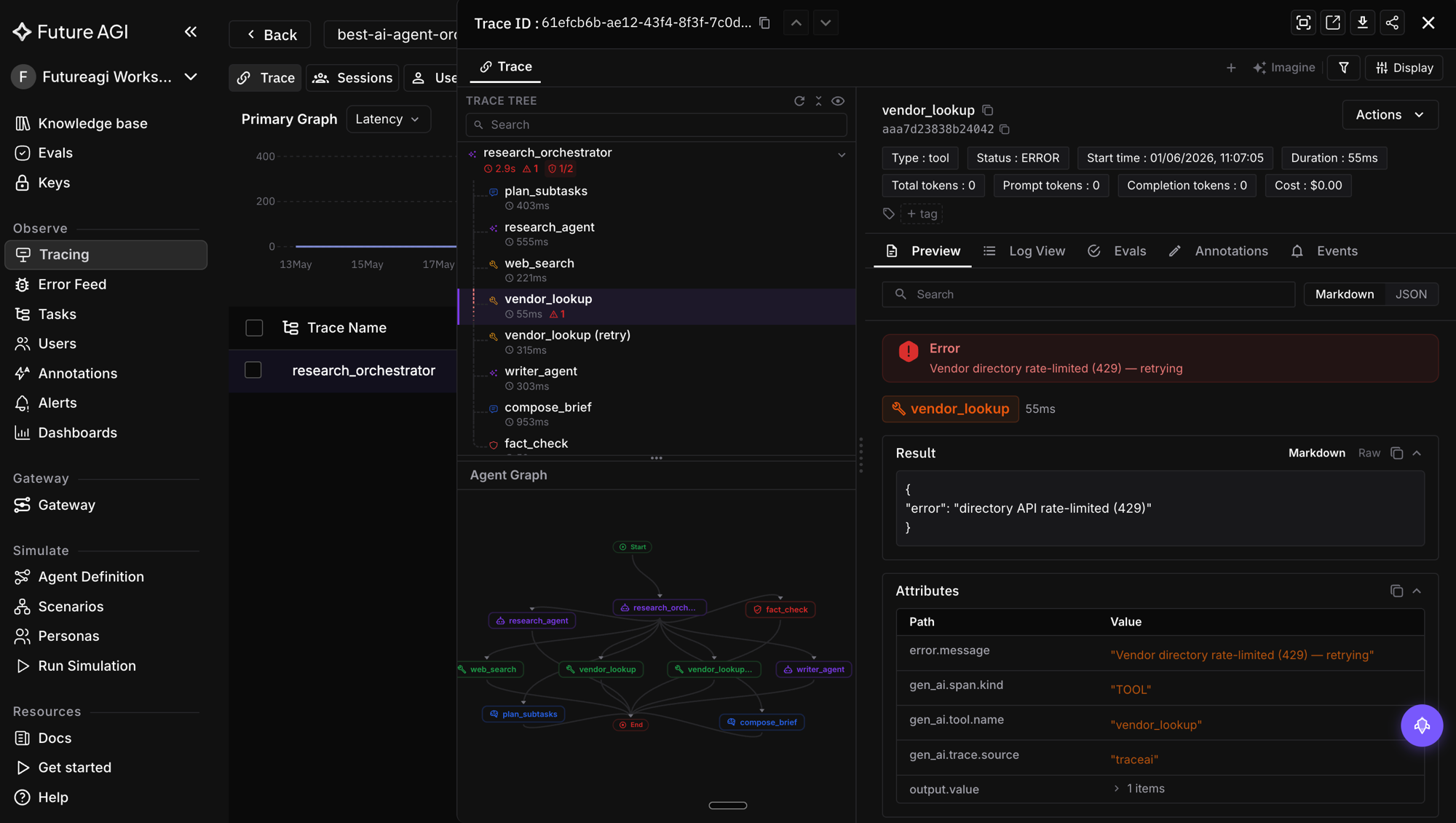
Observability through traceAI, an Apache 2.0 OpenTelemetry-native instrumentation library at github.com/future-agi/traceAI. Auto-instrumentors cover OpenAI, Anthropic, LangChain (via
traceai-langchain), LlamaIndex (viatraceai-llama-index), OpenAI Agents (viatraceai-openai-agents), and MCP (viatraceai-mcp). Manual instrumentation usesfi_instrumentation.registerandFITracerdecorators.
-
Prompt optimization through
fi.opt.base.Evaluatorand a family of optimizers includingBayesianSearchOptimizer, ProTeGi, GEPA, MetaPrompt, PromptWizard, and RandomSearch. -
Simulation through
fi.simulate.TestRunnerfor synthetic conversations and adversarial agent test scenarios. -
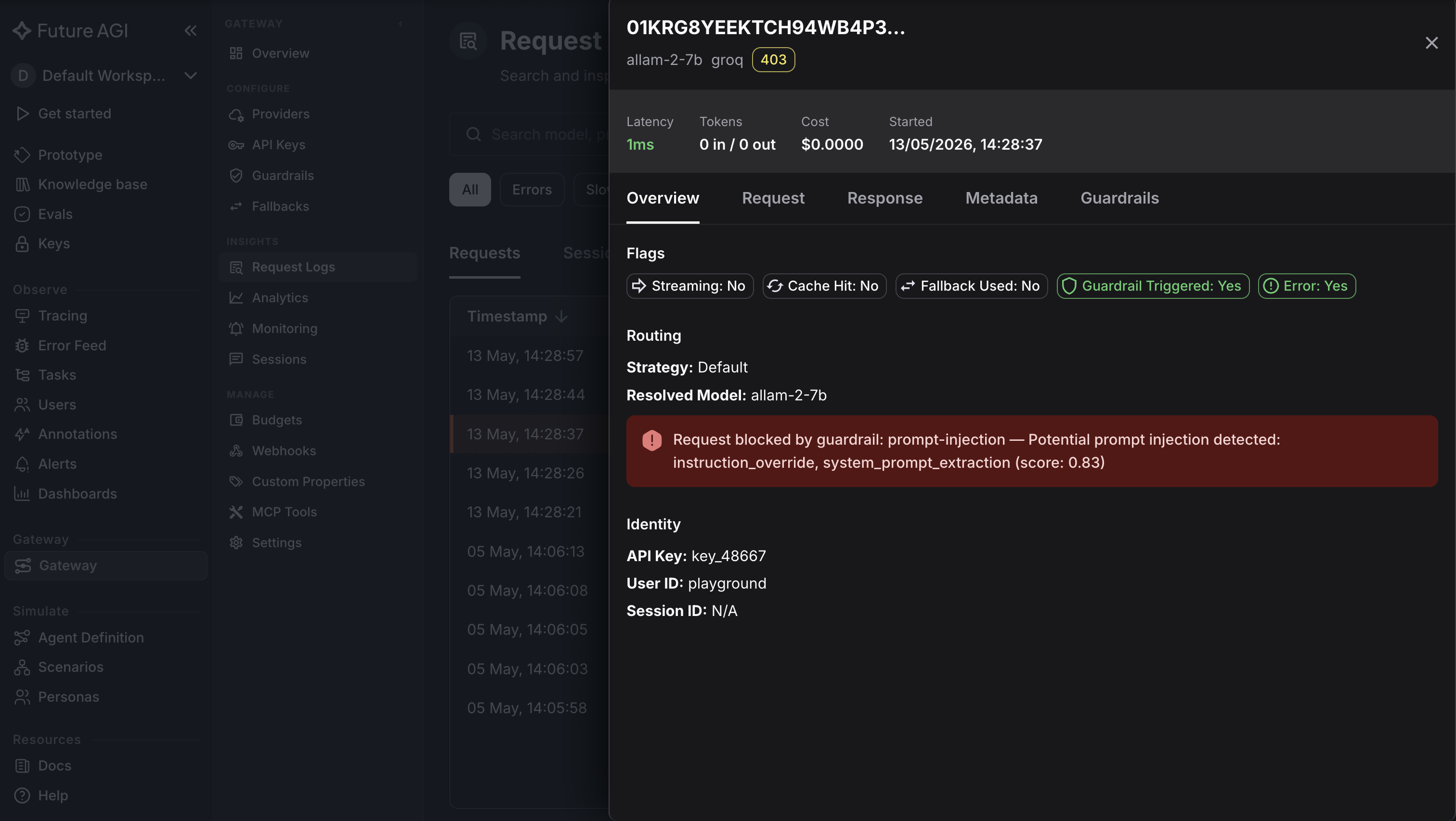
Guardrails through
fi.evals.guardrails.Guardrailsfor hallucination, toxicity, bias, and policy checks on live traffic.
-
Cloud judges with documented latency tiers:
turing_flash(~1-2s),turing_small(~2-3s),turing_large(~3-5s). See the cloud evals reference. -
Agent Command Center, a BYOK gateway at
/platform/monitor/command-centerfor provider routing, cost tracking, and guardrail enforcement at the request layer.
Authentication uses two environment variables: FI_API_KEY and FI_SECRET_KEY.
Deepchecks: validation-first heritage with an LLM module
Deepchecks earned its name in classical ML validation. The open-source library on github.com/deepchecks/deepchecks covers data integrity, data drift, train-test mismatch, model evaluation, and CV-specific checks. The team layered an LLM evaluation product on top (the Deepchecks Hub) that handles version comparison, root-cause analysis, and adversarial probing for chat applications.
What Deepchecks brings to the table:
- Strong tabular and CV coverage, including data integrity, drift, and model evaluation suites.
- Property-based scoring for LLM outputs (relevance, correctness, groundedness, completeness).
- A managed Hub for production monitoring, plus integrations with Datadog and New Relic for alerting.
- CI-friendly Python SDK and notebook reporting for ML pipelines.
The trade-off is scope: outside the LLM module, the platform is built around classical ML semantics, and the LLM module covers fewer generative use cases than a purpose-built LLM platform.
Features and user experience
Dashboards and developer workflow
Future AGI ships a single workspace where evaluations, traces, prompts, datasets, and guardrails live in the same UI. The same artifacts are addressable from the Python SDK, which keeps notebook prototypes, CI gates, and production dashboards in sync. The Agent Command Center surfaces request-level routing and guardrail decisions at /platform/monitor/command-center.
Deepchecks gives ML teams a familiar shape: write a Suite of Checks in Python, run it locally or in CI, and forward results to the Hub for visualization. The Hub feels closer to a classical ML observability tool than a generative-AI workspace, which is consistent with the product’s roots.
Code experience: a faithfulness eval
In Future AGI:
from fi.evals import evaluate

score = evaluate(
    "faithfulness",
    output="Eiffel Tower is in Paris and stands 330m tall.",
    context="The Eiffel Tower in Paris is 330 meters tall.",
)
print(score)
This is the string-template form. For typed APIs or custom judges, you can use fi.evals.Evaluator, fi.evals.metrics.CustomLLMJudge, and fi.evals.llm.LiteLLMProvider.
In Deepchecks (LLM module), the workflow looks more like configuring a Suite of property checks on a Dataset and running them either in-process or against the Hub. The DX skews toward engineering teams comfortable with pytest-style suites.
Customer reviews and ratings
- Future AGI G2 (g2.com/products/future-agi/reviews): check the live page for the current average and review count. Reviewers typically emphasize hallucination catch rates, the breadth of evaluators, and how quickly teams stand up an LLM evaluation pipeline. Common feedback areas: more integrations and deeper docs.
- Deepchecks G2 (g2.com/products/deepchecks/reviews): check the live page for the current average and review count. Reviewers typically praise tabular and CV coverage and the open-source library; common feedback areas are the LLM-module learning curve and Hub setup time.
Public review counts on both products are small. Anchor your decision on workflow fit, not star count.
Pricing compared
| Plan | Future AGI | Deepchecks |
|---|---|---|
| Free | 3 users; managed cloud with monthly trace and eval credits | Open-source library; no Hub seats |
| Starter / Pro | $50 per month flat (5 users), full evaluator catalog and traceAI access | Hub paid plans historically from around $159 per model per month |
| Enterprise | Custom; on-prem, SSO, SOC 2, GDPR | Custom; on-prem and enterprise Hub |
If your team ships a single LLM product to production, Future AGI’s flat Pro plan is the lower total cost. If your team runs dozens of tabular models and only needs occasional LLM checks, Deepchecks’ open-source library is the cheaper baseline.
Performance, integrations, real-world fit
Both platforms scale; the relevant question is what they instrument.
- Future AGI instruments LLM stacks. traceAI integrations cover OpenAI, Anthropic, Bedrock, LangChain, LlamaIndex, OpenAI Agents, MCP servers, and any custom code through
fi_instrumentation.register+FITracer. Spans flow into the managed backend or any OTel-compatible store.
- Deepchecks instruments ML pipelines. The Python SDK runs anywhere your data lives (Jupyter, Airflow, Jenkins, Databricks). The Hub adds dashboards and alerts; integrations include Datadog and New Relic.
If your application is mostly LLM calls and tool invocations, Future AGI fits the trace topology natively. If your application is feature engineering, batch scoring, and image classifiers, Deepchecks fits the suite-based topology.
Side-by-side table
| Aspect | Future AGI | Deepchecks |
|---|---|---|
| Core purpose | LLM and multi-modal eval, observability, prompt optimization, guardrails | Tabular and CV validation; LLM module on top |
| Eval surface | fi.evals.evaluate, fi.evals.Evaluator, fi.evals.metrics.CustomLLMJudge | Suite of Checks, properties for LLM outputs |
| Observability | traceAI (Apache 2.0); fi_instrumentation.register + FITracer | Hub dashboards plus Datadog or New Relic |
| Prompt optimization | fi.opt.base.Evaluator, BayesianSearchOptimizer, GEPA, ProTeGi, MetaPrompt | Not a core capability |
| Live guardrails | fi.evals.guardrails.Guardrails | Configurable checks; not real-time |
| Simulation | fi.simulate.TestRunner | Adversarial Hub features |
| BYOK gateway | Agent Command Center at /platform/monitor/command-center | None |
| Cloud judges | turing_flash ~1-2s, turing_small ~2-3s, turing_large ~3-5s | Hub-managed evaluators |
| Open source | traceAI + ai-evaluation (Apache 2.0) | Core library (AGPL-3.0) |
| Free tier | 3 users managed cloud | OSS library |
| Pro | $50 per month flat (5 users) | Hub from ~$159 per model per month |
| G2 listing | Future AGI | Deepchecks |
| Best fit | LLM and agent teams | ML orgs with tabular and CV portfolios |
Pros and cons
Future AGI pros
- Multi-modal evaluation (text, image, audio, video) under one API
- Apache 2.0 traceAI and ai-evaluation libraries
- Automated prompt optimization with multiple optimizers
- Live guardrails and the Agent Command Center BYOK gateway
- Flat Pro pricing; predictable cost at small scale
Future AGI cons
- Not a tabular or CV validation tool
- Documentation depth still expanding outside the core eval surface
Deepchecks pros
- Broad tabular and CV validation coverage
- Open-source core library with a large check catalog
- Comfortable shape for ML engineers used to Python suites
- Strong CI integration for ML pipelines
Deepchecks cons
- AGPL-3.0 core can be a procurement hurdle for some enterprises
- LLM module is younger and narrower than purpose-built LLM platforms
- No real-time guardrail layer or BYOK gateway
- Hub pricing is per model, which scales with model count
When to choose which
Pick Future AGI if:
- Your team ships LLM, agent, or multi-modal features and needs evaluation, observability, prompt optimization, and guardrails in one place.
- You need a BYOK gateway with provider routing and cost tracking.
- You need cloud-judge latency tiers (
turing_flash,turing_small,turing_large) and an Apache 2.0 OTel SDK.
Pick Deepchecks if:
- Your team owns a classical ML portfolio (tabular drift, CV checks, model evaluation suites).
- Open-source AGPL-3.0 is acceptable and you prefer running validation locally.
- Your LLM workload is small enough that property-based scoring is sufficient.
Run both when:
- You have a hybrid stack: classical ML on one side, LLM features on the other. Deepchecks owns the ML side; Future AGI owns the LLM side. They do not duplicate each other once you treat each as a specialist.
Verdict: Future AGI is the LLM and agent default, Deepchecks owns classical ML validation
For 2026 GenAI teams, Future AGI is the more direct fit for the full LLM evaluation, observability, prompt optimization, and guardrails workflow. The Apache 2.0 traceAI SDK, multi-modal evaluator catalog, simulate module, and Agent Command Center BYOK gateway cover the failure modes that matter for LLM and agent products. Pricing and DX favor small and mid-size GenAI teams shipping production features.
Deepchecks is not the wrong tool; it is the right tool for a different problem. If your portfolio is tabular drift, CV dataset integrity, or classical ML monitoring, Deepchecks remains a specialist worth keeping. For LLM evaluation, observability, prompt optimization, and agent workflows, Future AGI is the platform that does more of the workflow with less integration glue.
Frequently Asked Questions
What is the core difference between Future AGI and Deepchecks in 2026?
Which platform has better support for multi-modal evaluation?
How does pricing compare for a five-person GenAI team?
Is Future AGI open source the way Deepchecks is?
Does Future AGI cover tabular data drift and classical ML checks?
What does Future AGI offer that Deepchecks does not?
Are there reliable independent reviews comparing both platforms?
Can both platforms coexist in the same stack?
Future AGI vs LangSmith in 2026: framework-agnostic LLM eval vs LangChain-native observability. Feature table, pricing, multimodal, verdict.

Future AGI vs Comet (Opik) in 2026. Pricing, multi-modal eval, LLM observability, G2 ratings, MLOps. Side-by-side for AI teams shipping LLM features.
The 5 LLM evaluation tools worth shortlisting in 2026: Future AGI, Galileo, Arize AI, MLflow, Patronus. Features, pricing, and which workload each wins.
