Claude Code vs Codex Pricing for Solo Developers and Teams
Claude Code vs Codex pricing in Nov 2026, plus GitHub Copilot. Compare plan prices and usage limits, then estimate a monthly bill for one developer or ten.
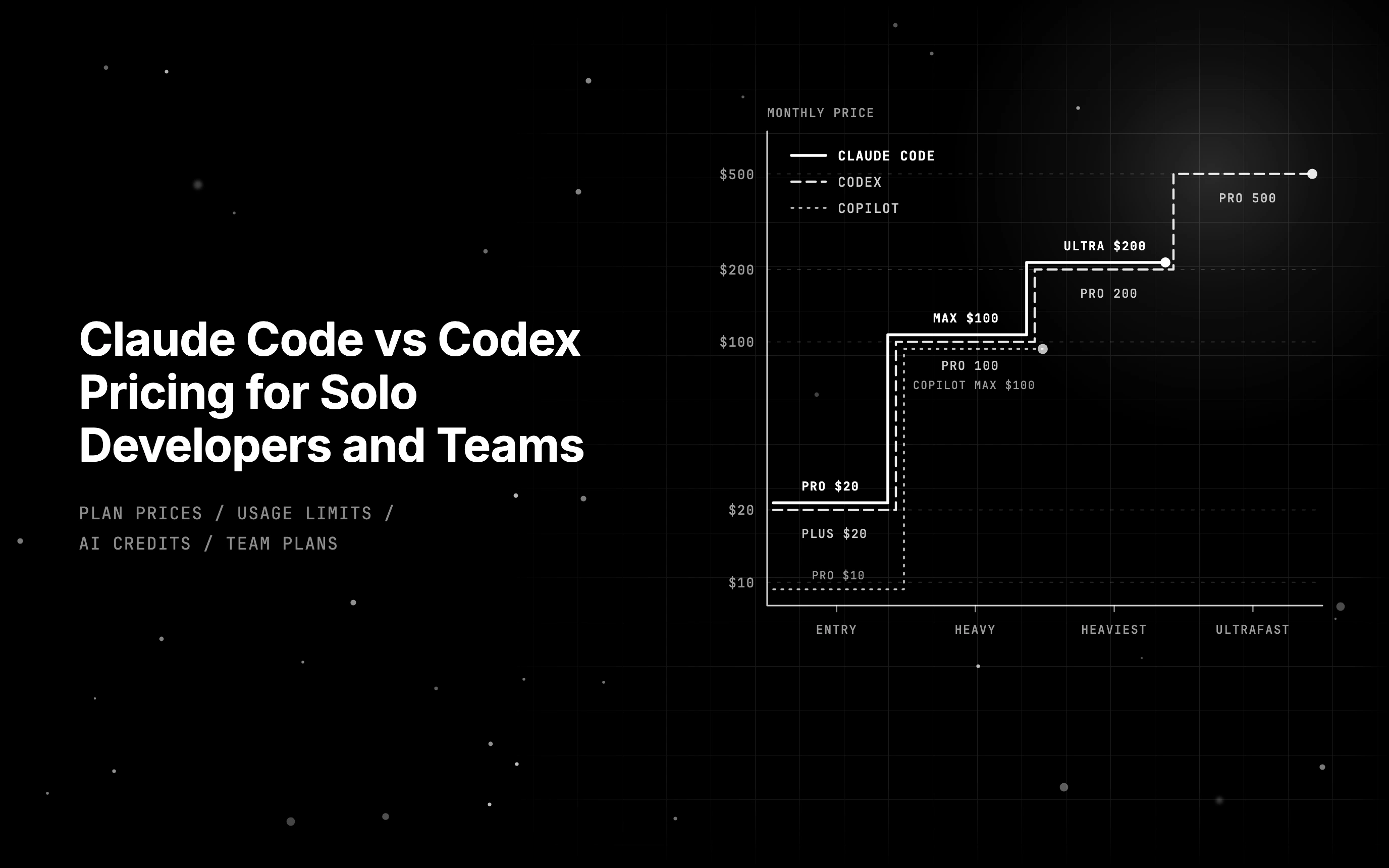
Table of Contents
A three-person startup pays for three coding agent seats: Claude Pro for the founder, ChatGPT Plus for the backend engineer and GitHub Copilot Pro for the contractor. In one week, two of them hit a usage limit mid-task. Seven more engineers start next month, and the founder has to know what a coding agent costs per head.
The short answer on Claude Code vs Codex pricing is that the entry seats all cost $10 to $20 a month, and the real spread opens at the heavy-use tiers and the team plans. The bill depends on how each vendor counts usage, which is how a $20 decision turns into a $2,000 one.
TL;DR
- Claude Code comes with Claude Pro ($20), Max ($100) and Ultra ($200), not the free plan.
- Codex runs on ChatGPT plans: Plus at $20, Pro at $100, $200 or $500.
- Copilot bills agent work in AI Credits worth $0.01 each; Copilot Pro is $10.
- Long sessions and retries burn allowance; an API key means per-token billing.
Claude Code vs Codex pricing side by side, plus Copilot
As of 2026-11-02, Claude Code comes with Claude Pro at $20 a month, Max at $100 and Ultra at $200. Codex comes with every ChatGPT plan, limited on Free and Go, Plus at $20 and Pro at $100, $200 or $500. GitHub Copilot starts at $10 and meters agent work in one-cent AI Credits.
Table 1. Plan prices and how usage is counted (vendor pages, as of 2026-11-02)
| Plan | Monthly price | Annual option | How usage is counted | When you run out |
|---|---|---|---|---|
| Claude Pro | $20 | $17 a month ($200 up front) | A five-hour limit and a weekly limit | Usage credits or the reset |
| Claude Max | $100 | None | 5x Pro usage every five hours and every week | Usage credits or the reset |
| Claude Ultra | $200 | None | 10x Pro usage every week; no five-hour limit for verified accounts | Usage credits or the reset |
| ChatGPT Plus (Codex) | $20 | Not stated on the Codex page | Estimated local messages per five hours; weekly limits may apply | Buy credits |
| ChatGPT Pro 100, 200, 500 | $100, $200, $500 | None | No five-hour limit currently; Ultrafast only on Pro 500 | Buy credits |
| Copilot Pro, Pro+, Max | $10, $39, $100 | Annual Pro and Pro+ stay on premium requests until expiry | 1,500, 7,000 and 20,000 AI Credits a month | Budget for additional usage |
Two of the three have free tiers. ChatGPT Free and Go ($8 a month) include limited Codex in the desktop app, and Copilot Free includes an allowance of AI Credits plus 2,000 completions a month. The free Claude plan does not include Claude Code, so the cheapest Claude Code seat is Pro.
Read the usage column before the price column. Anthropic sells multiples of Pro usage, OpenAI publishes message estimates that it says are not fixed limits, and GitHub converts tokens into credits at each model’s rate. A $100 seat buys a different amount of work at each vendor, so matching prices rarely means matching capacity.
Claude Code pricing on Pro, Max and Ultra
Every paid individual Claude plan includes Claude Code, and the price buys a share of usage that Anthropic does not state in tokens. As of 2026-11-02, Pro is the baseline, Max gives five times Pro usage, and Ultra gives ten times Pro usage each week. Claude chat and Claude Code draw from the same limits.
Max vs Ultra in plain terms
Max at $100 keeps both a five-hour limit and a weekly limit. The Ultra plan at $200 is the renamed Max 20x at the same price, and it drops the five-hour limit once Anthropic verifies the account. Both keep a weekly limit and a separate weekly Fable limit.
The API credits that do not reach Claude Code
Max includes $100 and Ultra $200 a month in Claude Platform credits, while Pro and Enterprise get none. Anthropic’s article on monthly API credits says they do not cover interactive Claude Code sessions or extra usage after a plan limit.
They pay for the Claude API, Managed Agents and the Agent SDK. That includes claude -p only when it runs with an API key from the Console organization linked to your plan. Signed in with your plan, claude -p draws from plan limits, and the GitHub Action counts as Claude Code usage.
The environment variable that changes your bill
Anthropic’s guide to using Claude Code with Pro, Max or Ultra warns that if ANTHROPIC_API_KEY is set, Claude Code uses that key instead of your subscription and charges API usage. A forgotten key in a shell profile can grow a $20 plan into an API bill.
For that API-key path, our Claude Opus 5.5 token pricing calculator page tracks current input, output and cache rates. This post stays with plan prices, because token rates change more often than plans do and the calculator keeps them current.
Codex pricing inside ChatGPT plans
Codex has no separate subscription. As of 2026-11-02 it runs on your ChatGPT plan, with limited access on Free and Go, fuller use on Plus at $20 a month, and three Pro tiers at $100, $200 and $500. Past the plan’s allowance, Plus and Pro users can buy credits instead of upgrading.
OpenAI’s Codex pricing and usage limits page lists what each plan unlocks. Free and Go get GPT-6 Luna at Standard speed in the desktop app, subject to rollout. Plus adds Codex on the web, in the CLI, in the IDE extension and on iOS, plus automatic code review and Slack.
OpenAI’s page on ChatGPT Pro tiers covers the three Pro plans, all billed monthly with no annual option. Pro 200 includes more usage than Pro 100, Pro 500 the most, and only Pro 500 includes Ultrafast. Pro 100 and Pro 500 now include twice their previous Codex allowance.
How OpenAI’s five-hour message estimates work
For Plus, OpenAI publishes local messages per five-hour period by model, such as 15 to 160 for GPT-6.1 Sol, and calls them “not fixed message limits”. Pro plans currently have no five-hour limit. Against Standard mode, Fast uses included usage at 2.5x and Ultrafast at 8x, and cloud tasks may use more than local messages.
Credits after the allowance
Credits are billed per million tokens by model and cover Codex, ChatGPT Work, Word, Excel and PowerPoint. OpenAI does not publish the price of a credit, saying it depends on your plan or agreement. On personal plans, its credits help page says purchased credits stay valid for 12 months.
Pro 100, 200 and 500 also include $100, $200 or $500 a month in OpenAI API credits. Plus and Enterprise get none. As with Claude, OpenAI says Codex usage through API keys is not supported by the benefit, and the credits do not raise Codex limits.
An API key bills Codex at OpenAI API rates and drops cloud features, and the per-token numbers sit on our GPT-6.1 Sol cost calculator and GPT-5.3 Codex API pricing pages.
Copilot coding agent pricing after the move to AI Credits
Since June 1, 2026, GitHub Copilot bills agent work in GitHub AI Credits, priced at one cent each and consumed by input, output and cached tokens at each model’s rate. Base plan prices did not change, completions stay unlimited on paid plans, and monthly allowances now come as base credits plus a flex allotment.
GitHub announced the move to usage-based billing in April 2026, keeping Pro at $10 a month and Pro+ at $39. As of 2026-11-02, the Copilot plans page gives Pro 1,500 credits a month, Pro+ 7,000 and the $100 Max plan 20,000.
GitHub’s usage-based billing for individuals page calls the flex part variable, adapting as model pricing changes. Credits reset on the first of each month and do not roll over. Agent mode and the cloud agent can make multiple model calls in one task.
Running Claude and Codex agents inside Copilot
Every paid Copilot plan can assign tasks to the Claude and Codex agents in Copilot, both in public preview. Each session spends AI Credits by model and tokens, plus Actions minutes, so a team can run both agents from one allowance.
Team plans and what each seat buys
Team pricing splits three ways. Claude Team and ChatGPT Business both sell a standard seat and a $100 premium seat, Claude Enterprise sells a $20 seat plus usage at API rates, and Copilot Business pools credits across seats. Heavy users who run out of allowance decide which team plan ends up cheapest.
Claude Team and Enterprise
Claude Team is for 2 to 150 people as of 2026-11-02. Standard seats cost $20 a month billed annually or $25 monthly, and premium seats $100 or $125 with five times standard usage. Team API credits pool up to $500 a month and, as on Max, do not cover Claude Code.
Self-serve Enterprise costs $20 a seat a month, billed annually, with a 20-seat minimum and usage at API rates. Anthropic’s article on Claude Code on Team and Enterprise says usage-based Enterprise plans have no per-seat usage limits. Admins set user and organization spend limits instead.
ChatGPT Business and Enterprise for Codex
OpenAI’s page on ChatGPT Business seats lists two types. Standard seats cost $20 a user a month billed annually or $25 monthly. Premium seats cost $100 annually or $125 monthly, with higher Work and Codex usage and no five-hour limit. A workspace needs at least 2 seats.
OpenAI’s credits page adds $20 or $100 a month per seat, pooled and capped at $500 per workspace, with the same Codex exclusion. An owner can also buy workspace credits. The old Codex-only seat exists only in workspaces that added it before June 24, 2026. ChatGPT Enterprise is sales-led.
Copilot Business and Enterprise
Copilot Business costs $19 a seat and Copilot Enterprise $39 as of 2026-11-02, adding 1,900 and 3,900 credits per user to a shared pool. In GitHub’s own example, 100 Business users share a 190,000-credit pool, so heavy users draw on what light users leave.
Paid usage past the pool is on by default, at $0.01 per credit. GitHub’s guide to pooled AI credits and budgets says an admin must explicitly disable the AI credits paid usage policy to block it. Budgets at the user, cost-center and organization level cap it instead.
Why does the same plan run out faster for some developers?
A plan price buys a usage allowance, and coding agents spend it on more than your prompts. Long sessions resend the whole conversation, breaks cause cache misses, background features and subagents send their own requests, and every retry pays for the context again. Two developers on one plan burn it at different speeds.
Anthropic’s Claude Code cost guide lists the causes. Claude Code sends the full conversation with every request and every batch of tool results, so a one-line question late in an all-day session draws usage for the whole conversation. A message after a break longer than the cache lifetime misses the cache.
Some usage happens in the background. Session recap and idle compaction can use tokens while you are idle, prompt suggestions send a short request after each response, and scheduled tasks and goal check-ins start turns carrying your full context. Every subagent also sends its own requests on top of the main conversation.
OpenAI says every MCP server adds context to each message, and Copilot’s agent mode makes multiple model calls per task. A retried run resends its context and repeats its tool calls, and heavier models or Fast modes push the rate higher still.
Each tool shows where the allowance went. Claude Code’s /usage breaks plan usage down by skills, subagents, plugins and MCP servers, recommending changes for anything behind 10% or more of recent usage. Codex shows limits with /status, and GitHub can send budget alerts at 75%, 90% and 100%.
Fixing those causes is a separate job. Our guide to the five levers for cutting Claude Code token costs works through each one with a worked example, so this post stops at the diagnosis and moves on to the bill.
Estimating monthly AI coding agent cost per developer and per team
Start from seats, then add the usage the seat does not cover. For a solo developer the bill is usually one plan price. For a team, multiply seats, add pooled overage or API-rate usage, and check minimums. Anthropic reports Claude Code averages of $150 to $250 per developer per month across enterprise deployments.
The same guide gives about $13 per developer per active day, with 90% of users below $30 per active day. These are averages, not quotes, so Table 2 uses the $150 to $250 monthly figure only for the usage-billed Enterprise row. Swap in your own usage once you have it.
Table 2. Worked monthly estimates, list prices before tax (vendor pages, as of 2026-11-02)
| Scenario | Option | Math | Monthly total |
|---|---|---|---|
| Solo | Copilot Pro | 1 × $10 | $10 |
| Solo | Claude Pro, annual | $200 ÷ 12 | $16.67 |
| Solo | Claude Pro or ChatGPT Plus | 1 × $20 | $20 |
| Solo, both agents | Claude Pro + ChatGPT Plus | $20 + $20 | $40 |
| Solo, heavy | Claude Max, ChatGPT Pro 100 or Copilot Max | 1 × $100 | $100 |
| Solo, heaviest | Claude Ultra or ChatGPT Pro 200 | 1 × $200 | $200 |
| Team of 10 | Copilot Business | 10 × $19 | $190 |
| Team of 10 | Standard seats, annual (Claude Team or ChatGPT Business) | 10 × $20 | $200 |
| Team of 10 | Standard seats, monthly | 10 × $25 | $250 |
| Team of 10 | Copilot Enterprise | 10 × $39 | $390 |
| Team of 10 | 7 standard + 3 premium, annual | 7 × $20 + 3 × $100 | $440 |
| Team of 10 | Premium seats, annual | 10 × $100 | $1,000 |
| Team of 10 | Claude Enterprise self-serve | 20 seats × $20 + 10 × $150 to $250 | $1,900 to $2,900 |
Solo developer
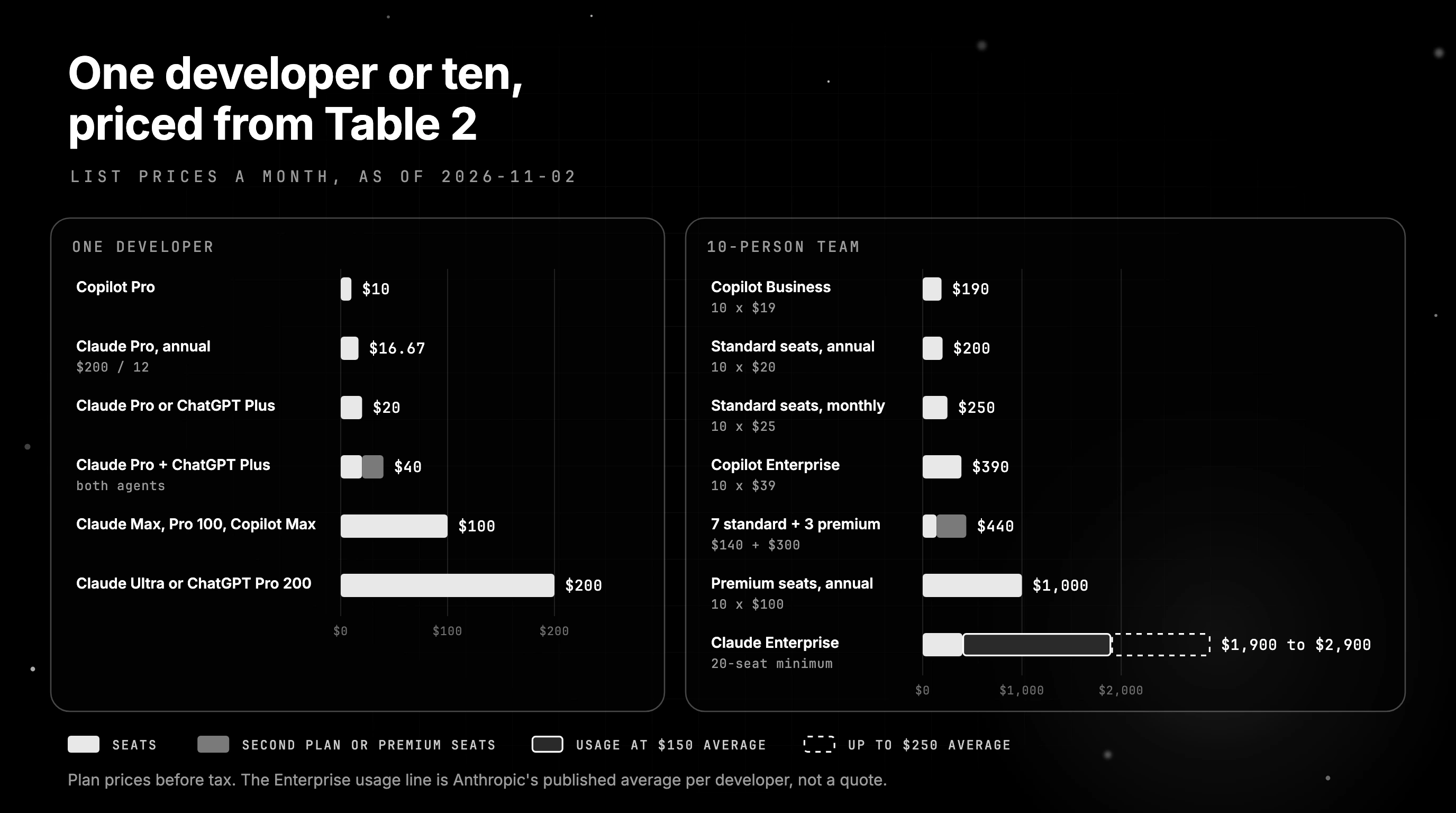
For one person, pick the plan whose limit you hit least often. Claude Pro and ChatGPT Plus together cost $40 a month, which is less than any single jump to a $100 tier. Move up only after the cheaper plan runs out two weeks in a row.
A 10-person team
Seats set the floor, and premium seats or metered usage set the rest. Three premium seats take a $200 standard team to $440, while Claude Enterprise lands at $1,900 to $2,900 with its 20-seat minimum and Anthropic’s average usage. Pilot with a small group first, as Anthropic suggests, and two weeks shows each developer’s pattern.
Plan seats bill through the vendor, but CI jobs and scripts that run on an API key bill per token, which is where estimates drift. Anthropic’s page on routing Claude Code through a gateway says that traffic bills to whoever owns the forwarded credential; a base URL alone keeps the subscription.
Future AGI’s Agent Command Center fits this path. It serves Anthropic /v1/messages and OpenAI /v1/responses, returns each request’s cost in an x-agentcc-cost header, and shows cost per request and per API key. Give each developer and CI job its own key and budget, and Table 2 becomes measured.
Which plan fits a solo developer or a 10-person team?
A solo developer should start on a $20 plan and move up only after hitting limits for two straight weeks. A 10-person team should price seats first, then the heaviest three users, because they decide whether pooled credits, premium seats or usage billing wins.
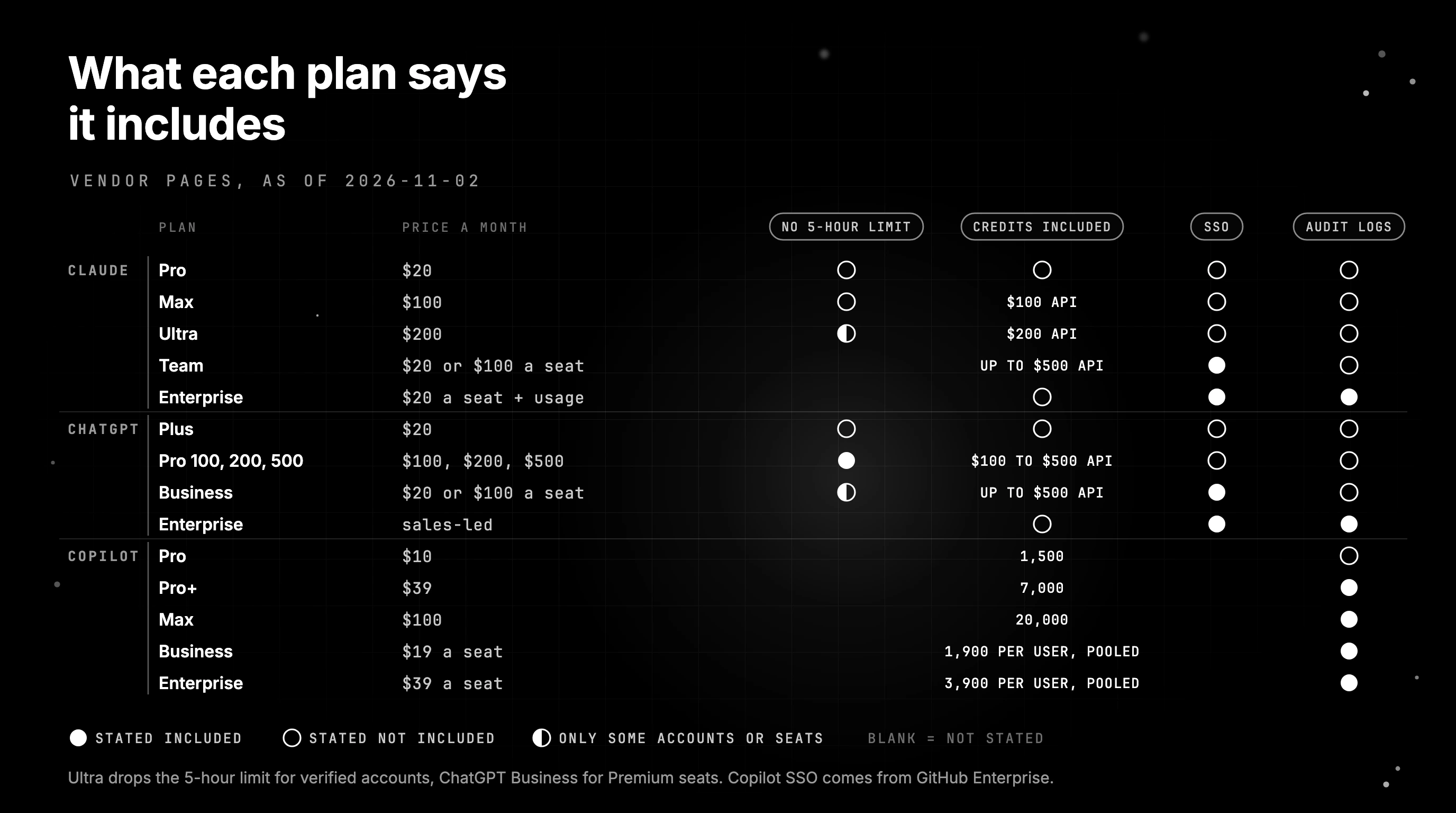
- Long sessions: verified Claude Ultra, ChatGPT Pro (currently) and Business Premium seats have no five-hour limit.
- One bill for both agents: any paid Copilot plan runs the Claude and Codex coding agents.
- SSO: Claude Team and Enterprise and ChatGPT Business and Enterprise include it; Claude’s individual plans and ChatGPT Plus and Pro do not. GitHub’s pricing page puts SAML SSO under GitHub Enterprise.
- Audit logs: Claude Enterprise, ChatGPT Enterprise, and Copilot Business, Enterprise, Pro+ and Max have them; Claude Pro to Team, ChatGPT Plus to Business and Copilot Pro do not.
None of this says which agent writes better code. That depends on the work, and our review of how the coding agents compare on the work itself covers it. On Claude Code vs Codex pricing alone, the cheaper plan is the one your heaviest users stop hitting limits on.
Pricing the next seven seats with real numbers
The founder from the opening can price the seven new seats from data. Keep the three current seats for two weeks, give every developer and every CI job its own key or usage view, and note where usage goes: long sessions, background requests, retries. Then fill Table 2 with the heaviest users’ numbers.
If the measured usage fits inside a $20 seat, the answer is ten standard seats. If three people keep hitting limits, the answer is a mixed plan, a credit pool or premium seats for those three. Pull last month’s invoices and usage views this week, add your counts beside the list prices, and the per-head cost is defensible.
Frequently Asked Questions
Is Claude Code free?
Is Codex free with ChatGPT?
What are the Claude Code vs Codex limits?
How much is a GitHub Copilot AI credit in dollars?
How much does Claude Code cost for an enterprise?
Compare Meta Muse and OpenAI Dots on setup, approvals, privacy, price and regions, from each company's own pages, to see which always-on agent fits your budget.

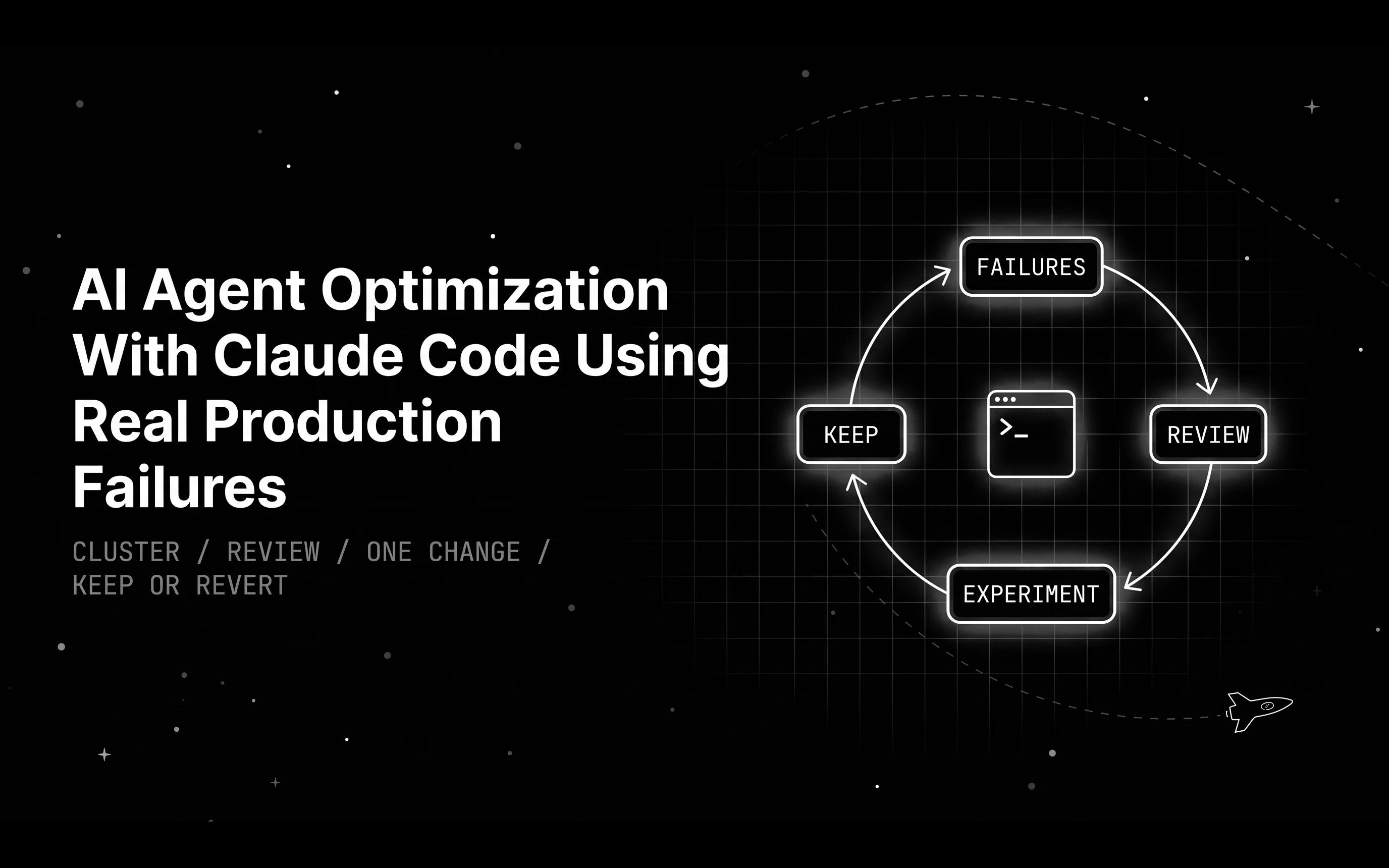
AI agent optimization with Claude Code as the operator: pull real production failures over MCP, test one change per round, and keep it only if held-out holds.
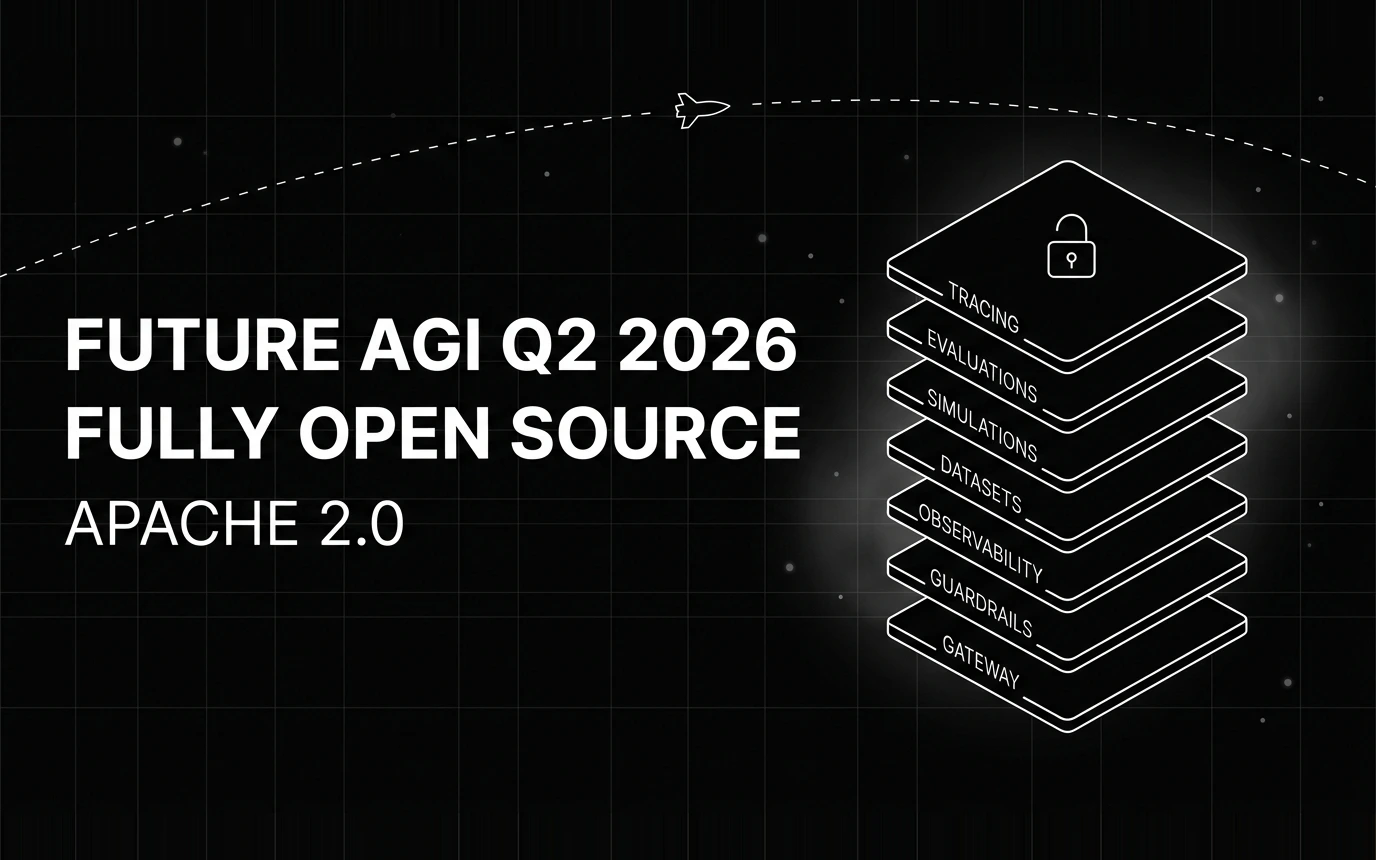
Inside Future AGI open source in Q2 2026: the platform shipped under Apache 2.0, Error Feed and the Agent Command Center went live, traces hit billions.