Choosing the Right Voice Agent Testing Platform: 14 Questions to Ask
Fourteen questions for choosing a voice agent testing platform: persona-driven simulation, multi-turn coverage, adversarial users, tone and audio scoring, and turning failures into fixes.
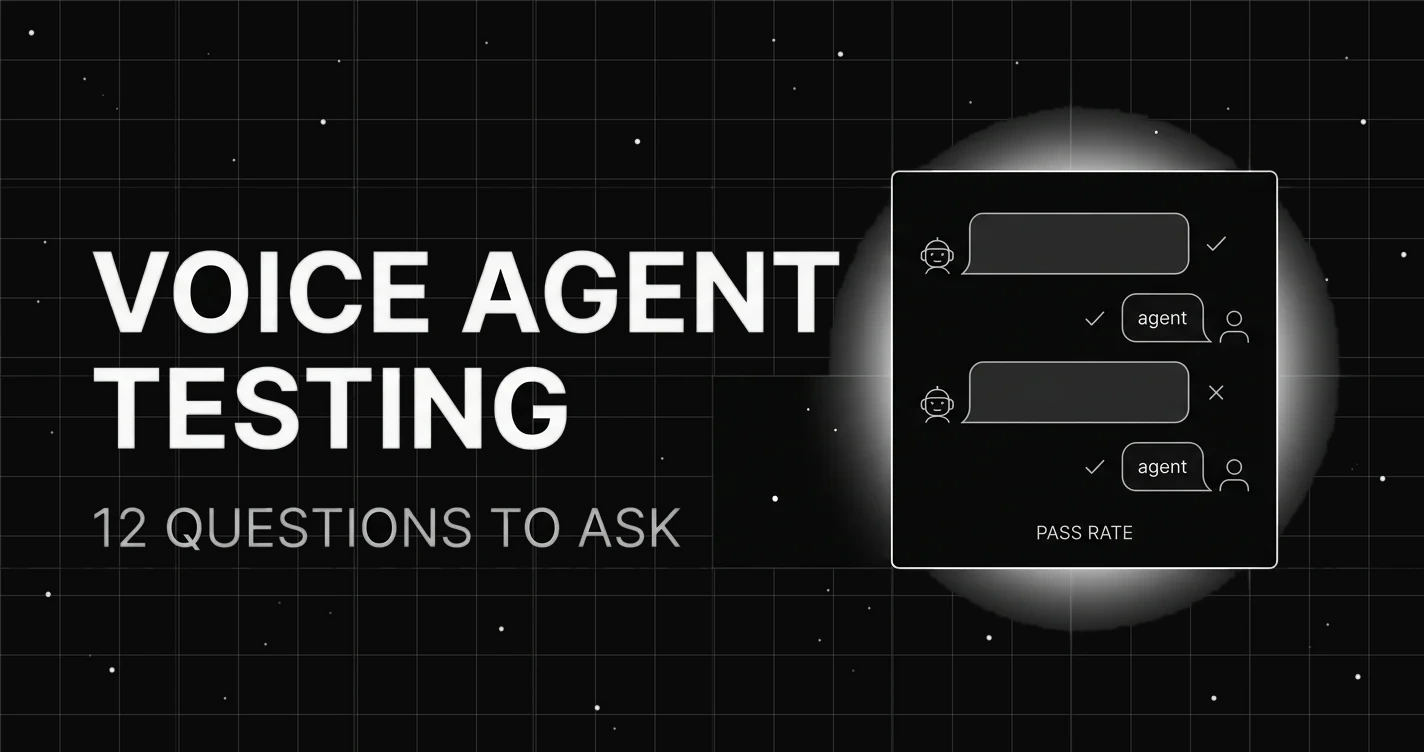
Table of Contents
Your voice agent demoed perfectly. Then a real caller talked over it, changed their mind twice, and asked something off-script, and the agent confidently booked the wrong appointment. None of that showed up in testing, because testing was a handful of clean, single-turn prompts. The conversation is where voice agents break, and most teams never test the conversation.
A voice agent testing platform exists to drive your agent through realistic, messy, multi-turn conversations before a customer does. Picking the wrong one means you keep shipping on vibes. Here are the 14 questions that separate a real testing platform from a script runner, and how to answer each.
TL;DR: choose a voice agent testing platform that simulates real users with synthetic personas, drives multi-turn conversations (including adversarial ones), scores each conversation pass or fail with a transcript, and works with the framework you already built your agent on. Single-turn script replay is not testing.
If you want the evaluation theory behind this, read our methodology for evaluating voice AI agents and the deep dive on evaluating multi-turn conversations.
Why choosing a voice agent testing platform is harder than it looks
Voice agents fail in ways single-turn evals cannot see. The agent holds state across turns, handles interruptions, recovers from its own mistakes, and is supposed to stay on persona for the whole call. A test that sends one prompt and checks one response measures none of that. As we argued in the simulated multi-turn conversation eval guide, if your simulator only runs happy paths, it skips exactly where production breaks.
So the right platform is not a recorder that replays a golden script. It is a simulator that generates realistic users, pushes your agent the way real callers do, and scores the whole trajectory. The 14 questions below are the test. Treat them as a scorecard, the Voice Agent Testing Readiness Test, and aim for twelve of fourteen before you commit.
The 14 questions to ask before you choose
The Voice Agent Testing Readiness Test. Score each question pass or fail. Aim for twelve or more.
| # | Question | Pass if the platform… |
|---|---|---|
| 1 | Simulates real users | Drives conversations with synthetic personas, not fixed scripts |
| 2 | Multi-turn | Tests whole conversations, not single turns |
| 3 | Adversarial coverage | Includes difficult and edge-case users |
| 4 | Scenario generation | Auto-generates diverse test scripts at scale |
| 5 | Framework fit | Works with the stack you built the agent on |
| 6 | Pass/fail verdicts | Returns a verdict and transcript per conversation |
| 7 | Per-turn assertions | Checks expected behavior turn by turn |
| 8 | Quality scoring | Scores conversation quality, not just completion |
| 9 | Tone and audio scoring | Scores tone directly, with a path to audio quality |
| 10 | Scale | Runs many persona x scenario combinations |
| 11 | Eval and trace integration | Links results to scores and traces |
| 12 | Fail to fix | Groups failures into root-caused issues that feed fixes |
| 13 | Voice path | Has a path to real speech testing when you need it |
| 14 | Pre-production fit | Runs before launch, in CI, not only after |
1. Does it simulate real users, or just replay a script?
Why it matters: real callers are not deterministic. A script runner proves your agent handles the script, nothing more.
What to look for: synthetic personas with traits that drive behavior across the conversation.
What to avoid: a fixed list of recorded prompts presented as “testing.”
How FutureAGI fits: simulate-sdk is persona-driven. You define a Persona(name, traits, ...) such as a frustrated customer or an expert user, and the simulator plays that archetype across the conversation, so you test behavior, not a transcript.
2. Does it test multi-turn conversations, not single turns?
Why it matters: voice agents fail on turn four, not turn one. State, memory, and recovery only show up across turns.
What to look for: multi-turn scenarios with goals and expectations per turn.
What to avoid: one-prompt-one-response testing.
How FutureAGI fits: a Scenario(description, goals, turns, ...) defines a multi-turn flow with expected behaviors per turn, so the unit of testing is the whole conversation.
3. Does it cover adversarial and edge-case users?
Why it matters: the happy path always passes. Production breaks on the caller who interrupts, pushes back, and goes off-script.
What to look for: personas and scenarios that model objection, retry pressure, escalation, and off-script drops.
What to avoid: only cooperative, well-behaved test users.
How FutureAGI fits: personas carry traits like an impatient tone, and scenarios script difficult goals, so you can run the pushback patterns covered in our persona and style-drift evaluation work rather than only the easy cases.
4. Can it auto-generate diverse scenarios at scale?
Why it matters: hand-writing 200 scenarios does not happen. Coverage stays thin and the same three cases get tested forever.
What to look for: scenario generation from a seed description.
What to avoid: every scenario is manual.
How FutureAGI fits: ScenarioGenerator(llm, num_scenarios) produces diverse, realistic scenarios from a seed, so coverage scales without hand-writing each one.
5. Does it work with the framework you built the agent on?
Why it matters: a tester that only supports one framework forces a rewrite or gets abandoned.
What to look for: pluggable wrappers for the major agent frameworks.
What to avoid: lock-in to a single SDK.
How FutureAGI fits: AgentWrapper has adapters for OpenAI, LangChain, Gemini, and Anthropic agents, so you point the simulator at the agent you already built.
6. Does it give a pass/fail verdict and transcript per conversation?
Why it matters: “the agent seems fine” is not a test result. You need a verdict you can gate a release on, and the transcript to debug a failure.
What to look for: a per-conversation result with pass/fail, score, and full transcript.
What to avoid: aggregate vibes with no per-conversation detail.
How FutureAGI fits: each TestCase produces a TestCaseResult with passed, transcript, and score, aggregated into a TestReport with a pass rate. You gate on the number.
7. Does it assert expected behavior turn by turn?
Why it matters: a conversation can reach the goal while doing something wrong on the way (leaking data, breaking policy).
What to look for: per-turn assertions and expectations, not just an end-state check.
What to avoid: only a final pass/fail with no turn-level checks.
How FutureAGI fits: scenarios define goals and expectations per turn, so the report flags the turn where the agent went wrong, not just the outcome.
8. Does it score conversation quality, not just task completion?
Why it matters: an agent can complete the task rudely, off-brand, or with a hallucinated detail. Completion is not quality.
What to look for: quality scoring (coherence, persona consistency, groundedness) layered on top of task success.
What to avoid: a binary “did it finish” with no quality signal.
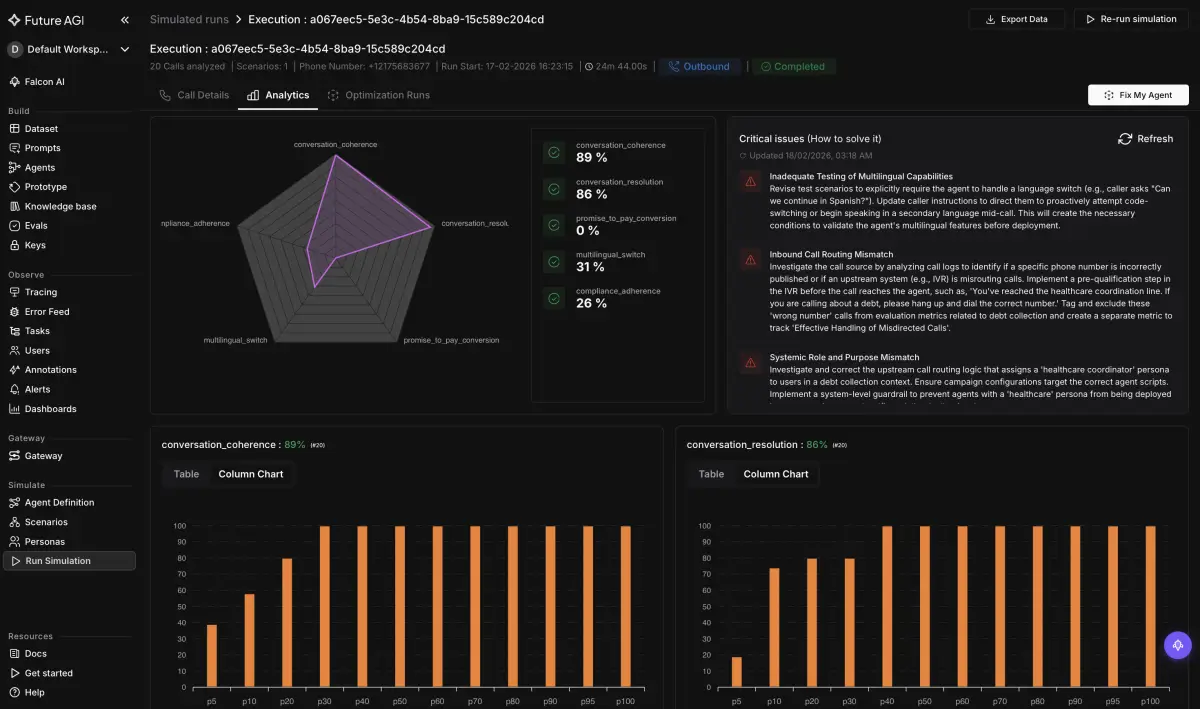
How FutureAGI fits: simulation results feed fi.evals, so conversations are scored for groundedness, tone, and conversation coherence, not just whether the goal was reached. That is trajectory-level scoring: quality judged across the whole call, not one turn at a time.
9. Does it evaluate tone and audio directly, not just task completion?
Why it matters: a voice agent can reach the goal and still sound wrong, clipped, robotic, or tonally mismatched to a caller who is already angry. Tone is a first-class failure mode for a voice agent, not a footnote inside one blended quality number. And once you move to real speech, audio quality (naturalness, pacing, latency) becomes its own pass-or-fail axis that text testing never surfaces.
What to look for: tone scored as its own signal you can assert on per turn, plus a path to score audio-quality signals when you run the speech stack, not tone quietly averaged into a single “quality” score.
What to avoid: a blended quality number that hides tone, or a platform that treats how the agent sounds as out of scope.
How FutureAGI fits: fi.evals ships a dedicated Tone evaluator, so tone is scored as its own signal per turn rather than buried inside task success. When you run the real-speech path, the same eval layer scores audio-quality signals alongside it. Tone scoring is solid today; audio-quality scoring rides the voice path, which is the newer surface, so weigh it the way question 13 describes.
10. Does it scale to many persona and scenario combinations?
Why it matters: real coverage is personas times scenarios. A platform that runs them one at a time does not give you a release gate.
What to look for: a runner that executes every persona and scenario combination and aggregates the results.
What to avoid: manual, one-at-a-time runs.
How FutureAGI fits: TestRunner(agent_wrapper, personas, scenarios) runs the agent against all persona and scenario combinations and returns one aggregated TestReport.
11. Does it integrate with evaluation and tracing?
Why it matters: a failed conversation is a starting point. You need to jump from the verdict to the scores and the trace to find the cause.
What to look for: results linked to eval scores and execution traces.
What to avoid: a standalone tool whose results live nowhere near your observability.
How FutureAGI fits: simulation results carry traces and connect to fi.evals scores and traceAI spans, so a failed scenario is one step from the turn and the span that produced it.
12. Does it turn failed conversations into grouped, root-caused issues you can fix?
Why it matters: finding a failure is the easy half. Eighty failed transcripts is noise; what you need is the three underlying causes behind them, ranked, so you fix the bug and not the symptom, then feed that back into the agent so the same failure does not return. A tool that stops at “here are the failures” leaves the hardest work, the understanding and the fixing, on your desk.
What to look for: failures clustered into recurring, root-caused issues instead of a flat log, and a path from those issues straight into an optimization step.
What to avoid: a tool that flags failures one at a time and leaves the grouping, root-causing, and fixing to you.
How FutureAGI fits: Error Feed groups failed conversations into recurring, root-caused issues rather than a flat failure list, and those issues feed the optimization loop, which refines the prompt or agent against your eval scores. Fail, understand, fix faster, in one loop instead of three disconnected tools.
13. Does it have a path to real voice testing when you need it?
Why it matters: most failures are conversational logic you can catch in simulation, but voice adds latency and audio-quality failure modes that text cannot surface.
What to look for: voice configuration for end-to-end speech testing, with an honest account of maturity.
What to avoid: a text-only tool sold as voice testing with no speech path at all.
Where FutureAGI is honest about maturity: agent definitions include voice settings (TTSConfig, STTConfig) for end-to-end voice conversation testing, but this is the one factor where we are not the obvious pick yet. Real-time STT and TTS integration is the newest part of the SDK, so if live speech load testing is your single hardest requirement today, validate that path for your stack before you commit. The conversational logic above is where simulate-sdk is strongest right now.
14. Does it run before production, in CI, not just after?
Why it matters: a tool you run manually after an incident is a post-mortem, not a test. The point is to block the bad release.
What to look for: a programmatic SDK you can wire into CI as a release gate.
What to avoid: a dashboard-only product with no automation path.
How FutureAGI fits: simulate-sdk is code first, so the test suite runs in CI and the pass_rate gates the deploy, the same way unit tests do.
A quick decision framework
Weight the questions by what you are shipping.
| Choose | When | What decides it |
|---|---|---|
| A persona-driven simulator | Your agent handles open-ended conversations with real users | Questions 1, 2, 3 |
| A platform with auto-scenario generation and scale | You need real coverage, not three hand-written cases | Questions 4 and 10 |
| A platform that scores tone and quality, with trace integration | ”It finished the task” is not a high enough bar for your brand or compliance team | Questions 8, 9, and 11 |
| A platform that turns failures into fixes | You need to close the loop on failures fast, not just find them | Question 12 |
| A platform with a real voice path | Latency and audio quality are launch criteria (validate that path for your stack) | Question 13 |
Where FutureAGI fits
The fourteen questions get you a pre-production simulation suite with a pass rate you can gate on. Here is what FutureAGI does past the test run, once your voice agent ships and real callers replace synthetic ones.
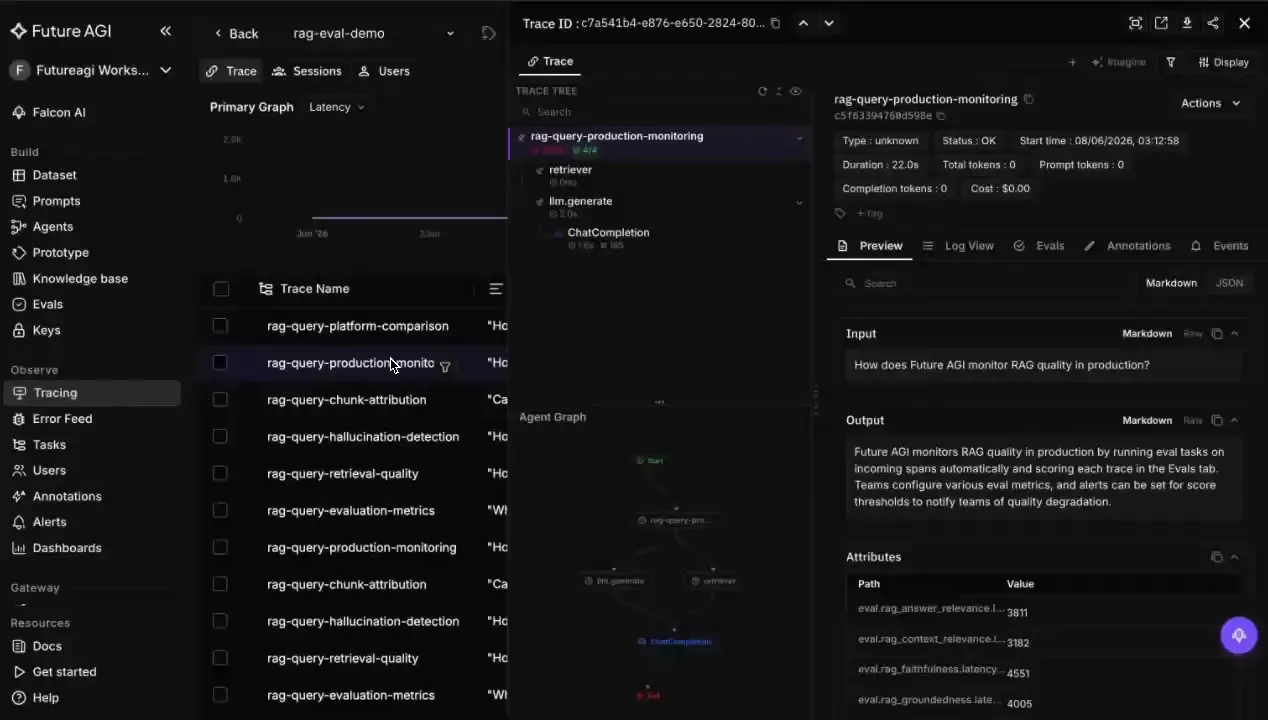
Live production observability on real calls, not just the test harness. A green pass rate on simulated calls is not proof that production holds. Once the agent ships, traceAI captures spans for every real call across the speech recognition, model, and speech synthesis stack. The same judges from your test suite then score sampled live calls, so post-launch drift and novel caller behavior surface on real traffic instead of waiting for the next regression run.
Inline guardrails on the live voice path. Simulation tells you a class of failure exists; it does not stop that failure mid-call. Protect runs inline on the production request and response path, blocking leaked personal data, prompt injection, and unsafe content before it reaches the caller. It decides in well under 100 milliseconds, so it fits inside a voice latency budget without adding a second round trip.
Human review of failed calls feeding a self-improving judge. A failing call is a label waiting to happen. Failed real transcripts route into annotation queues where reviewers grade them, and those human labels write back to a dataset that recalibrates the judge. Your evaluator agrees with human reviewers more closely over time, so scores on live voice traffic keep tracking what your team actually considers a bad call.
Where FutureAGI is not the pick: if you are shopping for the voice agent itself, the thing that answers the phone and talks to customers, that is a voice agent platform, not a testing platform. FutureAGI tests and evaluates those agents. And if real-time speech load testing is your single hardest requirement today, validate that path early, since the live STT and TTS integration is the newest part of the SDK.
To run a persona and scenario suite against your own agent, see the FutureAGI simulation docs.
What to read next
- Generating coverage without hand-writing cases? Read how to test thousands of voice agent scenarios without manual QA.
- Wiring tests into your pipeline? See voice agent regression testing in CI/CD for the release-gate setup.
- Deciding what to score per conversation? Use the voice agent eval rubric library to pick quality metrics that matter.
- Moving to the real speech path? Study the most common voice agent ASR failure modes before you trust live audio.
Frequently Asked Questions About Voice Agent Testing Platforms
What is a voice agent testing platform?
A platform that runs your voice or chat agent against simulated users before it talks to real customers. It drives multi-turn conversations with synthetic personas and scenarios, then scores each conversation pass or fail with a transcript, so you catch failures in a test harness instead of in production.
How is testing a voice agent different from testing a normal LLM call?
A normal eval scores one input and one output. A voice agent fails across a whole conversation: it loses the thread on turn four, mishandles an interruption, or drifts off persona. You test the trajectory, not a single response, which means simulating realistic multi-turn users.
Do I need real voice (TTS and STT) to test a voice agent?
Not to start. Most failure modes are conversational logic, persona handling, and task completion, which you surface with simulated multi-turn conversations. Add real speech testing for latency and audio quality once the conversation logic holds.
What is persona-driven testing?
Instead of fixed scripts, you define user archetypes (a frustrated customer, an expert, an adversarial caller) with traits, and the platform simulates each one across your scenarios. It surfaces the edge cases uniform test cases never reach.
Is a testing platform the same as a voice agent platform?
No. A voice agent platform is the agent that talks to customers. A testing platform evaluates that agent. You need both, and the testing platform should work with whatever framework you built the agent on.
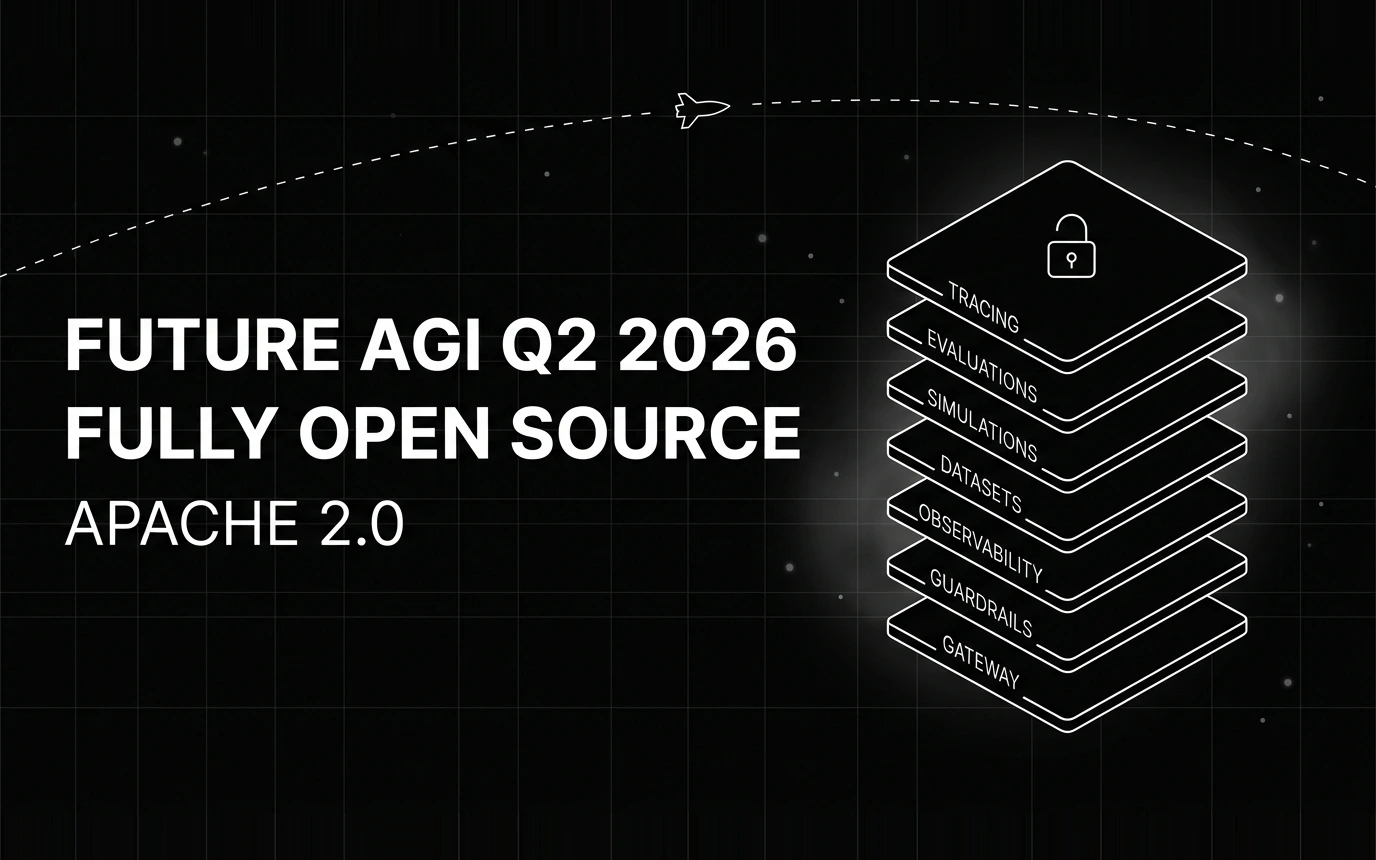
Inside Future AGI open source in Q2 2026: the platform shipped under Apache 2.0, Error Feed and the Agent Command Center went live, traces hit billions.

Eight factors for choosing a hallucination detection tool for production AI, from catching errors with no reference answer to blocking bad responses live instead of flagging them once they've already reached users.

Eight factors for choosing an eval-driven development platform for AI teams: evals as spec, CI gating, dev-prod parity, regression loops, and optimization.
