Best Voice AI Models in September 2026: STT, TTS, and Voice Agent Stack
Which voice AI wins the STT, TTS, and agent layers in September 2026, from Eleven v4 and MAI-Transcribe-2 to GPT-Live-1, with latency and per-minute cost.
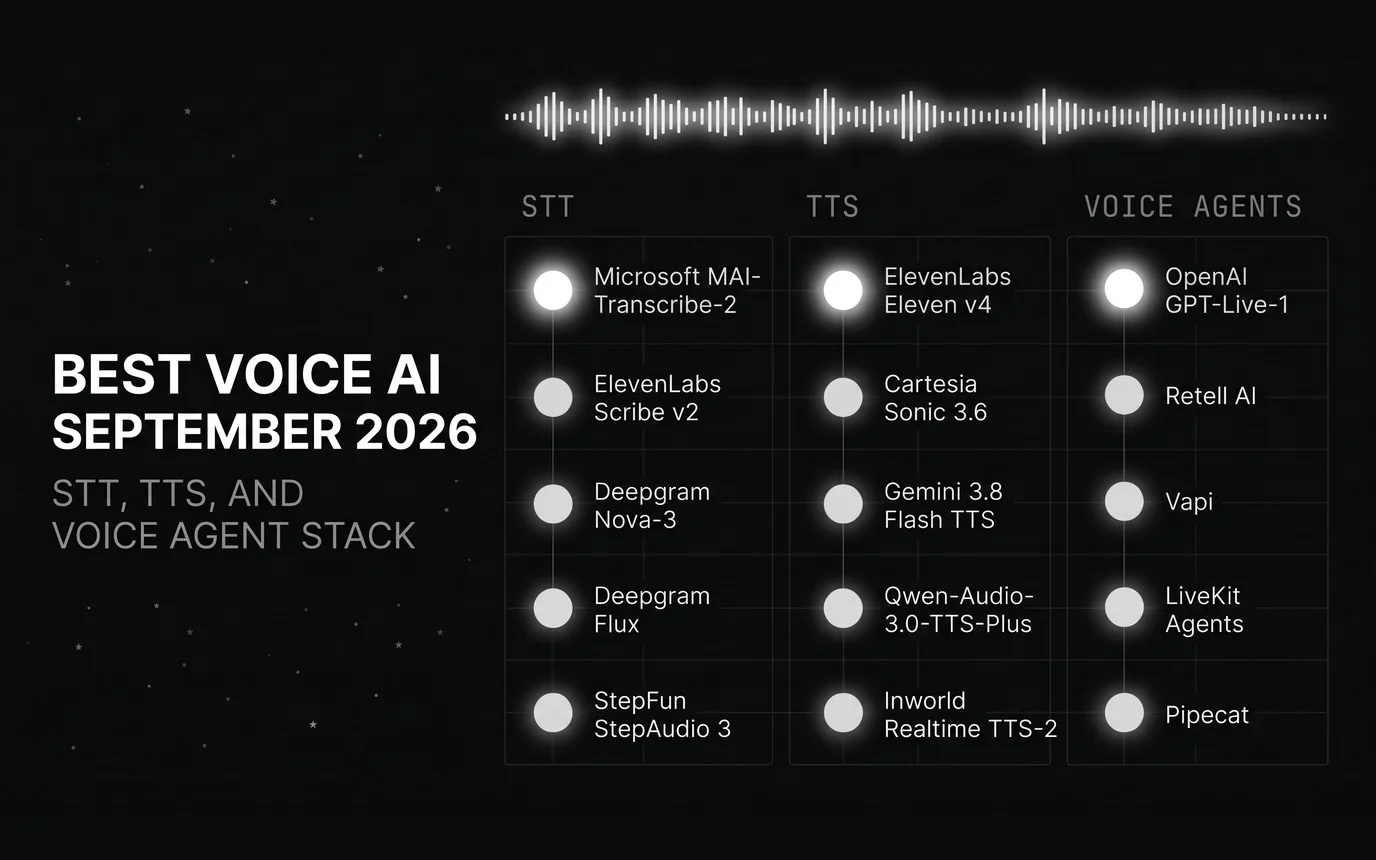
Table of Contents
By September 2026 the voice AI stack is an assembly of production-grade parts. Two releases reset the defaults this month. ElevenLabs shipped Eleven v4 and retook the text-to-speech crown on the Artificial Analysis Speech Arena at Elo 1316, and OpenAI put GPT-Live-1 full-duplex speech in the API at $0.05 per minute. This guide picks the components of a production voice agent, layer by layer, and the latency budget they have to fit.
TL;DR: Best voice AI per layer, September 2026
| Layer | Best pick | Why | Pricing |
|---|---|---|---|
| STT accuracy (major cloud) | Microsoft MAI-Transcribe-2 | 2.0% AA-WER, #2 on the board, 60 languages | $0.10/hr (limited-time thru 2026) |
| STT broad-language | ElevenLabs Scribe v2 | 2.2% AA-WER general, 90+ languages | Starter tier |
| Streaming STT (production) | Deepgram Nova-3 | 5.26% batch WER (vendor), streaming default | per-minute |
| Turn-taking detection | Deepgram Flux | End-of-turn p50 ~260ms | per-minute |
| STT board top | StepAudio 3 | 1.7% AA-WER board top, API-only, no open weights | StepFun API |
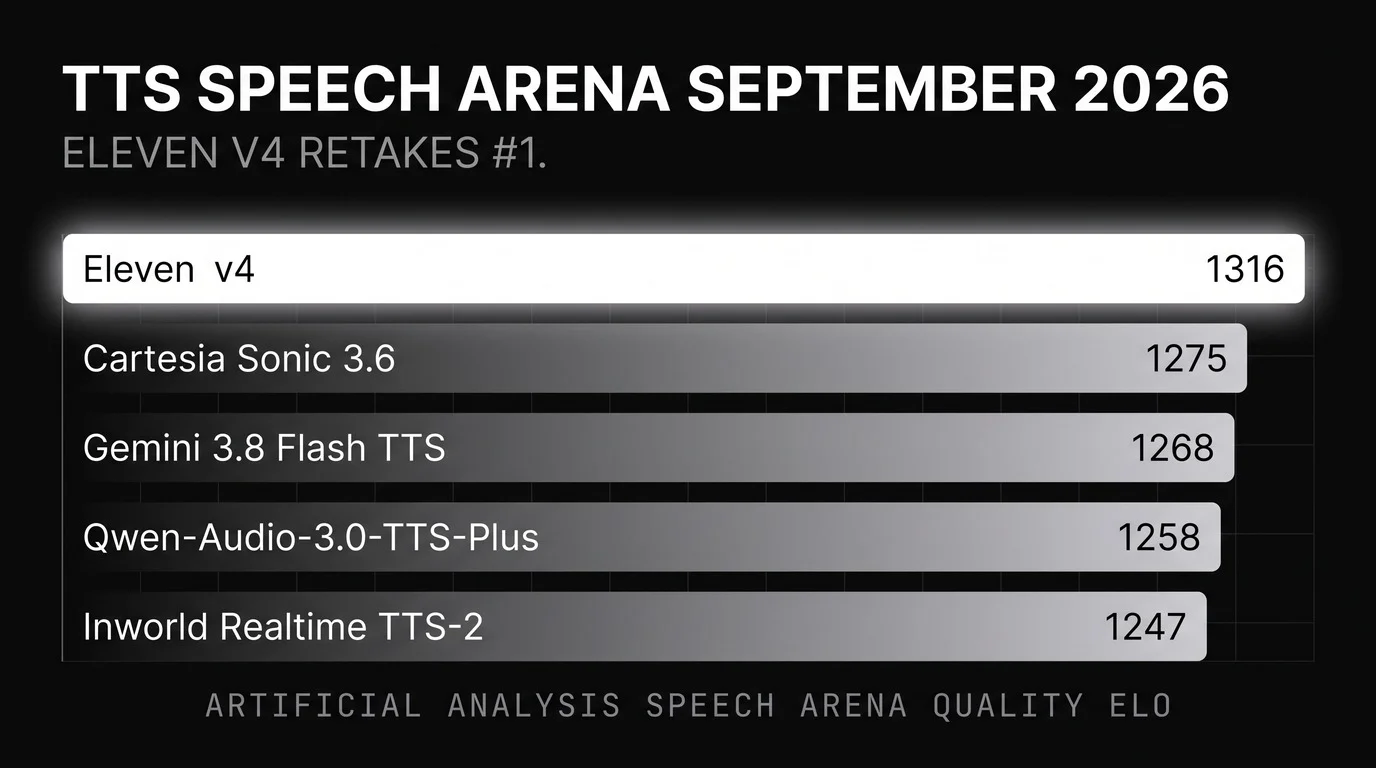
| TTS quality (independent) | ElevenLabs Eleven v4 | Speech Arena Elo 1316, #1, 90+ languages | per-character |
| TTS for real-time agents | Cartesia Sonic 3.6 | Elo 1275, sub-90ms class, 44 languages | per 1M characters |
| TTS board snapshot | Gemini 3.8 Flash TTS / Inworld Realtime TTS-2 | Elo 1268 / 1247 (board), verify | verify |
| Full-duplex speech-to-speech | OpenAI GPT-Live-1 | Handles speech; backend reasoning stays separate | $0.05/min voice + backend usage |
| Voice agent default (managed) | Retell AI | No-code builder, fastest managed setup | from $0.07/min |
| Voice agent at scale (BYO) | Vapi | Bring-your-own stack, $0.05/min platform fee | $0.05/min + passthrough |
| Open-source orchestration | LiveKit Agents / Pipecat | Apache-2.0 / BSD-2-Clause, self-host free | infra + providers |
| HIPAA requirements | Vapi | Confirm BAA coverage and eligible services | verify current add-on price |
| Open-weight STT baseline | Whisper large-v3 / Parakeet TDT v3 | ~7.4% / 6.34% WER, self-host | free (self-host) |
| LLM brain (low-latency) | Gemini 3.8 Flash / DeepSeek V4.1 Flash | Fast and cheap, keeps the loop tight | see the LLM guide |
| Transmission-delay reference | ITU-T G.114 | One-way transmission, not agent reply time | standard |
If you only read one row: For a classic pipeline, run Deepgram Flux for STT, ElevenLabs Eleven v4 or Cartesia Sonic 3.6 for TTS, a fast LLM such as Gemini 3.8 Flash for the brain, and Retell or Vapi to orchestrate. For full-duplex conversation, GPT-Live-1 handles speech at $0.05 per minute. Backend usage costs extra.
The story of voice AI in September 2026
Voice AI spent 2026 turning research demos into datasheet-grade parts, and September delivered two releases that reset the defaults rather than a slow month of leaderboard settling. One reclaimed a crown, the other removed a whole layer of the pipeline. Both change what a sensible default stack looks like going into the fourth quarter.
ElevenLabs shipped Eleven v4 on September 28 and retook #1 on the independent Artificial Analysis Speech Arena at Elo 1316. It covers 90+ languages, and the Turbo variant answers near 150ms on vendor timing, which keeps that quality inside a live-agent budget. Treat the Elo as a dated snapshot, since the board moves.
OpenAI put GPT-Live-1 in the API on September 10 as a full-duplex speech-to-speech model, billed at $0.05 per minute and metered per second. One model listens and speaks at once. Backend reasoning and tools stay separate and cost extra.
On measured accuracy, StepFun’s StepAudio 3 tops the Artificial Analysis board at 1.7% word error rate, available through the StepFun API with no open weights to self-host. Microsoft MAI-Transcribe-2 is close behind at 2.0%, released September 3 across 60 languages, and it is the most accurate option from a major cloud. Name the dataset with any word error rate, since Scribe v2 alone reads 2.2% general, 1.5% batch, and 5.1% streaming.
Compliance is a tier-and-contract question, so confirm it before you build. LiveKit offers a signed HIPAA BAA on its Scale tier at $500 per month and up, arranged through sales. Confirm Vapi’s current HIPAA add-on price and BAA terms. Confirm Retell’s current BAA terms and eligible services. Read each vendor’s current pricing page before you commit.
ITU-T G.114 covers transmission delay, not agent reply time. Budget turn detection, inference, first audio, and transport separately. Measure the complete loop at p50 and p95.
Best speech-to-text (STT) models in September 2026
Benchmark sources: non-streaming STT and streaming STT.
Speech-to-text splits by what binds you: raw accuracy on a named benchmark, streaming latency for turn-taking, or language breadth. The independent Artificial Analysis board is the cleanest cross-provider read, but it is a snapshot, and batch accuracy does not predict streaming behavior. Pick by your dominant constraint, then validate on your own audio.
Microsoft MAI-Transcribe-2. The major-cloud accuracy leader
The most accurate speech-to-text model from a major cloud in September 2026. MAI-Transcribe-2 posts 2.0% word error rate on the independent Artificial Analysis board, second only to StepFun’s API-only StepAudio 3, shipped September 3, and runs at an introductory $0.10 per hour that Microsoft frames as limited-time through the end of 2026.
Specs:
- WER: 2.0% on Artificial Analysis (independent)
- Languages: 60
- Pricing: $0.10/hr, limited-time introductory rate through end of 2026
- Released: September 3, 2026
Best for: Batch and near-real-time transcription where accuracy is the priority and the workload can ride the introductory rate.
Skip if: You need model-integrated turn detection in the same stack (use Deepgram Flux).
ElevenLabs Scribe v2. Broad-language accuracy
The pick when accuracy has to hold across many languages. Scribe v2 reads 2.2% word error rate on the Artificial Analysis general set, 1.5% on the AgentTalk batch set, and 5.1% streaming, so name the dataset every time you quote a number. It covers 90+ languages.
Specs:
- WER: 2.2% AA general, 1.5% AA-AgentTalk batch, 5.1% streaming (name the dataset)
- Languages: 90+
- Pricing: Starter tier and up
Best for: Accent-heavy or multilingual transcription where a wrong word cascades into a wrong action.
Skip if: You want the lowest WER from a major cloud (Microsoft MAI-Transcribe-2 at 2.0%).
Deepgram Nova-3. The streaming default
The default for any production agent that needs low-latency streaming transcription. Nova-3 reports 5.26% batch word error rate on Deepgram’s benchmark, closer to 6.84% streaming. For integrated turn detection, use Flux instead.
Specs:
- WER: 5.26% batch (vendor); 6.84% streaming (vendor)
- Latency: sub-300ms streaming class
- Pricing: per-minute pay as you go
- Use Flux instead when you need integrated turn detection
Best for: Production voice agents where end-to-end latency is the binding constraint.
Skip if: You want the lowest major-cloud WER (use MAI-Transcribe-2 or Scribe v2).
Deepgram Flux. The turn-taking layer
Flux handles transcription and turn detection. Deepgram documents about 260ms p50 end-of-turn latency at default settings. Test pauses and interruptions on your own audio.
Specs:
- Integrated transcription and end-of-turn detection
- End-of-turn p50 ~260ms at defaults (Deepgram documentation)
- Pricing: per-minute EN
Best for: Any turn-based production voice agent, where natural turn-taking separates a usable agent from one that interrupts.
Skip if: Your product is dictation or transcription only, with no turn-taking.
StepAudio 3. The board leader, API only
StepFun’s StepAudio 3 sits at the top of the Artificial Analysis board at 1.7% word error rate, below every major-cloud model. It is generally available through the StepFun API, but ships no open weights to self-host, so it fits a watchlist or an API trial more than a portable production dependency.
Specs:
- WER: 1.7% on Artificial Analysis (independent board top)
- Availability: generally available via the StepFun API; no open weights
- Pricing: check the exact API variant
Best for: Trialing the top board score through the StepFun API, or tracking the accuracy frontier on a watchlist.
Skip if: You need open weights to self-host, or a major-cloud SLA (use MAI-Transcribe-2 or Nova-3).
Best text-to-speech (TTS) models in September 2026
Text-to-speech optimizes three axes that rarely move together: quality, latency, and language breadth. September made the quality axis easy to call, because ElevenLabs retook the independent Speech Arena. Pick by the axis that binds your product, then confirm the current board live, since the Elo ordering shifts week to week.
ElevenLabs Eleven v4. The quality leader
The independent quality pick for September. Eleven v4 retook #1 on the Artificial Analysis Speech Arena at Elo 1316, covers 90+ languages, and ships a Turbo variant that answers near 150ms on vendor timing, which keeps that quality inside a live-agent budget.
Specs:
- Quality: Elo 1316, #1 on Artificial Analysis Speech Arena (independent)
- Languages: 90+
- Latency: Turbo variant ~150ms (vendor); higher on independent p50 streaming
- Released: September 28, 2026
- Pricing: per-character tier (verify current tier)
Best for: Branded and consumer voice where naturalness decides, with the Turbo variant when the same voice has to run inside a live turn.
Skip if: Sub-90ms time-to-first-audio is the binding constraint (use Cartesia Sonic 3.6).
Cartesia Sonic 3.6. The latency leader
The structural pick when round-trip latency binds. Sonic 3.6 reached general availability on August 27 (beta August 17), posts a sub-90ms time-to-first-audio class on vendor timing, sits at Elo 1275 on the board, and covers 44 languages.
Specs:
- Latency: sub-90ms class time-to-first-audio (vendor); higher on independent p50 streaming
- Quality: Elo 1275 (Artificial Analysis board)
- Languages: 44
- GA: August 27, 2026 (beta August 17)
- Pricing: per 1M characters
Best for: Sub-budget real-time agents and telephony where latency drives perceived call quality.
Skip if: Maximum quality on the independent board matters more than latency (use Eleven v4).
Board snapshot. Gemini 3.8 Flash TTS, Qwen-Audio-3.0-TTS-Plus, Inworld Realtime TTS-2
Three more models sit in the Speech Arena’s upper band and earn a watchlist, though their versions and pricing move, so verify each live before you commit. Google’s Gemini 3.8 Flash TTS reads Elo 1268, Alibaba’s Qwen-Audio-3.0-TTS-Plus reads Elo 1258, and Inworld’s Realtime TTS-2 reads Elo 1247 with an independent time-to-first-audio near 182ms.
Specs:
- Gemini 3.8 Flash TTS: Elo 1268 (board), streaming, verify version and price live
- Qwen-Audio-3.0-TTS-Plus: Elo 1258 (board), streaming, verify live
- Inworld Realtime TTS-2: Elo 1247 (board), TTFA ~182ms (independent), verify pricing live
Best for: Tracking the TTS frontier and A/B options behind the two leaders.
Skip if: You want a settled default today (use Eleven v4 or Sonic 3.6).
Best voice agent platforms in September 2026
If you would rather not wire STT, LLM, TTS, and orchestration by hand, the platforms below ship in days what a custom build ships in quarters. Compliance varies by tier and contract, so confirm the exact plan before you build: BAA coverage, eligible services, and extra fees need checking with each vendor.
OpenAI GPT-Live-1. Full-duplex speech-to-speech
GPT-Live-1 reached the API on September 10. It listens and speaks at once. Voice costs $0.05 per minute, billed per second. Backend reasoning and tools stay separate and cost extra.
Specs:
- Full-duplex speech-to-speech with separate backend reasoning
- Pricing: $0.05/min for voice, billed per second. Backend usage costs extra.
- Compliance: confirm BAA coverage for this exact service
- In-API: September 10, 2026
Best for: Teams that want full-duplex conversation without wiring separate STT and TTS.
Skip if: You need per-component control or a self-hosted stack (use Vapi, LiveKit, or Pipecat).
Retell AI. The managed default
The right default for most production voice-agent teams. Retell starts at $0.07 per minute and pairs a no-code builder with an SDK. Model, voice, telephony, and add-ons affect the total. Confirm BAA coverage and plan requirements with Retell before sending protected health information.
Specs:
- Pricing: from $0.07/min; total depends on model, voice, telephony, and add-ons
- Builder: no-code visual builder plus SDK
- Compliance: confirm current BAA terms and eligible services with Retell
- Latency: set by your chosen STT, LLM, and TTS; measure turn detection, inference, first audio, and transport
Best for: Most production voice agents that want a managed platform with a no-code builder and an SDK.
Skip if: You need bring-your-own components at volume (use Vapi) or a self-hosted stack (LiveKit or Pipecat).
Vapi. Bring-your-own at scale
The pick when you want to bring your own STT, LLM, and TTS and run at volume. Vapi charges a $0.05 per minute platform fee on top of provider passthrough, and HIPAA requirements need separate confirmation.
Specs:
- Pricing: $0.05/min platform fee plus providers at cost
- Bring-your-own STT / LLM / TTS
- Multi-channel: voice, plus SMS and chat
- Compliance: confirm current HIPAA add-on price and BAA terms
Best for: Teams that want component-level control, multi-channel deployments, and volume scale.
Skip if: You want managed setup rather than component-level control, or a self-hosted stack.
LiveKit Agents. Open-source orchestration at scale
The pick when you want to own orchestration and still get first-party adapters for every STT and TTS. LiveKit Agents is Apache-2.0 and free to self-host, with a managed cloud on top, and a signed HIPAA BAA is available on the paid Scale tier ($500/mo) and up, arranged through sales. Verify the exact tier on LiveKit’s pricing page before you harden it.
Specs:
- License: Apache-2.0 (self-host free)
- Cloud: roughly $0.01/min class, up to Scale and Enterprise
- Compliance: signed HIPAA BAA on Scale ($500/mo) and up, via sales (verify live)
- First-party adapters for major STT and TTS providers
Best for: Teams that want open-source orchestration with production infrastructure and a signed BAA on the Scale tier.
Skip if: You want a fully managed no-code platform (use Retell).
Pipecat. The open-source framework
The pick for a fully open, self-composed STT-LLM-TTS loop. Pipecat is BSD-2-Clause with a strong plugin ecosystem for Cartesia, Deepgram, ElevenLabs, and OpenAI, plus a managed Pipecat Cloud around $0.01 per minute.
Specs:
- License: BSD-2-Clause (framework free)
- Managed option: Pipecat Cloud around $0.01/min
- Plugin ecosystem across major STT / TTS / LLM providers
- Compliance: whatever your own deployment provides
Best for: Teams that want full control of orchestration code, retry logic, and barge-in handling.
Skip if: You want a managed platform to own reliability and on-call for you (use Retell or Vapi).
HIPAA tier matrix
Compliance is the cleanest differentiator across platforms, and the path to a signed BAA varies by tier and contract. This single matrix often decides the pick for regulated teams:
| Platform | HIPAA / signed BAA | Where it lands |
|---|---|---|
| Retell AI | Confirm current BAA terms | Check eligible services and plan requirements |
| Vapi | Confirm BAA and add-on terms | $0.05/min hosting; check any HIPAA fee |
| LiveKit Agents | On Scale and up, via sales | Scale tier ($500/mo); verify live |
| OpenAI GPT-Live-1 | Confirm coverage | Check the exact model and service in your signed BAA |
| Pipecat / self-host | Your own deployment | You own the compliance boundary |
Vendor latency vs independent benchmarks
Every TTS vendor publishes a best-case time-to-first-audio, and those numbers sit below what you measure in production. Independent p50 streaming latency runs meaningfully higher, so the vendor figure is a floor, not what your users hear.
On the STT side, self-reported WER also runs optimistic against the neutral Artificial Analysis index, and batch accuracy does not predict streaming behavior. Reproduce the numbers on your accents, your background noise, and your prompts before you commit.
End-to-end latency budget. The math
ITU-T G.114 covers transmission delay, not agent reply time. Agent replies also depend on turn detection, inference, and first audio. Measure the complete loop rather than applying transmission-delay bands to it.
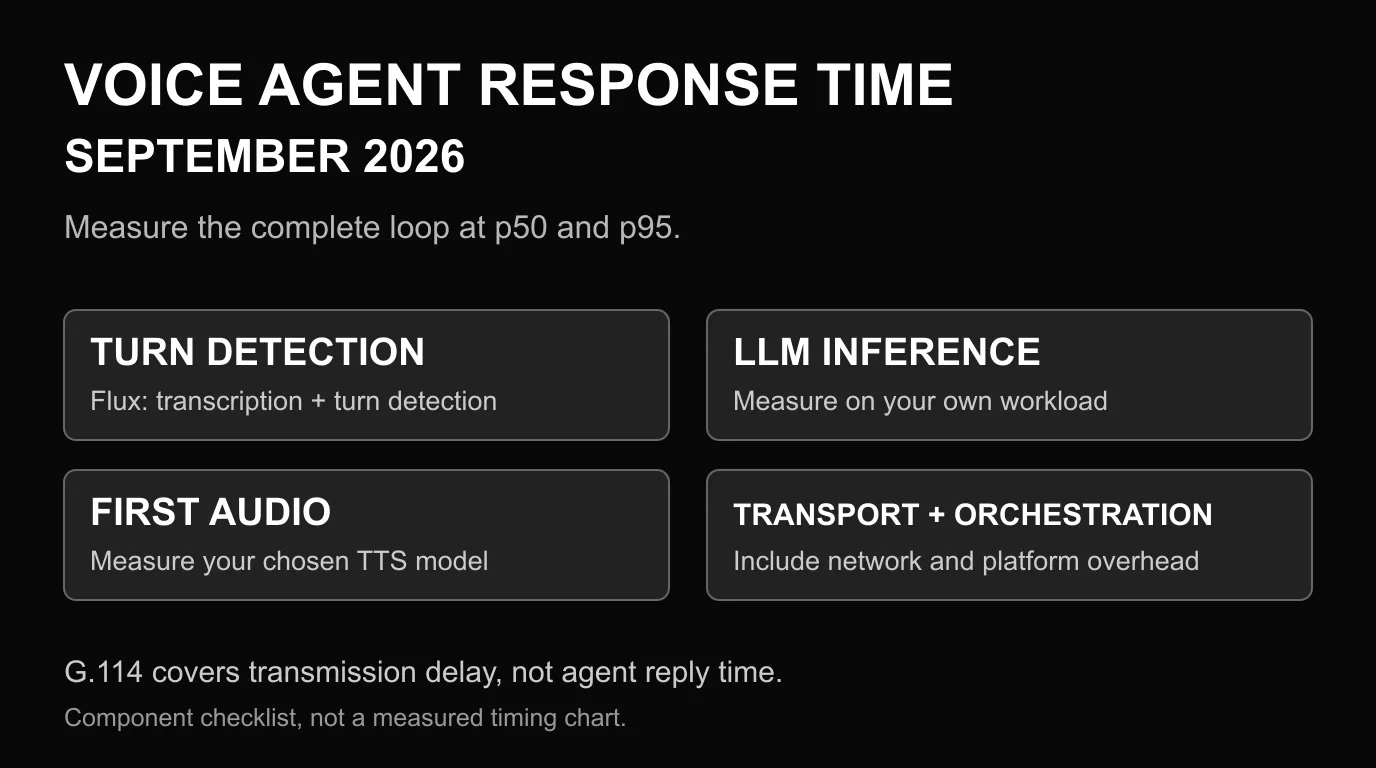
The component best-cases worth budgeting against are Eleven v4 Turbo near 150ms on vendor timing, Cartesia Sonic 3.6 in the sub-90ms class on vendor timing, Inworld Realtime TTS-2 at a 182ms independent time-to-first-audio, and Deepgram Flux at an end-of-turn p50 near 260ms at defaults (Deepgram documentation). Those are best-case component figures, not a round-trip, so no single round-trip millisecond belongs in a datasheet.
| Component | Best-case figure (source labeled) | Aggressive pick | Practical pick |
|---|---|---|---|
| STT + turn detection | Flux end-of-turn p50 ~260ms at defaults (Deepgram) | Deepgram Flux | Flux |
| LLM inference | Measure on your own workload | Gemini 3.8 Flash | DeepSeek V4.1 Flash or a fast frontier model |
| TTS first audio | sub-90ms (Sonic 3.6) to ~182ms (Inworld, independent) | Cartesia Sonic 3.6 | ElevenLabs Eleven v4 Turbo (~150ms) |
| Orchestration | tens of ms | platform-native | standard platform |
| Full-duplex alternative | speech session; separate backend reasoning | OpenAI GPT-Live-1 | GPT-Live-1 |
A classic pipeline sums STT, LLM, TTS, and orchestration, and independent p50 streaming latency runs higher than each vendor best-case, so measure the complete loop on your own calls.
GPT-Live-1 offers full-duplex speech with separate backend reasoning. Measure its complete response time on your own calls. For the LLM slot, a fast model keeps the loop tight; see the September LLM guide for the current low-latency picks.
Cost at scale: what 100K minutes/month actually costs
Per-minute list price hides the real production cost, and the September paths split into managed flat-fee, bring-your-own with passthrough, native full-duplex, and self-hosted with engineering load. The figures below start from verified per-minute rates, so treat them as component arithmetic rather than quotes:
| Stack | Pricing basis (verified) | Est. monthly (100K min) |
|---|---|---|
| Retell (managed) | from $0.07/min; total depends on model, voice, telephony, and add-ons | ~$7,000 base-rate floor; model, voice, telephony, and add-ons affect the total |
| Vapi (BYO + passthrough) | $0.05/min platform fee plus providers at cost | ~$5,000 platform + provider passthrough |
| OpenAI GPT-Live-1 (full-duplex) | $0.05/min voice, billed per second | ~$5,000 for voice, plus backend usage |
| LiveKit / Pipecat Cloud | ~$0.01/min class cloud | ~$1,000 cloud + provider passthrough |
| Self-host (LiveKit / Pipecat + providers) | Apache-2.0 / BSD-2-Clause framework free + passthrough | provider sum + engineering / on-call |
Retell is our default for managed setup. Choose Vapi or self-hosted orchestration when component control matters more. The cost crossover depends on provider charges, engineering time, and on-call costs.
GPT-Live-1 adds a $0.05-per-minute voice session, with backend usage billed separately. Compare the complete bill and response time against your classic pipeline.
Decision framework
Choose OpenAI GPT-Live-1 if:
- You want full-duplex conversation.
- The $0.05-per-minute voice rate suits your budget. Backend usage costs extra.
- You want a hosted voice layer connected to your backend reasoning and tools.
Choose Retell AI if:
- You are building most-team production voice agents.
- You want a managed platform with a no-code builder and an SDK.
- You want one vendor to own the STT, LLM, TTS, and telephony stack together.
Choose Vapi if:
- You want bring-your-own STT, LLM, and TTS control.
- You need multi-channel (voice, plus SMS and chat).
- You are running at volume and have confirmed any required HIPAA fees.
Choose LiveKit Agents or Pipecat if:
- You want permissive open-source orchestration (Apache-2.0 or BSD-2-Clause) with no platform fee.
- You are willing to own reliability, retries, and on-call.
- You need first-party adapters across many STT and TTS providers, or a signed BAA on LiveKit Scale.
Roll your own (Deepgram Flux, Eleven v4 or Sonic 3.6, plus a fast LLM) if:
- You need control over turn detection, inference, and first-audio latency.
- You have the engineering team to build and run orchestration.
- The managed platforms do not fit your specific stack.
Common mistakes when picking voice AI components in September 2026
-
Budgeting from vendor best-case latency. A sub-90ms vendor time-to-first-audio is a floor, and independent p50 streaming benchmarks land meaningfully higher. Budget from measured p50, not the datasheet.
-
Reading batch WER as streaming accuracy. Artificial Analysis reports both batch and streaming results. Scribe v2 alone reads 2.2% general, 1.5% batch, and 5.1% streaming, so name the dataset and validate streaming on your own audio.
-
Skipping turn-taking detection. Generic STT returns a transcript and stops. Without Flux or an equivalent end-of-turn layer, agents talk over users who pause or sit silent when they finish.
-
Treating the LLM as free latency. A 260ms STT paired with a 1,200ms LLM is not a fast agent. Pick a fast model for tight round-trips and measure the whole loop.
-
Assuming the board-topping number is portable. StepAudio 3 leads the STT board at 1.7%, but it is API-only with no open weights to self-host. Re-check the board live, and confirm the top score fits your infrastructure and SLA before you commit.
-
Reading HIPAA as one-size-fits-all. BAA coverage, eligible services, and fees vary by vendor. Confirm the exact tier before you build, not after.
How Future AGI fits
Voice agents fail in production for the same reasons text agents do: the transcript drifts on an accent, the LLM hallucinates a policy, the agent talks over a caller, or a tool call fires on the wrong turn. None of that shows up on a leaderboard, so the last step of any voice build is your own measurement loop. Future AGI is the layer voice teams wrap around the framework they already chose:
- Simulate generates voice scenarios (accents, background noise, interruptions, ambiguous phrasing) and replays them against your agent before you ship.
- Evaluate scores the transcripts and outcomes on Conversation Resolution and Task Completion for whether the call hit its goal, plus Groundedness, Tone, and Instruction Adherence on what the agent said, documented in the evaluation docs.
- Agent Command Center applies runtime guardrails that can block a bad output inline, before a policy breach reaches the caller.
- Observability traces live calls with OpenTelemetry-native instrumentation, so a failing turn surfaces as a scored span rather than a support ticket.
- Optimize turns your eval and production data into prompt and policy improvements you test against a regression set before promoting them.
The core is Apache-2.0 and self-hostable via Docker Compose at no license cost, and the repo is the place to start. Future AGI is a companion to GPT-Live-1, Vapi, Retell, LiveKit, and Pipecat, not a competitor on the voice-framework axis. For a deeper look at scoring a voice stack, see voice AI evaluation.
September settled into two resets rather than a slow drift: ElevenLabs retook the TTS crown at Elo 1316, and OpenAI’s GPT-Live-1 turned full-duplex speech into a $0.05 per minute API call. Every layer now has at least two production-grade options, and a signed BAA is available across the managed platforms if you confirm the tier, so the decision is which budget and constraint you are optimizing, rather than whether a layer works.
Treat the voice agent as a latency, cost, and reliability system. Decide full-duplex against a classic pipeline first, shortlist each layer by its binding constraint, wire the path, then measure real p50 and p95 on your own accents and noise before you ship. That measurement loop, not the leaderboard row, is what turns September’s parts into an agent that holds up on a live call.
See also: Best LLMs of September 2026 for the LLM brain in your voice agent. Previous voice post: Best Voice AI of August 2026.
Frequently Asked Questions
What is the best voice AI in September 2026?
What is the best text-to-speech AI?
What is the best AI voice generator?
What is the best speech-to-text API?
What is the best voice AI platform for agents?
Is ElevenLabs the best AI voice?
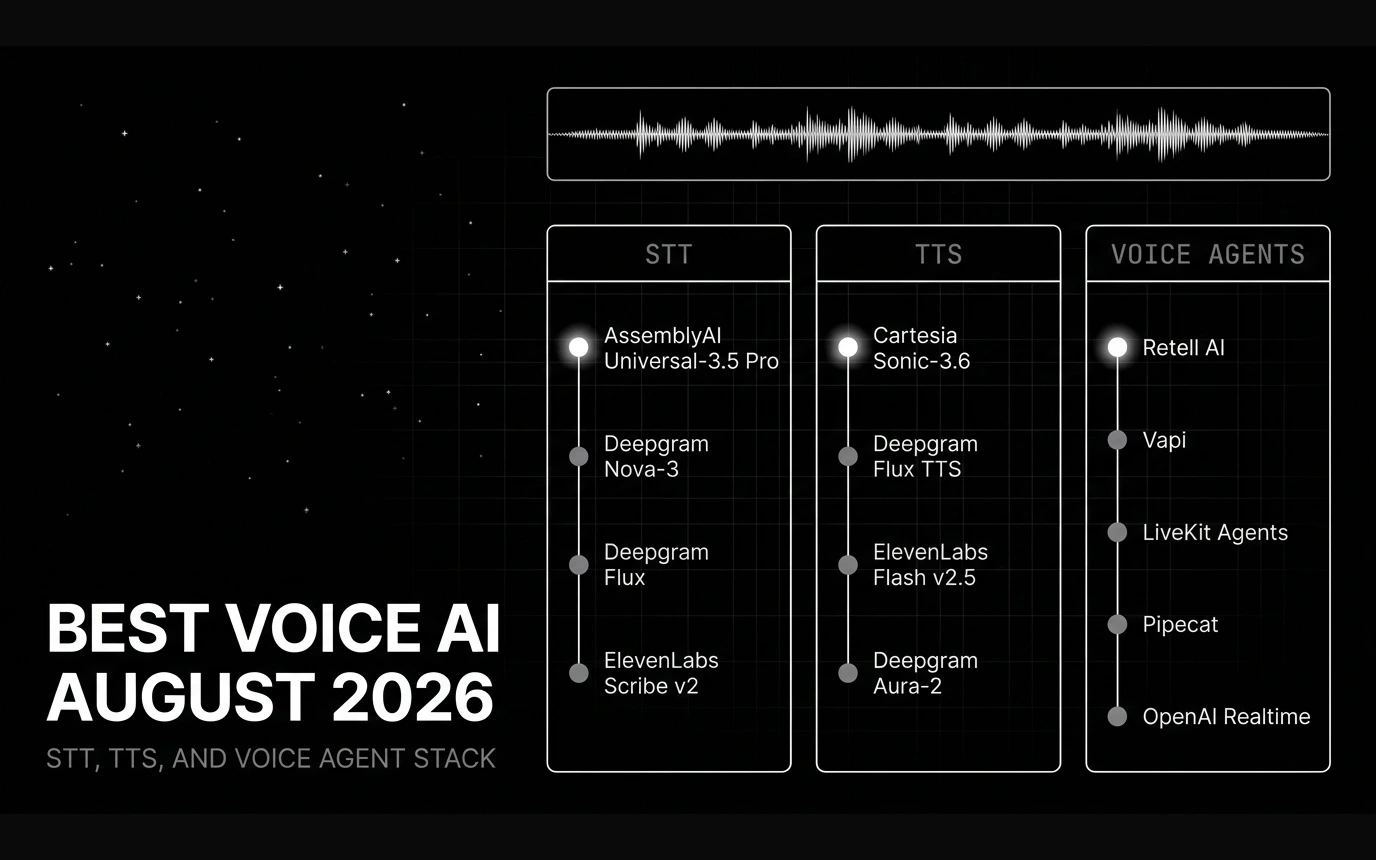
August 2026 voice AI picks: Cartesia Sonic-3.6 tops both speech arenas, Deepgram Flux TTS ships sub-100ms, free through September, plus the STT and agent stack.

Best TTS APIs in May 2026: Cartesia Sonic 4 at 40ms, ElevenLabs v3, Deepgram Aura-2, Hume Octave, plus pricing, latency, and the right pick by use case.
Best STT APIs in May 2026: Deepgram Nova-3 + Flux, AssemblyAI Universal-2, Whisper, ElevenLabs Scribe v2 with WER, latency, and pricing compared.