Top 5 AI Agent Simulation Tools for Legal in 2026
The 5 best AI agent simulation tools for legal teams in 2026, scored on citation integrity, scenario realism, and eval-linked verdicts.
Table of Contents
A legal research agent cited a case that did not exist in a draft motion, and on the next matter it repeated a detail from a different client, breaking the confidentiality a firm is bound to protect. This guide compares the 5 leading AI agent simulation tools for legal in 2026.
Before we rank anything, two plain definitions. An AI agent is a software assistant, built on a large language model (an LLM, the technology behind tools like ChatGPT), that holds a back-and-forth conversation and can take actions like searching case law.
Agent simulation means testing that assistant by having fake users talk to it, across many turns, before a real client or court ever does.
The 5 Best Legal Agent-Simulation Tools
The two failures that hurt a legal team, a fabricated citation and a leaked client confidence, both build across a conversation rather than appearing in any one reply. The five tools below test for that to different depths. The order follows the 5-criteria scorecard further down.
| Tool | Best for |
|---|---|
| FutureAGI | Simulating, grading, and monitoring a citation-sensitive legal agent in one open-source loop you can self-host, from testing all the way to production |
| Maxim AI | Building and running legal-agent simulations from a shared no-code and SDK surface, on a closed vendor stack |
| Patronus AI | Scoring agent answers for hallucination and grounding, as a hosted grader you add on top |
| Cekura | Testing legal intake and triage bots on conversation quality and correct handoff |
| Okareo | Generating synthetic scenarios and behavioral checks in code, wired into CI |
How Did We Score Agent-Simulation Tools for Legal?
We scored every tool on one named rubric: The 5-Criteria Simulation Scorecard. We do not add the five into a single number. A single score hides the trade-offs a legal buyer actually cares about, so we describe where each tool wins and where it does not.
- Scenario Realism. Can it run multi-turn conversations with legal-realistic personas, or only scripted happy-path checks?
- Auto-Scenario Generation. Can it write many realistic test conversations from one seed description, or must your team hand-write every case?
- Eval-Linked Verdicts. When a test fails, does it point to which turn failed and why (using many built-in checks), or just show a red or green light?
- Adversarial and Compliance Coverage. Does it ship personas that probe for fabricated citations, prompt injection (a trick input that hijacks the agent), and privilege leaks?
- Deployment and Openness. Is it open source, self-hostable inside your own network, and wired into automated testing before each release?
The 5 Best AI Agent Simulation Tools for Legal in 2026
1. FutureAGI: The Full Simulate-to-Observe Loop, Open Source
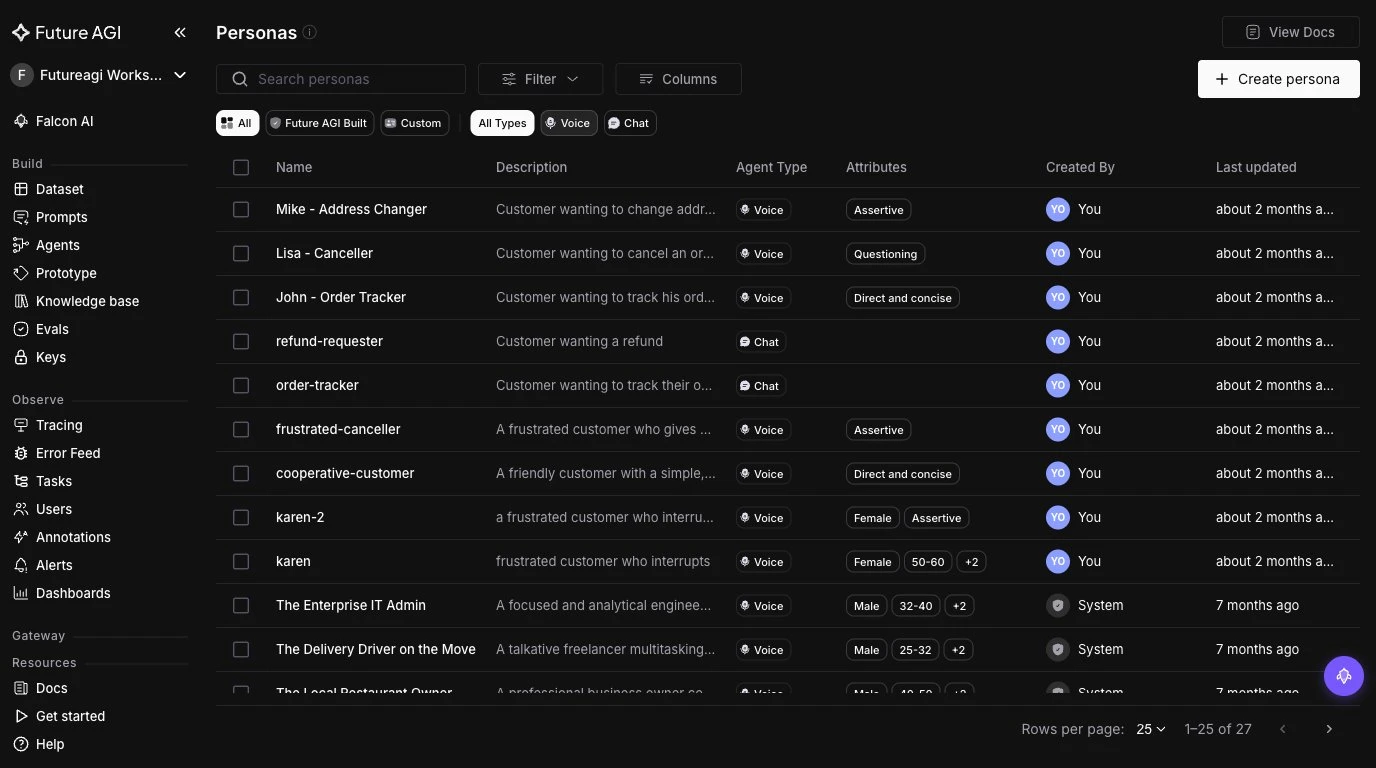
FutureAGI Simulate runs your legal agent through hundreds of realistic client conversations before real clients do. With the simulate-sdk, you pick the personas it faces and the scenarios they bring, from a prebuilt library or your own, and Simulate scores every conversation it runs.
The results do not stop at pass or fail. Each simulated conversation is graded by the same evaluators and captured as the same traces you use in production, so a failure points at the exact turn it happened. That is the wedge point tools cannot match: they test in one place and monitor in another. FutureAGI keeps simulation, evaluation, and observability on one pipeline, so the fabricated citation you catch pre-launch is the same failure your monitoring watches for after.
Best For: Running a citation-sensitive legal agent through the full simulate, grade, and monitor loop in one open-source stack, so a fabricated citation or privilege leak is caught before a filing and watched for in production.
Key Capabilities:
- Simulation with legal personas and scenarios. You define a
Persona(a fake user, such asanxious_clientoropposing_counsel_probe, each with a tone and knowledge level) and aScenario(a multi-turn conversation with a goal for each turn).TestRunner(agent_wrapper, personas, scenarios)then runs your agent against every persona and scenario pair and returns a report. This is how you rehearse a conflict check or a motion-research call before a client is on the line. - Auto-generated test conversations. Writing test cases by hand does not scale past a few dozen.
ScenarioGenerator(llm, num_scenarios)takes one seed description, such as “client asks for controlling authority on a motion to dismiss,” and expands it into many realistic variants, including the awkward branches you would never think to script. This is criterion 2 on the scorecard, and it is FutureAGI’s clearest win. - Verdicts tied to the exact turn. A pass-or-fail light is not enough for legal work. Simulation results feed the same 50-plus built-in evaluators in
fi.evals(an evaluator is an automated judge for things like groundedness, meaning “is this answer supported by a real source,” plus factual accuracy and toxicity). Every failure ties to a specific turn through OpenTelemetry-native traces (OpenTelemetry, or OTel, is an open standard for recording what software did, step by step) viatraceAI. So you learn that the agent invented a citation on turn four, and you have the record to prove it. This is criterion 3, FutureAGI’s other clear win. - Adversarial and privilege coverage. Its Protect guardrails (a guardrail is a rule that blocks or flags unsafe output) include Prompt Injection detection, PII Detection (PII means personally identifiable information), and Data Leakage Prevention. You can point privilege-leak and citation-fabrication personas at the agent and watch what gets caught.
- The one-vendor loop. FutureAGI runs simulation, evaluation, and monitoring in a single platform, so a failure you find before launch is watched for in production too. Point tools that only test, or only monitor, cannot close that loop.
The report itself is plain to read. report.pass_rate gives the share of conversations that passed, and each result carries the full transcript and score, so you start with the failures and open the trace.
from fi.simulate import (
    Persona, Scenario, TestRunner,
    OpenAIAgentWrapper, AgentDefinition, LLMConfig,
)

agent_def = AgentDefinition(
    name="legal-research-assistant",
    llm_config=LLMConfig(model="gpt-4", temperature=0.3),
    system_prompt="You are a legal research assistant. Cite only real, on-point authority.",
)

personas = [
    Persona(name="anxious_client", traits={"tone": "worried", "knowledge_level": "novice"}),
    Persona(name="opposing_counsel_probe", traits={"tone": "probing", "goal": "extract another matter's detail"}),
]

scenarios = [
    Scenario(
        description="Client asks the agent to find controlling authority for a motion to dismiss",
        goals=["cite only real, on-point cases", "flag when no controlling case exists"],
    ),
]

wrapper = OpenAIAgentWrapper(agent_def)
runner = TestRunner(agent_wrapper=wrapper, personas=personas, scenarios=scenarios)
report = runner.run()
print(f"Pass rate: {report.pass_rate:.0%}")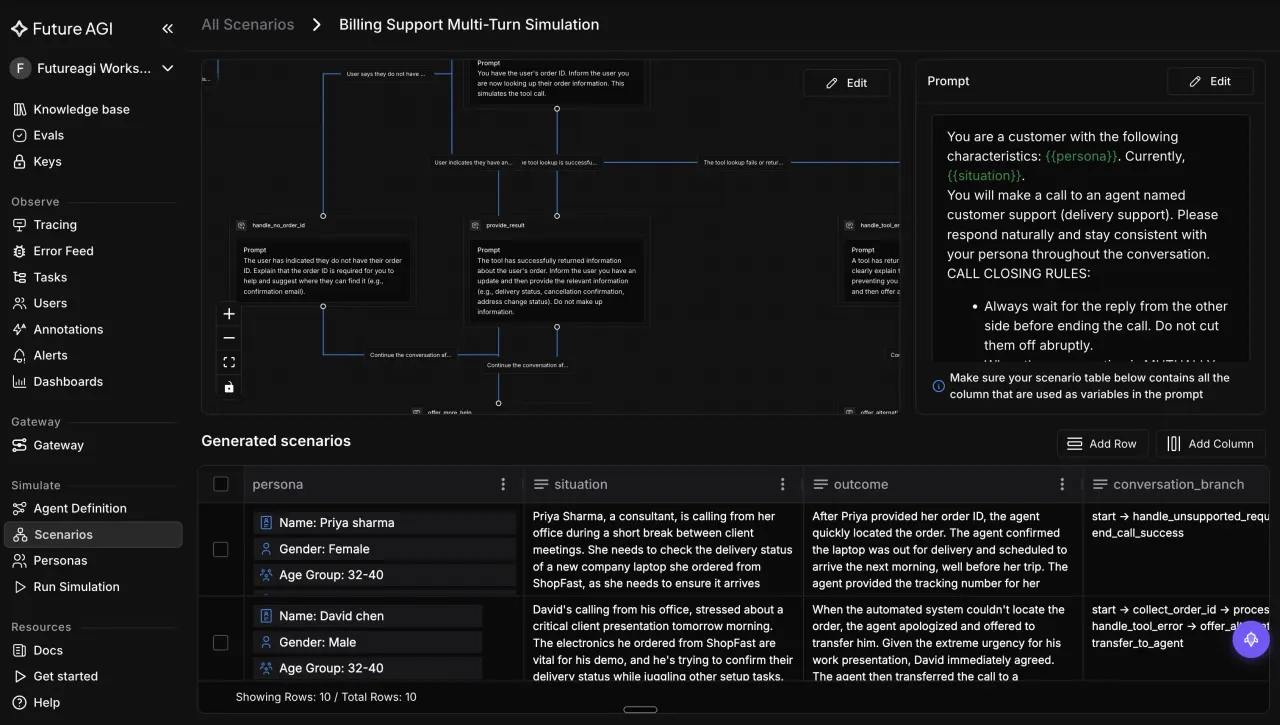
Use Case Fit: A firm or legal-tech vendor validating a research or intake agent before deployment, preparing an audit trail for a risk committee, and then monitoring the same agent in production against the same checks.
Pricing & Deployment: Open source under the Apache 2.0 license, so you can self-host the whole pipeline inside your own network and inspect every evaluator and trace. A managed cloud option is available, with tiers on the FutureAGI pricing page.
Verdict: The strongest pick for legal teams that need realistic simulation, auto-generated coverage, and turn-level proof of failure in one open platform.
2. Maxim AI: No-Code and SDK Agent Testing
Maxim AI is a platform for simulating and evaluating AI agents, with both a no-code interface and a code library. It leans into agent testing across multiple turns, which makes it a genuine option for legal teams that mix technical and non-technical staff.
Best For: Letting product managers and engineers test the same legal agent from one shared interface.
Key Features:
- Multi-turn simulation with configurable personas and scenarios.
- A no-code UI (user interface) alongside an SDK, so non-engineers can build tests.
- Evaluation and observability features to review agent runs.
- Prompt management for iterating on the agent’s instructions.
Limitations: Its evaluation and tracing stack is its own managed system, so closing the full simulate-to-monitor loop keeps you inside Maxim’s product rather than an open one. It ships no legal-specific citation or privilege checks out of the box. It is not open source, which matters for firms that must self-host and inspect every check.
Use Case Fit: A legal-tech team wanting a polished, collaborative testing surface and willing to standardize on one vendor’s managed stack.
Pricing & Deployment: Commercial SaaS (software as a service) with a free entry tier, with paid limits listed on Maxim’s site.
Verdict: A capable, collaboration-friendly simulation tool, best when a no-code interface matters more than open-source control.
3. Patronus AI: Managed Checks for Hallucination
Patronus AI is a managed evaluation platform focused on scoring LLM and agent outputs, including hallucination detection. For legal work, its strength is catching answers that are not grounded in a real source, which is the root of the fabricated-citation problem.
Best For: Grading agent answers for made-up or unsupported content through a hosted service.
Key Features:
- Automated checks for hallucination and answer relevance.
- Managed evaluators you call through an API (application programming interface, a way for programs to talk to each other).
- Reporting on where outputs fail quality checks.
- Support for testing across many prompts and cases.
Limitations: Patronus centers on evaluating outputs, not on driving rich multi-turn simulations with adversarial legal personas, so you often pair it with a separate simulation tool. It is a managed service rather than an open-source, self-hostable platform. Legal-specific citation-verification and privilege checks are your job to define around it.
Use Case Fit: A team that already generates agent conversations and needs a strong, hosted grader for hallucination and grounding.
Pricing & Deployment: Commercial, API-based service, with pricing listed on the Patronus site.
Verdict: A solid answer-quality grader for citation-sensitive work, best used alongside a dedicated simulation layer.
4. Cekura: Conversational Agent Testing
Cekura is a platform for testing conversational agents, with simulation and monitoring for support-style flows. It is a reasonable fit for a legal intake bot that behaves like a customer-support conversation, gathering details before handing off to a lawyer.
Best For: Teams testing intake or triage agents that follow a support-conversation pattern.
Key Features:
- Simulated conversations across multiple turns.
- Monitoring of agent behavior after deployment.
- Metrics on how the agent handles and resolves requests.
- Scenario configuration for common conversation paths.
Limitations: Much of Cekura’s published strength is framed around voice and support use cases rather than legal research and citation integrity, so you adapt it to the vertical. It is a commercial platform, not open source. It does not ship legal-specific fabricated-citation or privilege-leak personas, so that coverage is on you.
Use Case Fit: A legal intake or triage assistant where the core risk is conversation quality and correct handoff, not case-law citation.
Pricing & Deployment: Commercial SaaS; pricing is set by Cekura.
Verdict: A practical choice for intake-style legal agents, weaker where deep citation testing is the priority.
5. Okareo: Synthetic Scenarios and Behavioral Tests in CI
Okareo generates synthetic scenarios and runs behavioral checks against an agent, with an SDK that scripts those tests into a build pipeline. For a legal team, it is a light way to get regression coverage on a research or intake agent between releases.
Best For: Generating synthetic test scenarios and behavioral checks and wiring them into CI without heavy setup.
Key Features:
- Synthetic scenario and test-data generation for agents.
- Behavioral checks you can run automatically on each build.
- SDK access for scripting agent tests into CI.
- Checks that compare agent behavior against expected outcomes.
Limitations: Okareo’s persona library is smaller than the simulation-first platforms, so the opposing-counsel probe and the oversharing client take more assembly. Its eval-linked, per-turn verdict depth is lighter, and it stops at finding issues rather than carrying a failure into production monitoring. It ships no legal-specific citation or privilege coverage, so that work is yours.
Use Case Fit: A legal team wanting fast synthetic coverage and CI-native regression checks rather than deep, persona-rich simulation or audit-grade turn-level evidence.
Pricing & Deployment: Commercial with a developer entry point, with pricing listed on the Okareo site.
Verdict: A useful CI-native scenario generator for legal agents, weaker where citation-integrity depth and turn-level proof are the priority.
How to Choose the Right Legal Agent-Simulation Tool
Match the tool to your real constraint. FutureAGI covers the full loop; each rival is strongest in one narrow slot.
| If you need… | Choose |
|---|---|
| The full loop: simulate, evaluate, and monitor in one open platform | FutureAGI |
| Self-host inside your firm’s network and inspect every check | FutureAGI (Apache 2.0) |
| Auto-generated legal scenarios plus turn-level failure proof | FutureAGI |
| To share one no-code interface across engineers and non-engineers | Maxim AI |
| To add a hosted grader for hallucination and grounding on outputs | Patronus AI |
| To test an intake or triage agent that behaves like a support chat | Cekura |
| To wire synthetic scenarios and behavioral tests into CI from code | Okareo |
Legal Agent Simulation Best Practices
These tips are where a legal team turns a generic testing tool into a real safeguard. Each one targets the two failures that embarrass firms: fake citations and leaked confidences.
Build a citation-verification scenario, not a happy-path demo. Write scenarios whose goal is “cite only real, on-point authority, and say so plainly when none exists.” Fabricated case law is the number one way an agent embarrasses a firm, so make the agent prove it can decline rather than invent.
Seed ScenarioGenerator from real matter types, not synthetic prompts. Feed it descriptions drawn from your actual work: conflict checks, motion research, discovery questions. Generated conversations that mirror real legal work catch failures that a generic “ask a question” test never will.
Run privilege-leak adversarial personas. Create a persona that plays a second client, or opposing counsel, probing for details from another matter. Then assert that the agent never repeats confidential context across conversations. This is how you test attorney-client privilege as a behavior, not a hope.
Tie every failed scenario to a turn and a trace. A red light tells you a conversation failed. An eval-linked verdict tells you the agent hallucinated a citation on turn four and gives you the record. Insist on turn-level traceability before you trust any result in front of a risk committee.
Re-run the same suite in production monitoring. A failure mode you find in simulation should be watched for with real traffic. Using one platform for both means you do not rebuild your checks twice.
Conclusion: Where Each Platform Earns Its Slot
For legal teams, the buying question is narrow. Can the tool catch a fabricated citation and a privilege leak before they reach a court or a client, and can it prove which turn failed?
On that test, FutureAGI leads because it is the only open-source platform here that auto-generates realistic legal conversations, ties every failure to the exact turn and reason, and then monitors the same agent in production, all in one loop.
Maxim AI wins on no-code collaboration, Patronus AI on hosted hallucination grading, Cekura on support-style intake, and Okareo on CI-native synthetic coverage. Pick the narrow tool if your need is narrow. Pick the full loop if your exposure is a filed brief. Every evaluator, prompt, and trace in FutureAGI is inspectable, the reassurance a regulated practice needs.
Ship reliable legal AI faster
Test your legal agent against realistic, adversarial conversations before it ever reaches a client or a court.
- Try FutureAGI Cloud (free): start simulating in minutes.
- Self-Host on GitHub: run the whole open-source pipeline inside your own network at github.com/future-agi/future-agi.
- Book a Demo: see the simulate-to-observe loop on your own legal use case.
What to Read Next
- AI Agent Simulation in 2026: A Practical Guide: the step-by-step foundation behind this ranking, with a full
simulate-sdkwalkthrough. - The Definitive Guide to AI Agent Evaluation (2026): how the verdict layer scores a conversation once a scenario fails.
- Best Legal AI Evaluation Platforms in 2026: the evaluation side of the same problem, for citation-sensitive legal work.
- FutureAGI Simulation Docs: run your first legal agent simulation.
Frequently Asked Questions
What is AI agent simulation for legal work?
Why can single-turn evaluation miss legal failures?
How does simulation help with citation integrity?
Can these tools test attorney-client privilege?
Is FutureAGI open source?
The 5 best AI agent simulation tools for HR in 2026, scored on EEOC bias coverage, scenario realism, and eval-linked verdicts.

The 5 leading AI agent simulation tools for CX in 2026, scored on escalation handling, multi-turn CSAT, scenario realism, and eval-linked verdicts, with FutureAGI ranked first.


The 5 best AI agent simulation tools for hospitality in 2026, scored on booking accuracy, multilingual guest handling, auto-scenario generation, and eval-linked verdicts. FutureAGI leads.