AI Agent Registry: Architecture, Discovery, and Governance
An AI agent registry records each agent's owner, live version, evaluation and status. See a 14-field schema, lifecycle gates, card discovery and cloud options.
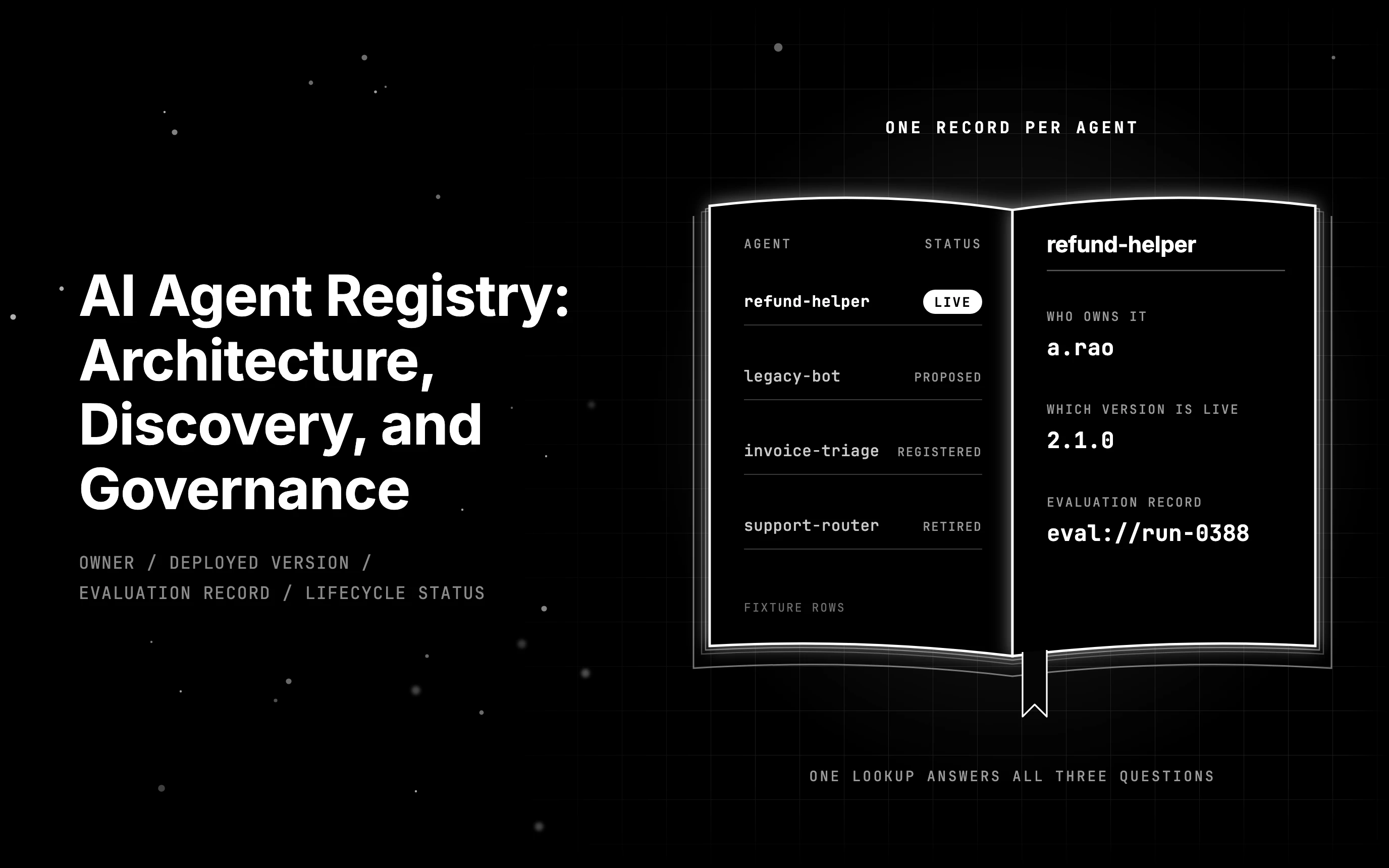
Table of Contents
An illustrative scene, not a real incident: a payments engineer notices an agent named refund-helper calling the refunds API from a service account. Its launch channel is archived and its builder has moved teams. Nobody can say who owns it, which version is serving or whether that version passed an evaluation.
An AI agent registry is a catalog that keeps one record per agent: its owner, deployed version, evaluation pointer and lifecycle status. It stays apart from the identity, deployment and policy systems that act on those facts, so one lookup answers all three questions.
The post builds a 14-field schema, six gated lifecycle states and card discovery with drift checks. It then shows where enforcement lives, dated cloud and open-source options and a four-step retirement, with Python and gateway code tested end to end on 2026-11-20.
TL;DR
- An AI agent registry is the record of every agent’s owner, deployed version, evaluation and lifecycle status, kept apart from the systems that enforce access.
- Key each entry on an id the registry assigns and store fourteen fields, including the agent card URL, the data access class and an evaluation record pointer.
- Six lifecycle states with one gate per move keep unowned or unevaluated agents from going live and block retirement while traffic still flows.
- A2A agent cards feed discovery, and ETag plus version checks flag cards that changed, drifted from the deployed version or stopped answering.
- AWS, Google and Azure API Center ship generally available registries that take A2A agent cards, Microsoft 365 admins get the Agent 365 registry, and two Apache-2.0 projects cover self-hosting.
When a team needs an AI agent registry
You need an AI agent registry once nobody can answer three questions about an agent from one place: who owns it, which version is live and whether that version passed an evaluation. That point arrives when agents ship from several teams, frameworks and clouds, and the shared spreadsheet stops matching production.
Each gap has a price: an unowned agent keeps its credentials after its builder leaves, an unknown live version leaves an incident unanswerable, and an unevaluated release reaches users. The usual signs are a months-old spreadsheet and teams asking who owns an agent.
Prompt versioning is a separate job, covered in how teams version prompts.
An agent inventory schema with fourteen fields
An agent inventory schema needs fourteen fields that cover identity, ownership, what runs, where it runs, what it touches and where it stands. Each row is one agent keyed on an id the registry assigns, so the record follows the same agent across versions.
The A2A AgentCard has no id field, and an open A2A proposal for a stable agent id states that “agent_card.name is not guaranteed unique and is prone to branding changes.” Discovery refreshes the name and URLs, never the owner, status or evaluation pointer. Table 1 lists the fields.
| Field | What it holds | Set by | Checked by the sample gates |
|---|---|---|---|
| agent_id | stable id the registry assigns | registry | key |
| name | display name, refreshed from the card | discovery | no |
| owner | named person | team lead | registered and live |
| team | owning team | team lead | no |
| purpose | one-line job | owner | registered |
| deployed_version | version serving traffic | deployment record | live |
| endpoint | base URL | discovery | live |
| agent_card_url | where the card is read | discovery | no |
| dependencies | models and tools it calls | owner | no |
| data_access_class | highest data class it touches | security review | no |
| evaluation_record | pointer to the experiment or CI result | evaluator | evaluated and live |
| risk_tier | low, medium or high | security review | no |
| lifecycle_status | one of six states | registry gates | every move |
| last_review_date | date of the last status change | registry | written on every allowed move |
Owner, deployed version and evaluation record
The live gate in registry.py checks these three fields plus endpoint. owner names a person and team names the group, so ownership survives one departure. deployed_version is the version serving traffic, compared with the card version whenever a re-read returns a new card. evaluation_record holds a pointer, such as an experiment or CI result URL, never the scores. The sample checks only that the pointer exists. CI or the operator must verify a passing evaluation for the current version and endpoint before setting it.
Lifecycle states from proposed to retired
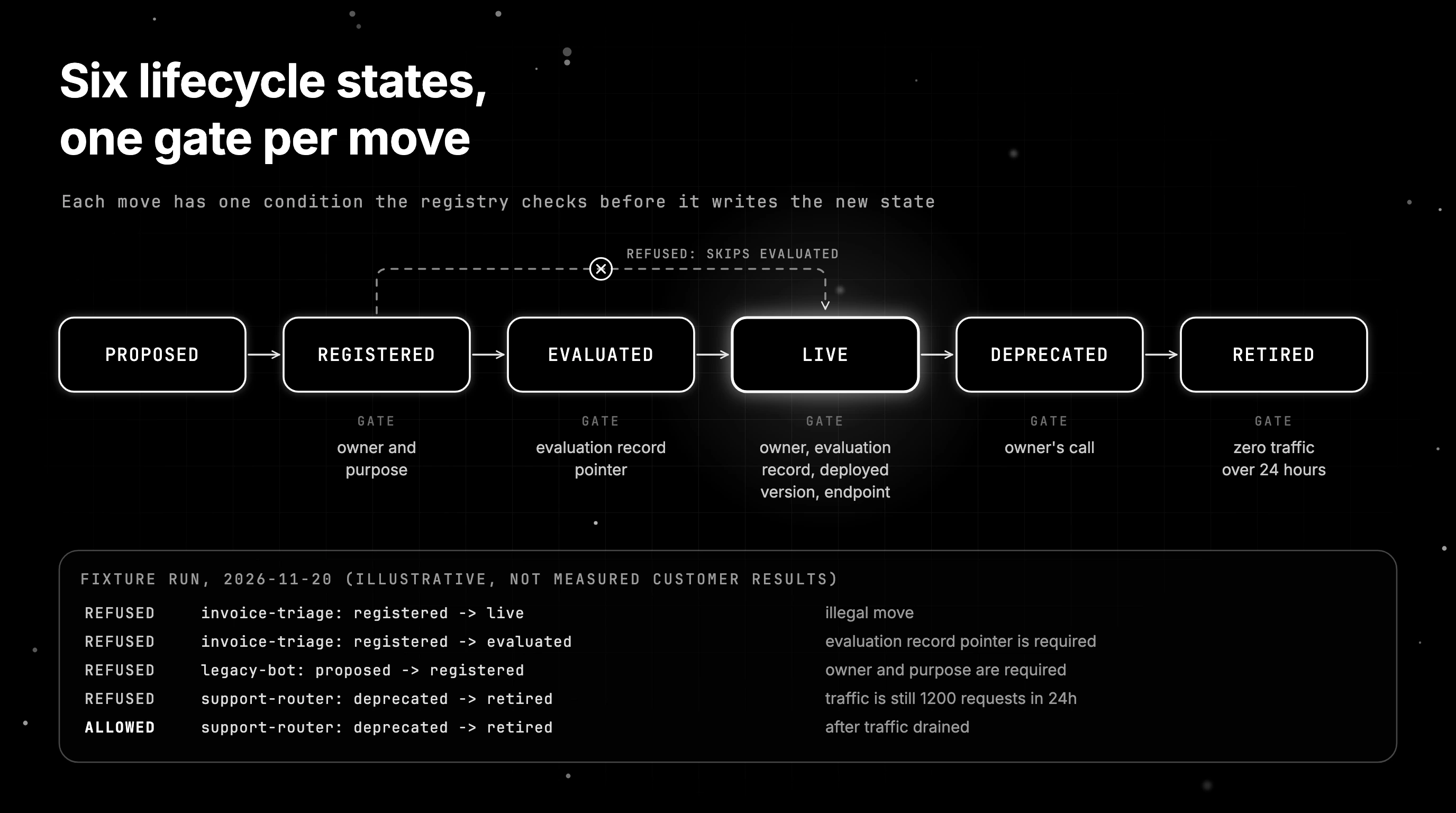
A registry entry moves through six states: proposed, registered, evaluated, live, deprecated and retired. Each move has one condition the registry checks before it writes the new state, and an entry only steps forward, so a release cannot jump from registered to live without an evaluation record on file.
Registering needs an owner and a purpose; evaluated needs an evaluation record pointer; live needs owner, evaluation record, deployed version and endpoint. Deprecation is the owner’s call. Retired needs zero traffic over 24 hours, counted outside the registry. Every decision is logged with time, both states, verdict and reason.
Four moves the sample registry refused
registry.py uses only the Python standard library, with sqlite3 for storage. Its lifecycle command runs a scripted sequence on four synthetic fixture rows (illustrative, not measured customer results), and its check command re-reads every card. It is tested end to end with Python 3.12.5 on 2026-11-20.
"""Agent registry sketch: Python standard library only (sqlite3, urllib).

All agent rows below are synthetic fixture data, not real systems. The registry records
governance metadata; traffic comes from a separate source (a fixture function here) and
credentials, deployment and policy are enforced by other systems.

Usage:
  python registry.py lifecycle                      # scripted lifecycle run on fixture rows
  python registry.py discover DB AGENT_ID BASE_URL DEPLOYED_VERSION OWNER
  python registry.py check DB                       # re-read every card, report stale or drifted entries
"""
import datetime as dt
import json
import sqlite3
import sys
import urllib.error
import urllib.request

CARD_PATH = "/.well-known/agent-card.json"  # A2A v1.0 and a2a-sdk 1.3.1 path; this registry reads it
NEXT = {"proposed": {"registered"}, "registered": {"evaluated"}, "evaluated": {"live"},
        "live": {"deprecated"}, "deprecated": {"retired"}, "retired": set()}

SCHEMA = """
CREATE TABLE IF NOT EXISTS agents (
  agent_id TEXT PRIMARY KEY, name TEXT NOT NULL, owner TEXT, team TEXT, purpose TEXT,
  deployed_version TEXT, endpoint TEXT, agent_card_url TEXT,
  dependencies TEXT,            -- JSON: model and tool dependencies
  data_access_class TEXT, evaluation_record TEXT,   -- pointer (URL or id), not the results
  risk_tier TEXT, lifecycle_status TEXT NOT NULL DEFAULT 'proposed', last_review_date TEXT);
CREATE TABLE IF NOT EXISTS cards (
  agent_id TEXT PRIMARY KEY, card_version TEXT, skills TEXT, etag TEXT, fetched_at TEXT);
CREATE TABLE IF NOT EXISTS decisions (
  at TEXT, agent_id TEXT, from_status TEXT, to_status TEXT, allowed INTEGER, reason TEXT);
"""


def connect(path=":memory:"):
    db = sqlite3.connect(path)
    db.row_factory = sqlite3.Row
    db.executescript(SCHEMA)
    return db


def gate(to, row, traffic):
    """Return a refusal reason, or None when the move is allowed."""
    if to == "registered" and not (row["owner"] and row["purpose"]):
        return "owner and purpose are required"
    if to == "evaluated" and not row["evaluation_record"]:
        return "evaluation record pointer is required"
    if to == "live":
        missing = [f for f in ("owner", "evaluation_record", "deployed_version", "endpoint") if not row[f]]
        if missing:
            return "missing " + ", ".join(missing)
    if to == "retired" and traffic is None:
        return "24h traffic observation is required"
    if to == "retired" and traffic != 0:
        return f"traffic is still {traffic} requests in 24h; drain first"
    return None


def transition(db, agent_id, to, traffic=None):
    row = db.execute("SELECT * FROM agents WHERE agent_id=?", (agent_id,)).fetchone()
    frm = row["lifecycle_status"]
    reason = None if to in NEXT[frm] else f"illegal move, {frm} can only go to {sorted(NEXT[frm]) or 'nothing'}"
    reason = reason or gate(to, row, traffic)
    ok = reason is None
    if ok:
        db.execute("UPDATE agents SET lifecycle_status=?, last_review_date=? WHERE agent_id=?",
                   (to, dt.date.today().isoformat(), agent_id))
    db.execute("INSERT INTO decisions VALUES (?,?,?,?,?,?)",
               (dt.datetime.now().isoformat(timespec="seconds"), agent_id, frm, to, int(ok), reason or "ok"))
    print(f"{'ALLOWED' if ok else 'REFUSED'}  {agent_id}: {frm} -> {to}" + ("" if ok else f"  ({reason})"))
    return ok


def report(db):
    print("agents by status:")
    for r in db.execute("SELECT lifecycle_status s, COUNT(*) n, GROUP_CONCAT(agent_id, ', ') ids "
                        "FROM agents GROUP BY s ORDER BY s"):
        print(f"  {r['s']:<11} {r['n']}  {r['ids']}")


def fetch_card(base, etag=None):
    """Return (http_status or None, etag, card dict or None). 304 returns the old etag and no card."""
    req = urllib.request.Request(base.rstrip("/") + CARD_PATH, headers={"If-None-Match": etag} if etag else {})
    try:
        with urllib.request.urlopen(req, timeout=5) as r:
            return r.status, r.headers.get("ETag"), json.load(r)
    except urllib.error.HTTPError as e:
        return e.code, (etag if e.code == 304 else None), None
    except OSError:
        return None, None, None


def discover(db, aid, base, deployed_version, owner):
    """aid is the registry's own stable id (the card name is not one). Re-discovery refreshes name and
    URLs only; lifecycle_status and governance fields are never touched here."""
    status, etag, card = fetch_card(base)
    if card is None:
        print(f"discover {base}: no card (status {status})")
        return
    db.execute("INSERT INTO agents (agent_id,name,owner,purpose,deployed_version,endpoint,agent_card_url)"
               " VALUES (?,?,?,?,?,?,?) ON CONFLICT(agent_id) DO UPDATE SET name=excluded.name,"
               " endpoint=excluded.endpoint, agent_card_url=excluded.agent_card_url",
               (aid, card["name"], owner, card.get("description"), deployed_version, base, base + CARD_PATH))
    db.execute("INSERT OR REPLACE INTO cards VALUES (?,?,?,?,?)",
               (aid, card["version"], json.dumps([s["id"] for s in card.get("skills", [])]), etag,
                dt.datetime.now().isoformat(timespec="seconds")))
    db.commit()
    print(f"discovered {aid}: card_version={card['version']} skills={[s['id'] for s in card['skills']]} "
          f"card_url={base}{CARD_PATH} etag={etag}")


def check(db):
    """Stale-card detection: unreachable, no card, changed card, or card version != deployed_version."""
    for a in db.execute("SELECT a.agent_id, a.endpoint, a.deployed_version, c.card_version, c.etag "
                        "FROM agents a JOIN cards c USING (agent_id)").fetchall():
        status, etag, card = fetch_card(a["endpoint"], a["etag"])
        if status is None:
            print(f"{a['agent_id']}: UNREACHABLE (no answer from the card URL)")
        elif status == 304:
            print(f"{a['agent_id']}: unchanged (304, etag {etag})")
        elif card is None:
            print(f"{a['agent_id']}: NO CARD (status {status})")
        else:
            changed = etag != a["etag"]
            label = "no ETag; content not compared" if etag is None else ("CHANGED" if changed else "same content")
            print(f"{a['agent_id']}: {label} (etag {a['etag']} -> {etag}), "
                  f"card version {a['card_version']} -> {card['version']}")
            db.execute("UPDATE cards SET card_version=?, etag=?, skills=?, fetched_at=? WHERE agent_id=?",
                       (card["version"], etag, json.dumps([s["id"] for s in card.get("skills", [])]),
                        dt.datetime.now().isoformat(timespec="seconds"), a["agent_id"]))
            if card["version"] != a["deployed_version"]:
                print(f"  DRIFT: card says {card['version']}, registry deployed_version is {a['deployed_version']}")
    db.commit()


def lifecycle_demo():
    print("FIXTURE DATA: synthetic agents, not real systems\n")
    db = connect()
    rows = [  # agent_id, owner, deployed_version, eval pointer, status
        ("invoice-triage", "a.rao", "1.2.0", None, "registered"),
        ("support-router", "m.chen", "3.0.1", "eval://run-0412 (fixture pointer)", "deprecated"),
        ("legacy-bot", None, "0.9.0", None, "proposed"),
        ("refund-helper", "a.rao", "2.1.0", "eval://run-0388 (fixture pointer)", "registered"),
    ]
    for aid, owner, ver, ev, st in rows:
        db.execute("INSERT INTO agents (agent_id,name,owner,team,purpose,deployed_version,endpoint,"
                   "agent_card_url,dependencies,data_access_class,evaluation_record,risk_tier,lifecycle_status)"
                   " VALUES (?,?,?,?,?,?,?,?,?,?,?,?,?)",
                   (aid, aid, owner, "fixture-team", "fixture purpose", ver, f"http://fixture/{aid}",
                    f"http://fixture/{aid}/.well-known/agent-card.json", json.dumps({"model": "fixture-model"}),
                    "internal", ev, "medium", st))
    traffic = {"support-router": 1200}   # requests in 24h, supplied by a separate source
    print("start:"); report(db)
    print("\nscripted sequence:")
    transition(db, "invoice-triage", "live")                                  # refused: skips the evaluated state
    transition(db, "invoice-triage", "evaluated")                             # refused: no evaluation record pointer
    transition(db, "legacy-bot", "registered")                                # refused: no owner
    transition(db, "refund-helper", "evaluated")                              # allowed
    transition(db, "refund-helper", "live")                                   # allowed
    transition(db, "support-router", "retired", traffic["support-router"])    # refused: traffic non-zero
    traffic["support-router"] = 0                                             # traffic drained
    transition(db, "support-router", "retired", traffic["support-router"])    # allowed
    print(); report(db)
    n = db.execute("SELECT COUNT(*) FROM decisions WHERE allowed=0").fetchone()[0]
    assert n == 4 and db.execute("SELECT lifecycle_status FROM agents WHERE agent_id='invoice-triage'"
                                 ).fetchone()[0] == "registered", "self-check failed"
    print(f"\nself-check passed: {n} refused, invoice-triage still registered")


if __name__ == "__main__":
    cmd = sys.argv[1]
    if cmd == "lifecycle":
        lifecycle_demo()
    elif cmd == "discover":
        discover(connect(sys.argv[2]), *sys.argv[3:7])
    elif cmd == "check":
        check(connect(sys.argv[2]))
python registry.py lifecyclescripted sequence:
REFUSED invoice-triage: registered -> live (illegal move, registered can only go to ['evaluated'])
REFUSED invoice-triage: registered -> evaluated (evaluation record pointer is required)
REFUSED legacy-bot: proposed -> registered (owner and purpose are required)
ALLOWED refund-helper: registered -> evaluated
ALLOWED refund-helper: evaluated -> live
REFUSED support-router: deprecated -> retired (traffic is still 1200 requests in 24h; drain first)
ALLOWED support-router: deprecated -> retiredThe first refusal is the state machine itself. Two more are gates on missing fields, and the fourth holds a retirement at 1,200 requests in 24 hours. The final report lists refund-helper live, legacy-bot proposed, invoice-triage registered and support-router retired.
Discovery through A2A agent cards
A registry discovers an A2A agent by fetching the card the agent publishes and copying what it needs: the name, the card version, the skills and the card URL. The registry then adds what a card never carries: the owner, the risk tier and the evaluation record.
The A2A specification 1.0 places the card at /.well-known/agent-card.json, and its required fields (name, description, supportedInterfaces, version, capabilities, defaultInputModes, defaultOutputModes, skills) carry no owner or evaluation field.
The A2A agent discovery guidance names well-known URIs, curated registries and direct configuration, and says “The current A2A specification does not prescribe a standard API for curated registries,” so the read path is your design.
For the protocol walkthrough, read A2A protocol in Python.
Catching a stale or drifted card
Section 8.6 of the specification says card endpoints SHOULD send an ETag and clients SHOULD send If-None-Match when a cached card expires. a2a-sdk 1.3.1 serves a weak ETag and answers 304 on a match, so an unchanged card comes back with no body.
The check command reports unchanged (304), changed or same content, no card, or unreachable, plus a DRIFT line when a re-read card’s version differs from deployed_version. Without an ETag, it compares versions but does not compare card content. Two a2a-sdk fixture agents, tested end to end, serve one card at both well-known paths. agents.py, requirements.txt and run.sh follow.
"""Fixture A2A agent for the registry demo. No LLM and no task handling: it only serves its agent card.

Usage: python agents.py NAME PORT VERSION SKILL_ID [--no-card]
The same card is served at /.well-known/agent-card.json (the a2a-sdk 1.3.1 and A2A v1.0 path,
read by registry.py) and /.well-known/agent.json (the path the Agent Command Center gateway fetches).
--no-card serves nothing, so both paths answer 404.
"""
import sys

import uvicorn
from a2a.server.routes import create_agent_card_routes
from a2a.types.a2a_pb2 import AgentCapabilities, AgentCard, AgentInterface, AgentSkill
from starlette.applications import Starlette

name, port, version, skill = sys.argv[1], int(sys.argv[2]), sys.argv[3], sys.argv[4]
card = AgentCard(
    name=name,
    description=f"Synthetic fixture agent {name} (no LLM)",
    version=version,
    supported_interfaces=[AgentInterface(
        url=f"http://127.0.0.1:{port}", protocol_binding="JSONRPC", protocol_version="1.0")],
    capabilities=AgentCapabilities(),
    default_input_modes=["text/plain"],
    default_output_modes=["text/plain"],
    skills=[AgentSkill(id=skill, name=skill, description=f"{skill} (fixture)", tags=["fixture"])],
)
routes = [] if "--no-card" in sys.argv else (
    create_agent_card_routes(card, card_url="/.well-known/agent-card.json")
    + create_agent_card_routes(card, card_url="/.well-known/agent.json"))
uvicorn.run(Starlette(routes=routes), host="127.0.0.1", port=port, log_level="warning")
a2a-sdk[http-server]==1.3.1
uvicorn==0.54.0#!/usr/bin/env bash
# Runs the three parts. Ports 127.0.0.1:18300-18349 only. Usage: VENV=... GATEWAY_BIN=... ./run.sh
set -u
HERE="$(cd "$(dirname "$0")" && pwd)"
PY="${VENV:?set VENV to a venv with requirements.txt installed}/bin/python"
GW="${GATEWAY_BIN:?set GATEWAY_BIN}"
WORK="$(mktemp -d)"; PIDS=()
trap 'kill "${PIDS[@]}" 2>/dev/null; rm -rf "$WORK"' EXIT
start() { "$@" >>"$WORK/proc.log" 2>&1 & PIDS+=($!); LAST=$!; }
wait_port() { for _ in $(seq 40); do curl -s -o /dev/null "http://127.0.0.1:$1$2" && return 0; sleep 0.25; done; return 1; }
for p in 18301 18302 18303 18310; do lsof -iTCP:$p -sTCP:LISTEN >/dev/null 2>&1 && { echo "port $p already in use"; exit 1; }; done
show() { curl -s http://127.0.0.1:18310/v1/agents | python3 -c "import json,sys; print(json.dumps(sorted(json.load(sys.stdin), key=lambda a: a['name']), indent=2))"; } # sorted by name, the gateway returns map order
say() { printf '\n== %s ==\n' "$*"; }
cfg() { # cfg PORT ; reads AGENTS lines "name port"
printf 'server:\n port: %s\n host: "127.0.0.1"\na2a:\n enabled: true\n card:\n name: "registry-demo-gateway"\n description: "demo"\n version: "0.0.1"\n agents:\n' "$1"
while read -r n p; do printf ' %s:\n url: "http://127.0.0.1:%s"\n description: "fixture agent %s"\n' "$n" "$p" "$n"; done
}
run_gw() { # run_gw NAME ; config from stdin, leaves gateway running in GWPID
cfg 18310 >"$WORK/gw.yaml"
start "$GW" --config "$WORK/gw.yaml"; GWPID=$LAST; wait_port 18310 /v1/agents; sleep 1
}
say "(a) lifecycle state machine, fixture rows"
python3 "$HERE/registry.py" lifecycle
say "(b) two a2a-sdk agents, registry discovery"
"$PY" -c "import importlib.metadata as m; print('a2a-sdk', m.version('a2a-sdk'), 'uvicorn', m.version('uvicorn'))"
start "$PY" "$HERE/agents.py" agent-a 18301 1.0.0 triage; A=$LAST
start "$PY" "$HERE/agents.py" agent-b 18302 2.0.0 summarize; B=$LAST
wait_port 18301 /.well-known/agent-card.json; wait_port 18302 /.well-known/agent-card.json
for p in agent-card.json agent.json; do echo "agent-a /.well-known/$p -> HTTP $(curl -s -o "$WORK/$p" -w '%{http_code}' http://127.0.0.1:18301/.well-known/$p)"; done
cmp "$WORK/agent-card.json" "$WORK/agent.json" && echo "both paths return the same card bytes"
curl -s -D - -o /dev/null http://127.0.0.1:18301/.well-known/agent-card.json | grep -i -E '^(HTTP|etag)'
python3 "$HERE/registry.py" discover "$WORK/r.db" agent-a http://127.0.0.1:18301 1.0.0 owner-a-fixture
python3 "$HERE/registry.py" discover "$WORK/r.db" agent-b http://127.0.0.1:18302 2.0.0 owner-b-fixture
echo "-- check with nothing changed"; python3 "$HERE/registry.py" check "$WORK/r.db"
echo "-- agent-b restarted as 2.1.0, registry deployed_version still 2.0.0"
kill $B; wait $B 2>/dev/null
start "$PY" "$HERE/agents.py" agent-b 18302 2.1.0 summarize; B=$LAST; wait_port 18302 /.well-known/agent-card.json
python3 "$HERE/registry.py" check "$WORK/r.db"
echo "-- agent-b stopped"; kill $B; wait $B 2>/dev/null
python3 "$HERE/registry.py" check "$WORK/r.db"
start "$PY" "$HERE/agents.py" agent-b 18302 2.1.0 summarize; B=$LAST; wait_port 18302 /.well-known/agent-card.json== (b) two a2a-sdk agents, registry discovery ==
a2a-sdk 1.3.1 uvicorn 0.54.0
agent-a /.well-known/agent-card.json -> HTTP 200
agent-a /.well-known/agent.json -> HTTP 200
both paths return the same card bytes
HTTP/1.1 200 OK
etag: W/"dec2fae897920c5bdf6c25f49c935ca5ec3e5c80c9f039fdd48788614627b4b4"
discovered agent-a: card_version=1.0.0 skills=['triage'] card_url=http://127.0.0.1:18301/.well-known/agent-card.json etag=W/"dec2fae897920c5bdf6c25f49c935ca5ec3e5c80c9f039fdd48788614627b4b4"
discovered agent-b: card_version=2.0.0 skills=['summarize'] card_url=http://127.0.0.1:18302/.well-known/agent-card.json etag=W/"f38c123a0ac695ef962eecfe9b85a26dacd87845868e95aaaf774b1296d63d6a"
-- check with nothing changed
agent-a: unchanged (304, etag W/"dec2fae897920c5bdf6c25f49c935ca5ec3e5c80c9f039fdd48788614627b4b4")
agent-b: unchanged (304, etag W/"f38c123a0ac695ef962eecfe9b85a26dacd87845868e95aaaf774b1296d63d6a")
-- agent-b restarted as 2.1.0, registry deployed_version still 2.0.0
agent-a: unchanged (304, etag W/"dec2fae897920c5bdf6c25f49c935ca5ec3e5c80c9f039fdd48788614627b4b4")
agent-b: CHANGED (etag W/"f38c123a0ac695ef962eecfe9b85a26dacd87845868e95aaaf774b1296d63d6a" -> W/"89735b3273aae9d10e89bc8c8bfb5e640c3cf7f5d07d3f29d1eb488bb04f1dcb"), card version 2.0.0 -> 2.1.0
DRIFT: card says 2.1.0, registry deployed_version is 2.0.0
-- agent-b stopped
agent-a: unchanged (304, etag W/"dec2fae897920c5bdf6c25f49c935ca5ec3e5c80c9f039fdd48788614627b4b4")
agent-b: UNREACHABLE (no answer from the card URL)Agent registry architecture splits records from enforcement
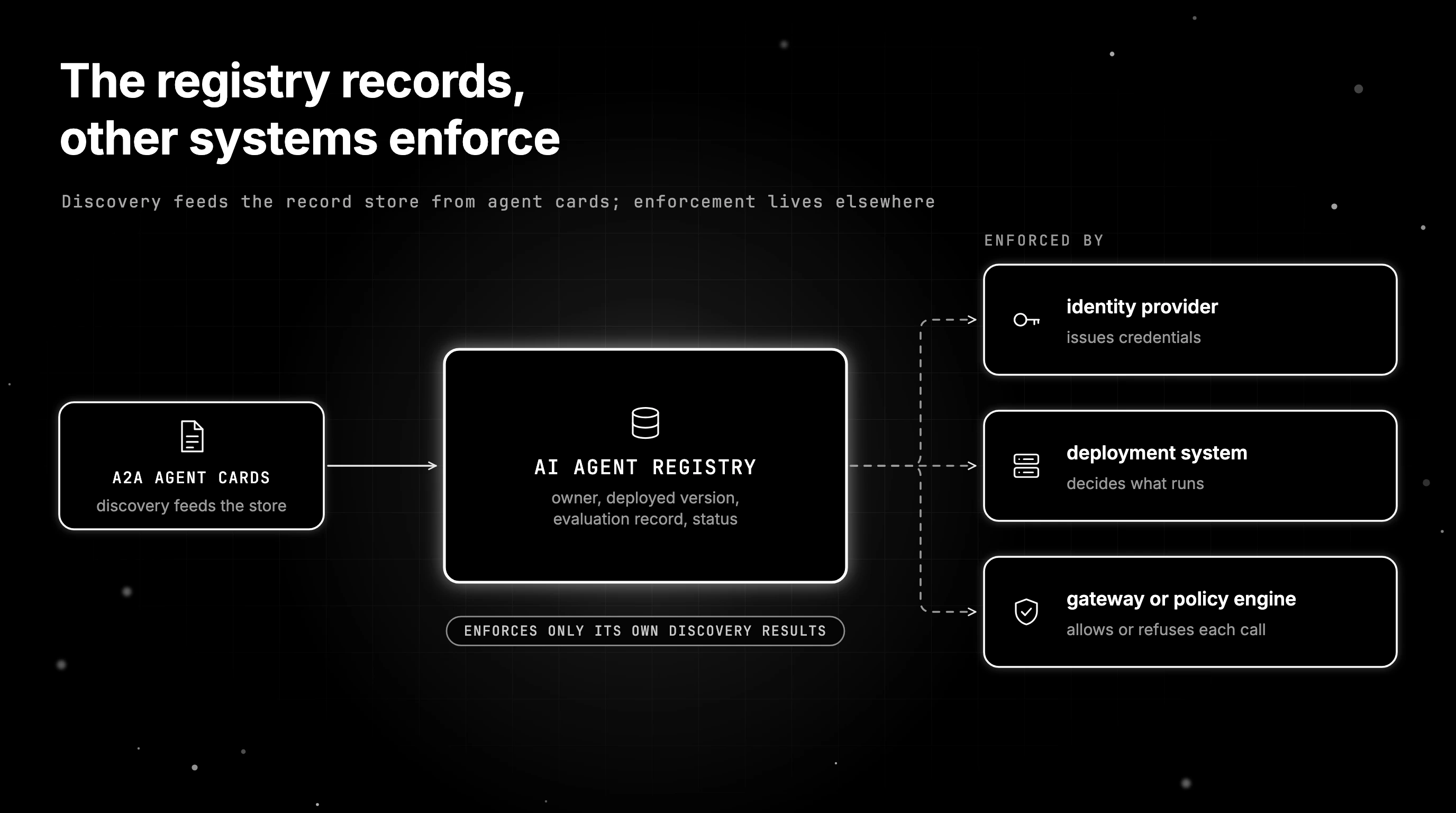
Agent registry architecture works when the registry records governance facts and other systems enforce them. The registry says who owns an agent and which version passed evaluation, while the identity provider issues credentials, the deployment system decides what runs and a gateway or policy engine allows or refuses each call.
A registry enforces only its own discovery results, and AWS shows it: discovery returns only approved revisions. The split holds for a managed registry per cloud and for a federated one, where AGNTCY Directory publishes records peer to peer. Table 2 maps each fact to its enforcer.
| Concern | Registry records | Enforced by | Documented example |
|---|---|---|---|
| identity and credentials | agent_id, owner | identity provider | Microsoft Entra Agent ID is the identity layer under the Agent 365 registry |
| tool and data access | dependencies, data access class | gateway or policy engine | Google Agent Gateway queries Agent Registry and evaluates IAM policies before routing |
| what runs | deployed version, endpoint | deployment system | our registry run flags card version drift, the deployment system changes the version |
| release approval | evaluation record, lifecycle status | CI gate and registry discovery | AWS discovery returns only approved revisions |
| retirement | retired status, decision log | router drains traffic, identity provider revokes | AWS DEPRECATED is terminal and cannot be edited |
The registry is the inventory layer of governance; a comparison of seven governance platforms covers policy and audit.
Credentials belong to agent identity, scoped keys and tool lists.
AI agent registry options on AWS, Google, Microsoft and GitHub
For an AI agent registry on a cloud, AWS, Google and Azure API Center each ship a generally available service that takes A2A agent cards, and Microsoft 365 admins also get the Agent 365 registry. Two Apache-2.0 projects on GitHub cover self-hosting, and each date below was read from the vendor’s own pages as of 2026-11-20.
AWS Agent Registry
AWS Agent Registry general availability was announced on 2026-08-31, after a move to its own agent-registry namespace on 2026-08-06. It catalogs agents, tools, skills, MCP servers and custom resources and validates agent records against the A2A protocol schema, per the Amazon Bedrock AgentCore developer guide.
The AWS registry record lifecycle runs DRAFT, PENDING_APPROVAL, then APPROVED or REJECTED, with DEPRECATED terminal.
Google Cloud Agent Registry
The Google Cloud Agent Registry release notes list Preview on 2026-04-22 and GA on 2026-06-18, with API v1 and A2A 1.0 support beside the 0.3 schema. Standalone skills went GA on 2026-11-06. Agent Registry extracts A2A skills and capabilities from the Agent Card.
The Agent Registry overview says Agent Gateway checks the registry and IAM policies before routing.
Microsoft Agent 365 and Azure API Center
On Azure, you register agents in Azure API Center, A2A agents included, with a title, version, lifecycle stage and optional A2A agent card. API Center syncs agents from API Management or Git and scores them against a pass threshold; its agent registration went GA in June 2026, announced 2026-06-02.
Microsoft Agent 365, GA for the Commercial segment from 2026-05-01, includes the Agent 365 agent registry, which lists agents from Microsoft, partners and your teams with owner, publisher type, status and risk signals and an Agents without owners card; its Graph APIs are in preview.
Microsoft Entra Agent ID stays the identity layer, per Entra registry convergence with Agent 365.
AI agent registry open source projects
agentregistry (Apache-2.0, last commit 2026-10-27, release v0.4.0 on 2026-08-03) is one catalog for MCP servers, agents, skills and prompts, with a CLI, a web UI and Kubernetes deployment.
AGNTCY Directory (Apache-2.0, last commit 2026-11-19, release v1.9.1 on 2026-11-18) publishes and discovers records over a distributed peer-to-peer network, describes agents with OASF and supports record signing.
The MCP Registry lists MCP servers, not agents, so it sits outside this scope; for a small fleet, fourteen fields in one sqlite3 table are a working start.
A retirement workflow that keeps the record
Retiring an agent takes four steps in order: drain its traffic to zero, revoke its credentials, withdraw its card from discovery, then freeze its registry entry as read-only. Run them out of order and you leave a live credential for an agent nobody owns or a card that still advertises it.
- Deprecate and drain traffic to zero; the sample registry refused support-router at 1,200 requests in 24 hours.
- The owner revokes the agent’s credentials in the identity provider, then sets the entry to retired.
- Stop serving the card and remove the agent from every gateway or cloud registry that lists it.
- Freeze the record and its decision log as read-only decommission evidence for audits.
For retention rules on decommissioned agents, see AI agent compliance and governance.
Listing A2A agents with Future AGI Agent Command Center
Future AGI Agent Command Center keeps a list of downstream A2A agents in its config file, fetches each agent’s card when the gateway starts and lists every agent at GET /v1/agents. Future AGI Evaluation produces the scored experiment that a registry entry’s evaluation record field can point to.
Setting a2a.enabled turns A2A on; each agent under a2a.agents takes a url, auth, description and skills. At startup the gateway fetches each card once from the agent’s url plus /.well-known/agent.json, and GET /v1/agents returns name, url, healthy and the card, plus description and skills when configured.
Each listed agent is callable as the model a2a/<name> in chat completions, and the gateway serves its own card, per the Agent Command Center MCP and A2A docs.
healthy starts true, turns false if the startup fetch cannot connect or times out, and true on a valid card; a non-200 or unreadable card leaves it unchanged. Part (c) of run.sh, tested end to end on the gateway at commit 08de8321 (Go 1.27.4), lists a stopped agent-b “healthy”: false with no card after a gateway restart.
say "(c) gateway: GET /v1/agents before and after stopping agent-b and restarting the gateway"
run_gw <<'L'
agent-a 18301
agent-b 18302
L
echo "-- BEFORE (both agents up)"; show
kill $B; wait $B 2>/dev/null; kill $GWPID; wait $GWPID 2>/dev/null
run_gw <<'L'
agent-a 18301
agent-b 18302
L
echo "-- AFTER (agent-b stopped, gateway restarted)"; show
-- BEFORE (both agents up)
[
{
"name": "agent-a",
"url": "http://127.0.0.1:18301",
"description": "fixture agent agent-a",
"healthy": true,
"card": {
"name": "agent-a",
"description": "Synthetic fixture agent agent-a (no LLM)",
"url": "",
"version": "1.0.0",
"capabilities": {},
"skills": [
{
"id": "triage",
"name": "triage",
"description": "triage (fixture)",
"tags": [
"fixture"
]
}
],
"defaultInputModes": [
"text/plain"
],
"defaultOutputModes": [
"text/plain"
]
}
},
{
"name": "agent-b",
"url": "http://127.0.0.1:18302",
"description": "fixture agent agent-b",
"healthy": true,
"card": {
"name": "agent-b",
"description": "Synthetic fixture agent agent-b (no LLM)",
"url": "",
"version": "2.1.0",
"capabilities": {},
"skills": [
{
"id": "summarize",
"name": "summarize",
"description": "summarize (fixture)",
"tags": [
"fixture"
]
}
],
"defaultInputModes": [
"text/plain"
],
"defaultOutputModes": [
"text/plain"
]
}
}
]
-- AFTER (agent-b stopped, gateway restarted)
[
{
"name": "agent-a",
"url": "http://127.0.0.1:18301",
"description": "fixture agent agent-a",
"healthy": true,
"card": {
"name": "agent-a",
"description": "Synthetic fixture agent agent-a (no LLM)",
"url": "",
"version": "1.0.0",
"capabilities": {},
"skills": [
{
"id": "triage",
"name": "triage",
"description": "triage (fixture)",
"tags": [
"fixture"
]
}
],
"defaultInputModes": [
"text/plain"
],
"defaultOutputModes": [
"text/plain"
]
}
},
{
"name": "agent-b",
"url": "http://127.0.0.1:18302",
"description": "fixture agent agent-b",
"healthy": false
}
]{"time":"2026-11-20T04:05:16.143054+05:30","level":"WARN","msg":"a2a: failed to fetch agent card","agent":"agent-b","url":"http://127.0.0.1:18302/.well-known/agent.json","error":"Get \"http://127.0.0.1:18302/.well-known/agent.json\": dial tcp 127.0.0.1:18302: connect: connection refused"}Each Future AGI Evaluation result is a score between 0 and 1 with a default pass threshold of 0.5, per eval output types.
Teams run an experiment to score every prompt or agent and model combination on one dataset, and evaluation_record holds its link.
The gateway source is at Future AGI on GitHub.
One lookup for the refund agent
Back with the refund agent from the start, a registry turns asking around into one row: a named owner, the version serving traffic, a link to its evaluation record and a status that says live. If the answer is retire, the four steps run in order and the record stays.
This week, put your five busiest agents into the fourteen fields and add the lifecycle gates so nothing goes live without an owner and an evaluation record. Then schedule the card check so drifted or unreachable cards show up early.
Frequently Asked Questions
Which AI agent registry open source projects exist?
What is the AI agent registry on AWS?
What is the AI agent registry for Azure?
What should an agent registry template include?
What does a sound agent registry architecture look like?
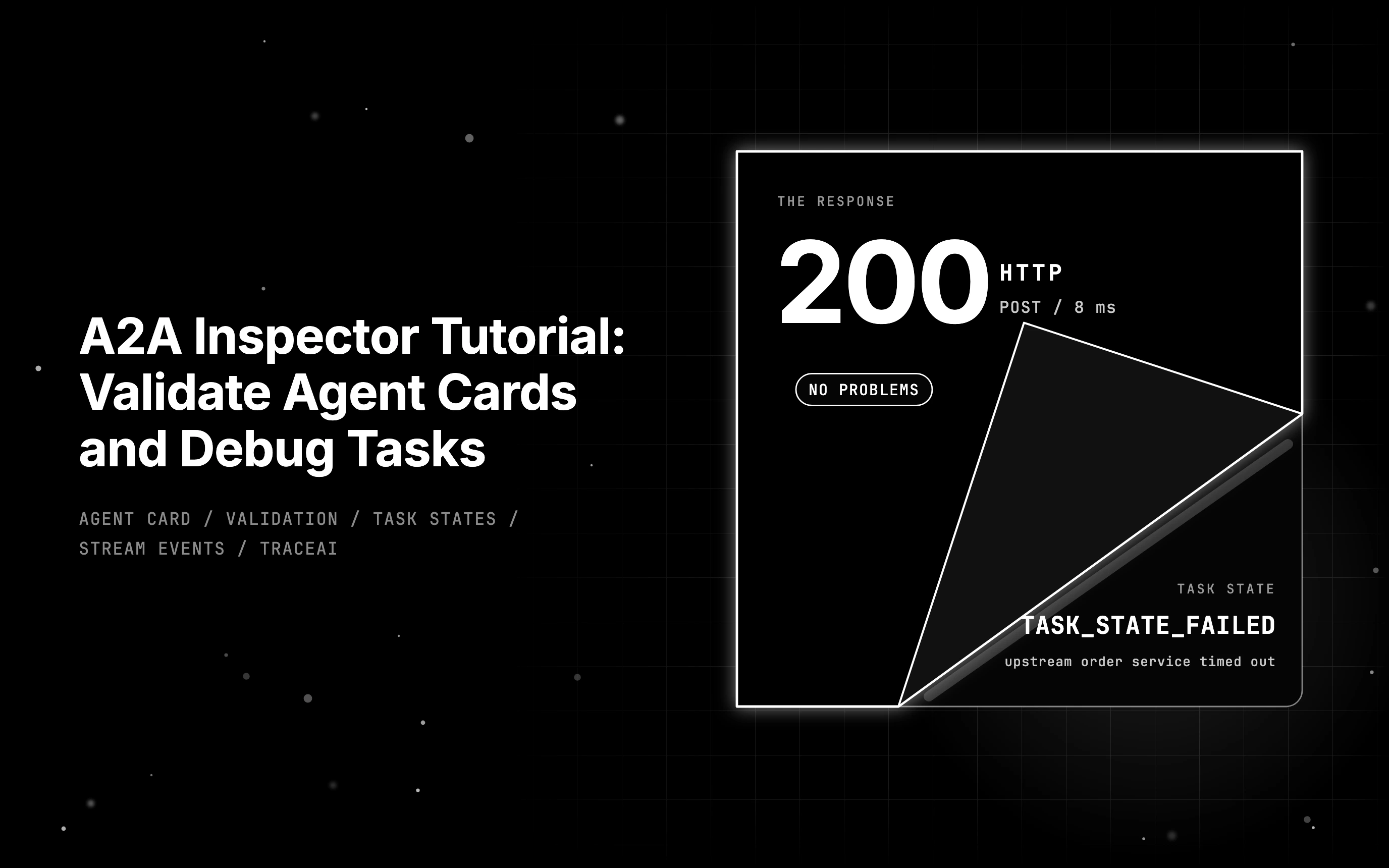
Install the A2A Inspector from its Go release, validate agent cards, and debug A2A tasks that stall, stream with no final event, or fail behind an HTTP 200.

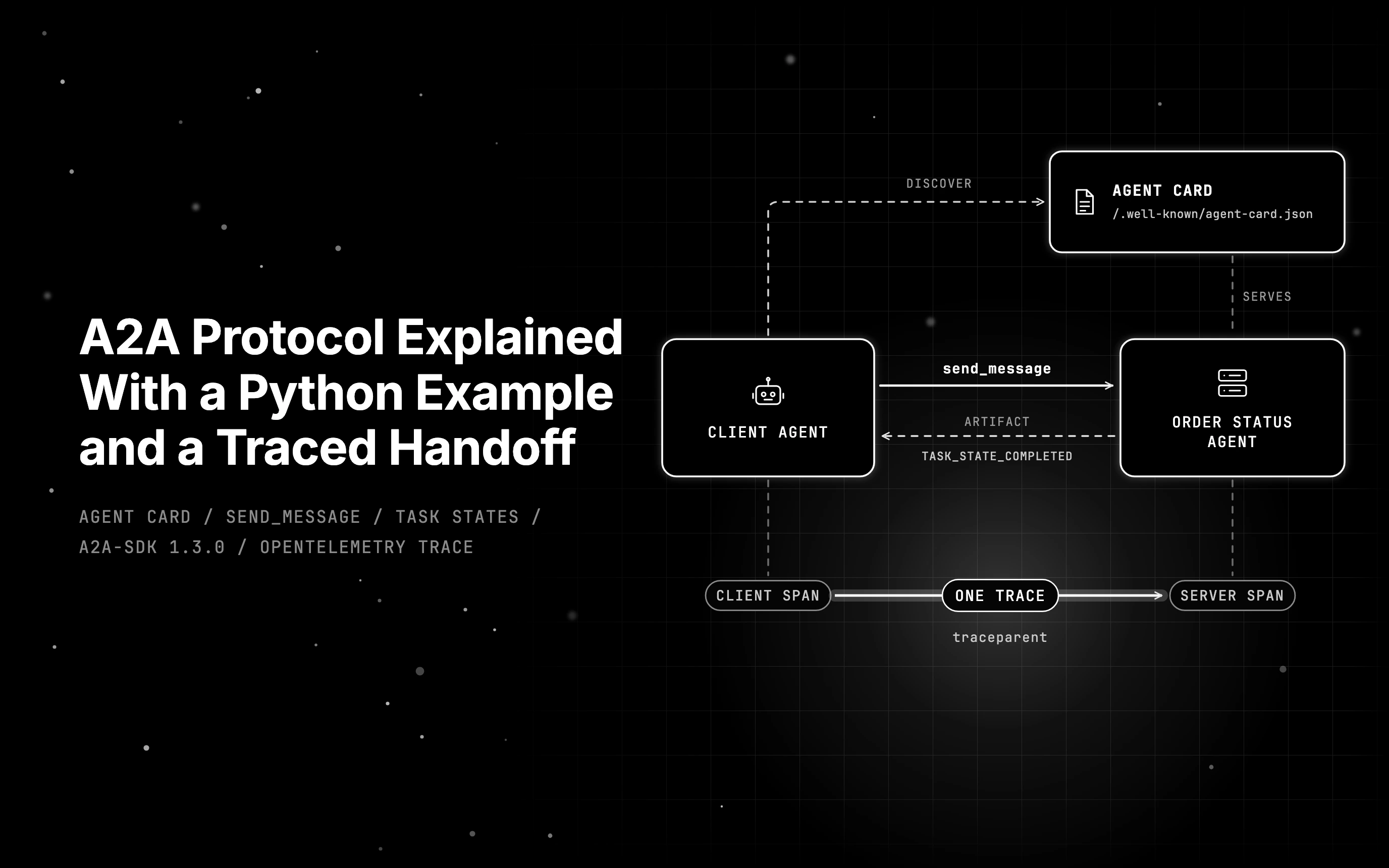
Learn the a2a protocol at v1.0: Agent Cards, task states, auth schemes, and a runnable Python handoff between two agents, traced end to end in one trace.

Inside Future AGI open source in Q2 2026: the platform shipped under Apache 2.0, Error Feed and the Agent Command Center went live, traces hit billions.