What Is Prompt Chaining: How to Trace and Score Every Step
A chain that returns a clean answer can still be wrong in the middle. Here is how to record each link as its own span and put a score on it.
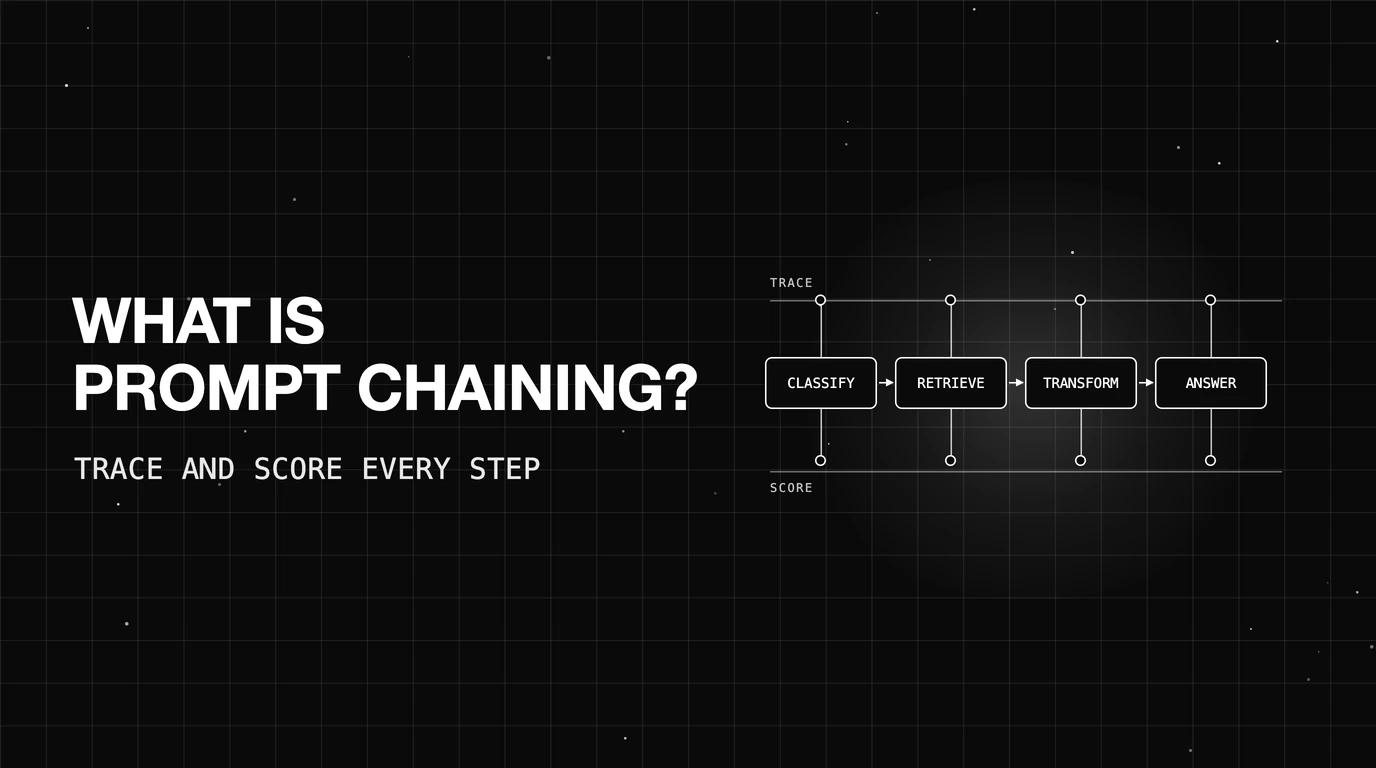
Table of Contents
A chain that returns a clean final answer can still be wrong at step one. This is how you find out which link broke, before a user does.
A support bot classifies a ticket as “billing,” pulls three billing articles, and writes a confident, well-formatted reply. The customer was asking about a login loop. The answer reads perfectly. It is also useless.
Nothing in that run threw an error. The classifier returned a valid label, retrieval returned real documents, and the writer did its job on the inputs it was handed. The failure happened at step one and every step after it inherited the mistake without noticing.
That is the problem with judging a prompt chain by its final output. One score at the end tells you something went wrong. It does not tell you where, and in a four-step chain that leaves you guessing between four candidates.
This post is about the tracing and scoring layer: how to record every link of a chain as its own span, and how to put a number on each step instead of only the last one.
If you want the definition and the pattern itself, our prompt chaining glossary entry covers that ground. If you are choosing software, we compared the options in best prompt chaining tools for LLM workflows in 2026. This piece assumes the chain is already built and you now need to see inside it.
What Is Prompt Chaining?
Prompt chaining splits one complex task into an ordered sequence of smaller prompts. Each prompt handles a single job, and its output becomes part of the next prompt’s input. The chain runs in a fixed order that you defined in advance.
A document-summary chain might run four links: extract the key claims, verify each claim against the source, rank them by importance, then write the summary. Four separate model calls, four separate outputs, one final answer.
The reason teams reach for this is that each step gets a narrower instruction. A prompt that only classifies is easier to write, easier to test, and easier to fix than a prompt that classifies, retrieves, reasons, and formats in one pass.
How Each Link Passes Its Output Into the Next Prompt
The handoff between steps is where the design work lives. Step two does not see the original user request unless you pass it along. It sees whatever you chose to forward from step one.
Well-built chains forward structured output rather than prose. Step one returns JSON with a label and a confidence field, and step two reads specific keys from it. That structure is what makes a step checkable, because you can assert on a field instead of parsing a paragraph.
Loose handoffs are a common source of drift. If step one returns free text and step two interprets it, small wording changes upstream can quietly change downstream behavior with nothing in your logs marking the moment.
Prompt Chaining vs. One Large Mega-Prompt
The alternative to a chain is a single prompt that tries to do everything. It works, sometimes, and it is faster to build. One call, one latency budget, one place to edit.
What you lose is the seam. A mega-prompt produces one output, so there is exactly one thing to score and one thing to debug. When it gets an answer wrong, you cannot tell whether the model misread the request, retrieved the wrong context, or reasoned badly, because all three happened inside one opaque call.
A chain trades latency and token cost, since a four-step chain is roughly four calls where a mega-prompt was one, for observable seams. Every boundary between steps is a place you can inspect, assert on, and score. That is the whole argument for the pattern in production.
Prompt Chaining vs. Single Prompts vs. Agents
These three sit on a spectrum from fixed to free. A single prompt has one step. A chain has several steps in a sequence you control. An agent decides its own steps at runtime.
It is easy to conflate a chain with chain-of-thought prompting, but they operate at different levels. Chain-of-thought is reasoning the model writes out inside one call’s output, still a single prompt from the tracing and scoring perspective described here. A prompt chain is multiple separate calls, each with its own input, output, and span.
| Pattern | Predictability | Debuggability | Best use case |
|---|---|---|---|
| Single prompt | High, one call with one output | Low, no internal seams to inspect | Short, self-contained tasks like rewriting or classification |
| Prompt chain | High, the sequence is fixed in advance | High, every step is a separate call you can score | Multi-stage workflows with known stages, such as extract, verify, answer |
| Autonomous agent | Low, the path changes per run | Moderate, you can trace it but cannot predict the expected path | Open-ended tasks where the right sequence is not known upfront |
The Predictability and Flexibility Tradeoff
An agent handles cases you did not anticipate. It can decide a task needs a search it was never told to run, and that flexibility is valuable for open-ended work.
The cost is that two runs of the same input can take different paths. Your monitoring has to accommodate a variable step count, tool set, and order. That is harder to assert on.
A chain gives up that adaptability. In exchange, you know how many steps a healthy run has and what each one should produce. The expected shape of a good run becomes something you can write down.
Why a Chain Is Easier to Audit Than an Autonomous Agent
Auditing means comparing what happened against what should have happened. With a fixed chain, “should have happened” is a concrete artifact: four steps, in this order, each producing this shape of output.
With an agent, you are often reduced to judging the outcome, because there is no single correct path to compare against. Tool-chain failures in agentic systems compound in ways that are hard to trace back, which we covered in cascading failures in LLM tool chains.
This is why teams with strict correctness requirements often pin a workflow into a chain even when an agent could handle it. The predictability is the feature.
Where Prompt Chains Actually Break
Chains fail differently from single prompts. The failure usually starts small, in one step, and then travels.
| Step type | Typical failure | How it shows up downstream | Detection method |
|---|---|---|---|
| Classifier / router step | Picks the wrong branch or label | Every later step runs correctly on the wrong premise | Compare the chosen label against a ground-truth label per run |
| Retrieval step | Returns plausible but off-topic context | The writer grounds a fluent answer in the wrong documents | Score retrieved context for relevance before it reaches the writer |
| Transformation / formatting step | Emits malformed or partially valid JSON | Next step silently reads a missing key as empty | Assert on the output schema and required fields at the seam |
| Final answer step | Fluent answer that ignores part of the request | Looks correct in review, fails the user’s actual need | Score the response against the original request, not the previous step’s output |
Error Compounding: A Wrong Early Step Poisons Everything After It
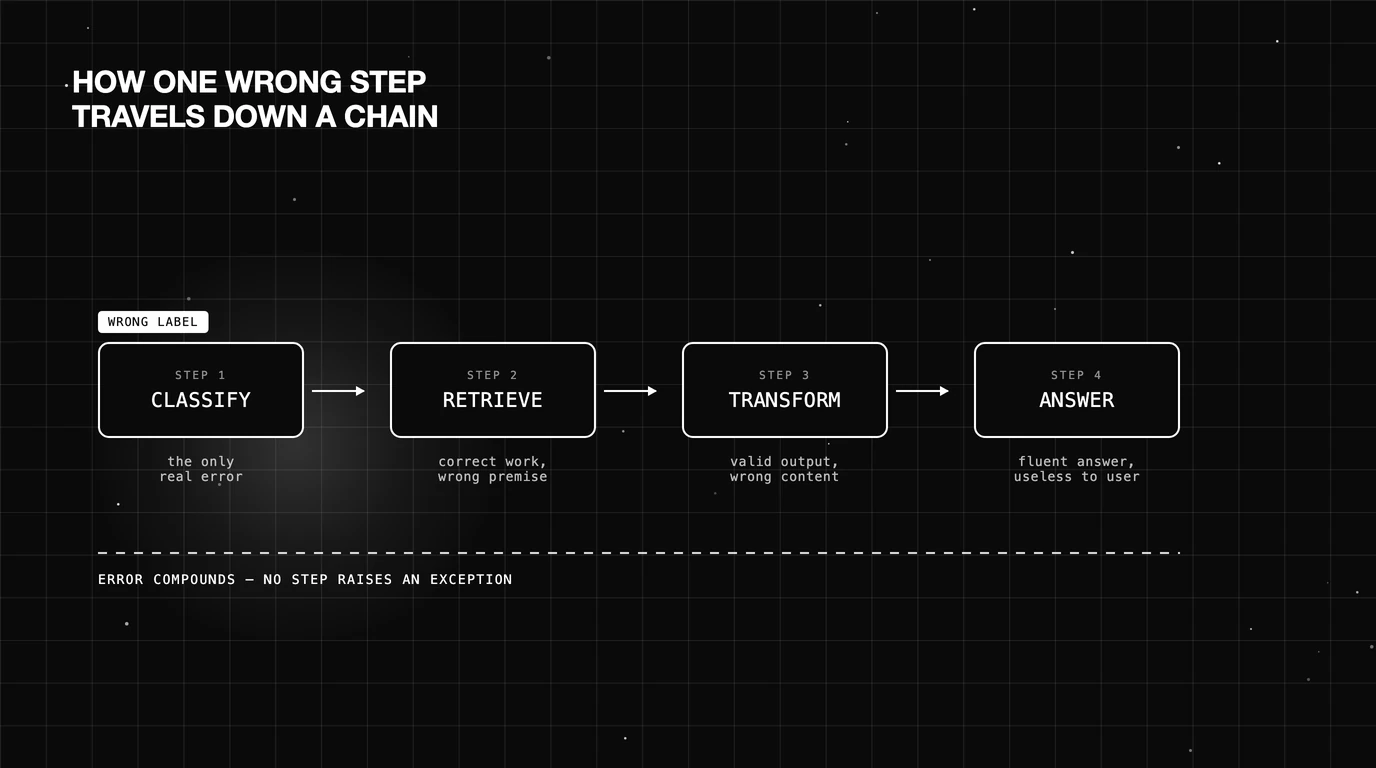
Compounding is the most characteristic failure mode of chained prompts. Step two hands step three a wrong input, and step three does excellent work on bad data.
The support bot from the opening is exactly this. The classifier’s mistake was the only real error in the run. Retrieval and generation both behaved correctly and both produced garbage, because correctness at a step is relative to the input it received.
The practical consequence is that a chain’s reliability is not the reliability of any single step. Each link multiplies against the ones before it, so a sequence of individually decent steps can add up to a chain that is unreliable end to end.
Silent Failures: The Answer Looks Fine, the Reasoning Was Not
A silent failure is a run that completes normally and returns something that passes casual review. No exception, no timeout, no red status anywhere.
These are the expensive ones. Loud failures get caught by ordinary error monitoring, because something raised. A step that returned a valid-but-wrong value never triggers that path, so it reaches the user and sits in your logs looking healthy.
Harness-level error handling makes this worse, since a caught exception replaced with a default can look identical to a real result. We went deep on that pattern in why agent harnesses hide their own failures.
How Do You Trace Every Step of a Chain?
Tracing a chain means recording it as a structured tree rather than a single log line. Future AGI’s docs define a trace as “the step-by-step record of the model calls, tool calls, and retrievals behind one response” (Observe docs).
That definition is the target. One request in, one trace out, with every intermediate call visible inside it as its own node.
Recording Each Step as Its Own Span, Not One Opaque Call
A span is a single unit of work inside a trace. In a four-step chain, you want four spans, nested under one parent, each carrying its own inputs, outputs, and timing.
The failure mode to avoid is wrapping the entire chain in one span. You get a total latency number and a final output, which is the same visibility a mega-prompt would have given you. The seams you built the chain for disappear.
Future AGI’s observability model is built around traces, spans, sessions, and scores fitting together, with instrumentation for OpenAI, Anthropic, LangChain, and 30+ more frameworks (Observe docs). Auto-instrumentation captures the model calls, and you can add custom spans for the steps your framework does not know about (send your first trace).
Grouping Related Steps Into a Session for a Full Run
Spans cover one request. Sessions cover the longer arc, letting you follow a full conversation or one customer across sessions (Observe docs).
This matters when a chain runs more than once for the same user. A retry, a clarification round, or a multi-turn workflow produces several traces that only make sense read together.
Without that grouping, you get a pile of individually fine traces and no way to see that the same user hit the same broken branch three times in a row.
How Do You Score Each Step, Not Just the Final Output?
Tracing shows you what happened. Scoring tells you whether it was any good. The two are separate jobs and you need both.
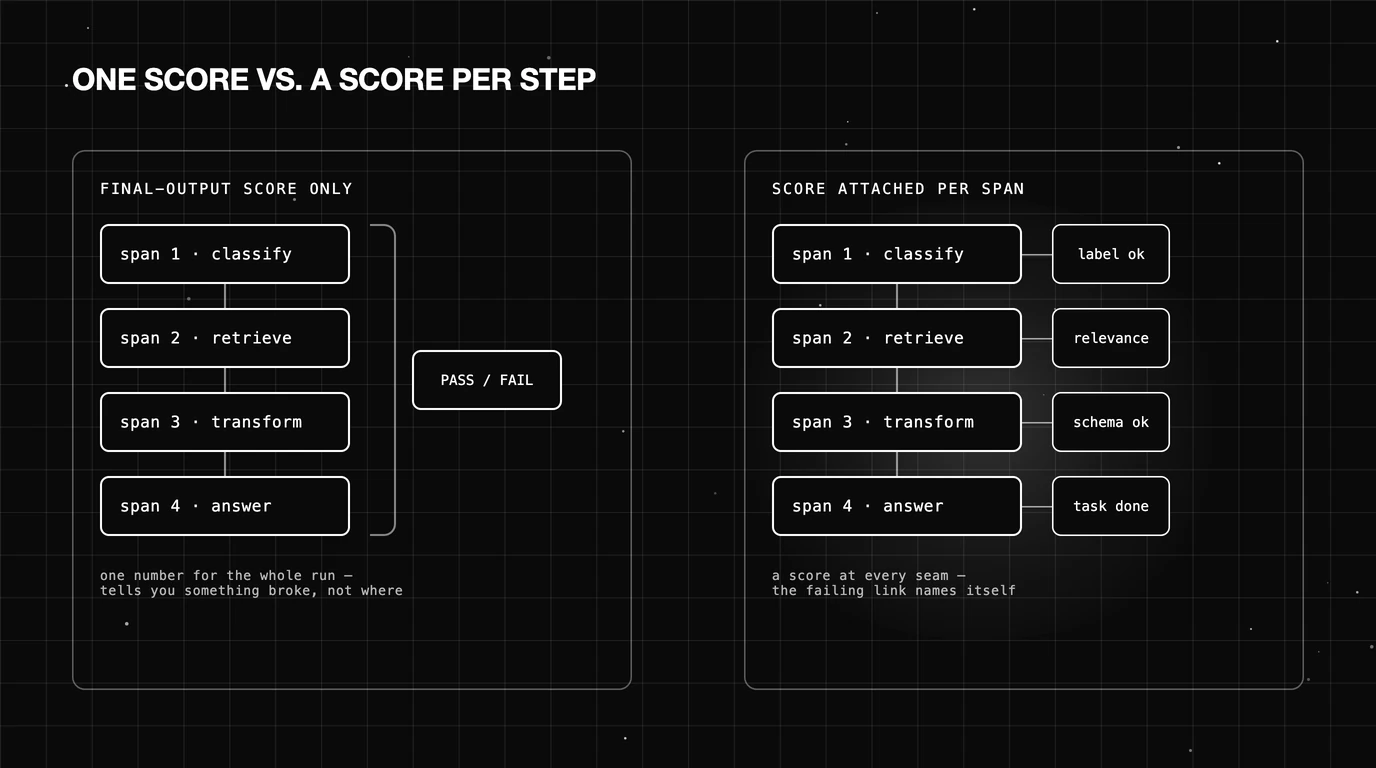
The key move is attaching scores at the span level rather than only the trace level. Future AGI supports exactly this, letting you attach quality scores to whole traces or single spans (Observe docs).
Step-Level Accuracy Checks vs. End-to-End Evaluation
End-to-end evaluation asks one question: was the final answer right? It is the cheapest thing to set up and the least useful for debugging.
Step-level checks ask a different question at every seam. Did the classifier pick the right label? Did retrieval return relevant context? Did the transformation produce the required fields? Each answer localizes a fault to one link.
You want both. The end-to-end score tells you the chain has a problem. The step scores tell you which link to open.
| Scoring approach | What it answers | Catches a wrong intermediate step? | Localizes the fault? |
|---|---|---|---|
| Final-output score only | Was the answer acceptable? | Only when the error survives to the output | No, you get one number for the whole chain |
| Per-step output checks | Did each step produce a valid, correct result? | Yes, at the step where it started | Yes, down to a single span |
| Sequence checks | Did the run take the expected path and length? | Yes, including skipped or repeated steps | Yes, by comparing against an expected trajectory |
| Combined | All of the above | Yes | Yes, with an end-to-end pass/fail on top |
Catching a Wrong Intermediate Step Before It Reaches the User
Step scores serve two different modes, and it is worth naming them separately. Inline, a fast deterministic check at the seam can act while the run is still going: if the classifier’s confidence is low, route to a human, or if retrieval scores badly for relevance, retry with a different query before the writer ever sees it.
Attaching a score to a span after the fact is the other mode, better suited to slower or LLM-judged checks you review after the run completes.
That turns a chain from a pipeline into a pipeline with checkpoints. Each checkpoint is a place where a bad intermediate result can be stopped instead of forwarded.
Offline, the same scores do a different job. Run them over yesterday’s traffic and you learn which link is weakest, which beats “quality is down.”
Future AGI
Future AGI records each request as a trace, and traces, spans, sessions, and scores are the core of its observability model (Observe docs). For a prompt chain, that means each link lands as its own span under one parent, and you can attach scores to a single span rather than only to the whole run.
The Error Feed runs on top of that. It detects errors ranging from factual grounding failures to tool crashes to safety violations, groups similar traces into named clusters, and links its findings back to the relevant trace spans (Error Feed docs).
For a chain that fails the same way repeatedly, that clustering points at the recurring link instead of showing you a hundred separate incidents.
For scoring the sequence itself, four built-in evals apply directly to chained workflows.
Trajectory Match compares an agent’s actual action sequence against an expected trajectory using configurable matching modes. It is a code-based check with four modes (Trajectory Match docs).
strict compares the sequences in order and scores the length of the matching prefix. unordered treats both as sets and scores their Jaccard overlap. subset checks that every expected action appears in the actual trajectory, and superset checks that every actual action was expected. The default is strict, which is the right mode for a fixed chain.
Step Count validates the number of steps in a trajectory against an exact count or a min/max range. It parses the trajectory into a list of steps, counts them, and checks that count against expected_steps, or against min_steps and max_steps.
At least one of those must be set or the eval fails outright. The result is Pass or Fail with a plain-language reason (Step Count docs). A four-step chain that ran three steps is a bug you catch without reading a single output.
Tool Call Accuracy compares actual tool calls against expected ones. An exact match on both name and arguments scores 1.0 for that call, and a match on name only scores 0.5.
The per-call scores are summed and divided by max(len(expected), len(actual)), so extra or missing calls pull the score down too (Tool Call Accuracy docs). Both of these evals score trajectories and tool calls, so they apply once your chain’s steps and any retrieval or tool calls are emitted in that form, not automatically for every chain.
Task Completion is the end-to-end check. It is an LLM-as-Judge eval that reads the input request and the output, then scores whether the response fulfilled the request, returning Pass or Fail with a reason (Task Completion docs). Run it alongside the step-level checks, not instead of them.
Conclusion
A prompt chain is only as trustworthy as its weakest link, and a final-output score cannot tell you which link that is. The pattern’s real advantage over a mega-prompt is that it has seams, and seams are only useful if you instrument them.
So record every step as its own span, group the run into a session, and attach a score at each seam rather than only at the end. Check the sequence separately from the outputs, because a chain can produce a good-looking answer while skipping a step it needed.
Do that, and a wrong final answer stops being a mystery. It becomes a span, with a score on it, that you can open.
Frequently Asked Questions
What is prompt chaining?
Is prompt chaining the same as chain-of-thought prompting?
When should I use prompt chaining instead of a single prompt?
How is prompt chaining different from AI agents?
How do you debug a broken prompt chain in production?
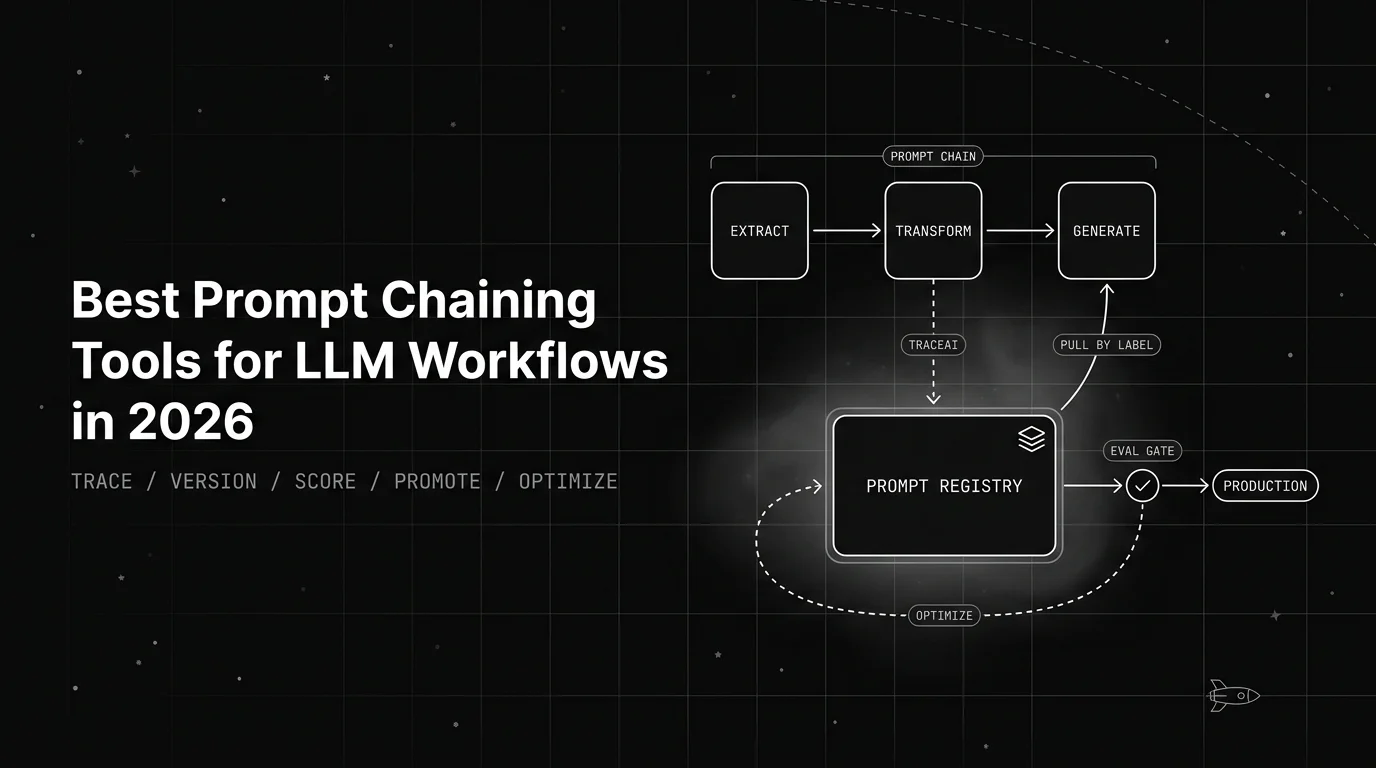
See the 6 best prompt chaining tools for LLM workflows in 2026, ranked on per-link versioning, tracing, evaluation, and debugging each step of the chain.

LLM tool chaining in 2026. Cascading failure modes, real traceAI patterns, frameworks compared. Stop silent corruption, context loss, and timeout cascades.

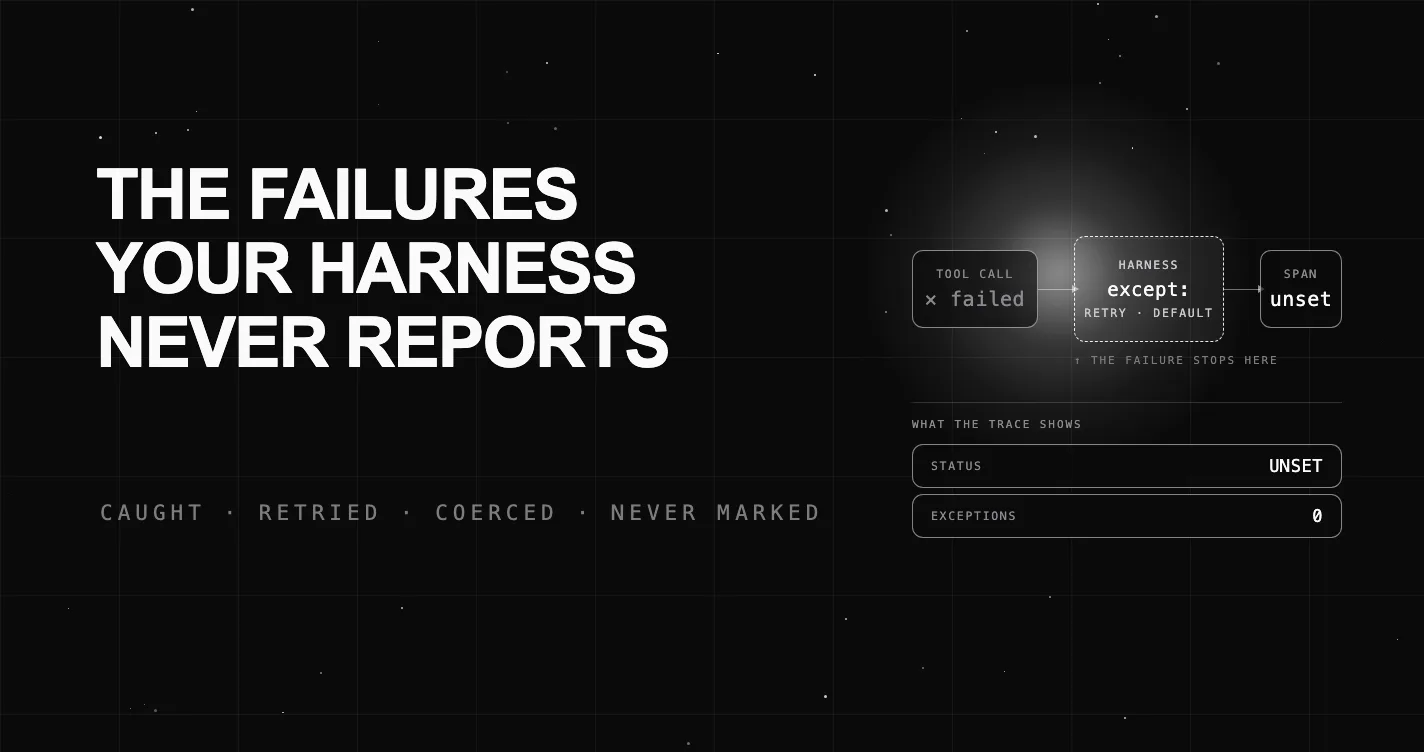
Agent harnesses catch errors to keep a run alive, so failed steps leave an Unset span that trace UIs render as green. Here is how to surface them.