What Is OSINT? Why Verification Beats Search
What is OSINT? Learn the five-step verification workflow, legal boundaries, source checks, and how AI changes open-source intelligence in 2026.
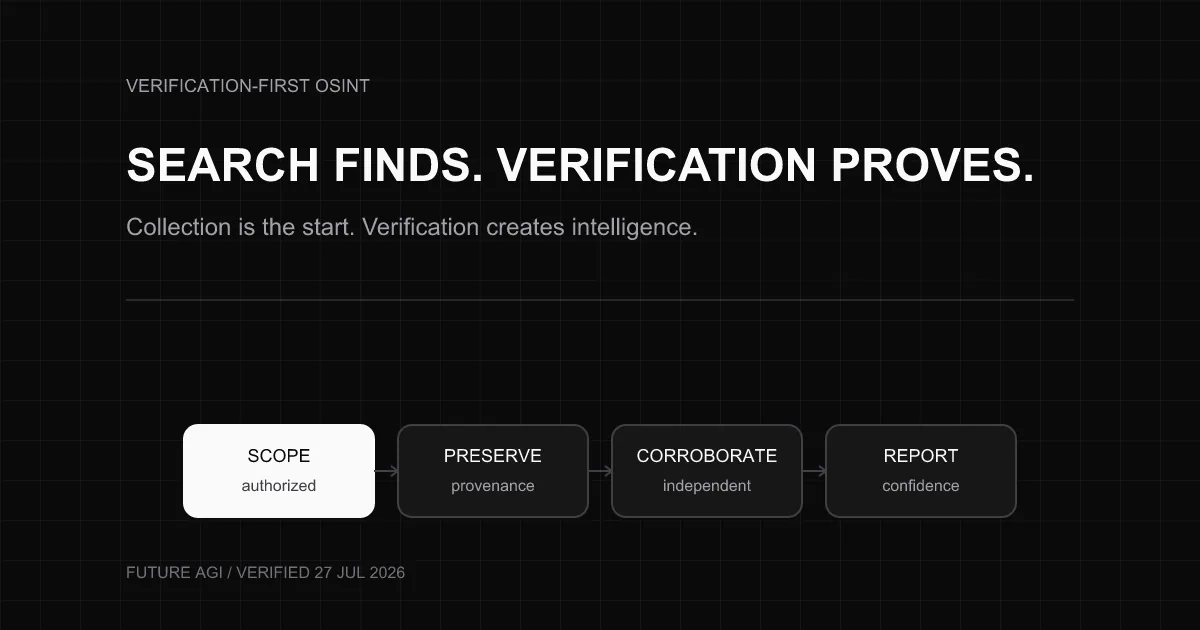
Table of Contents
Open-source intelligence (OSINT) is intelligence derived from publicly or commercially available information to answer a specific requirement. The work is not “finding something online.” It is preserving provenance, corroborating claims, separating fact from inference, and reporting confidence so another person can audit the result.
The US intelligence community’s 2024–2026 OSINT Strategy includes both publicly and commercially available information. Many explainers omit the commercial half and define OSINT too narrowly.
Our position: search is collection. OSINT begins when you can show why a source is relevant, how a claim was verified, and what would change your conclusion.
AI makes that distinction more important. It has made collection cheap while making provenance, identity resolution, and verification harder.
How Is OSINT Different From Ordinary Web Research?
OSINT is defined by the purpose and method, not by a special list of websites.
| Activity | Primary goal | Verification standard | Typical output |
|---|---|---|---|
| Web search | Find information | Often one useful source is enough | Links or an answer |
| Academic or market research | Build knowledge | Cite credible evidence and methods | Report or analysis |
| OSINT | Answer a specific intelligence requirement | Preserve provenance, corroborate, grade confidence | Actionable assessment |
| Doxxing or stalking | Expose, intimidate, or monitor a person | No legitimate necessity or restraint | Harmful disclosure |
The same public record can appear in all four activities. What separates legitimate OSINT is authorization, a proportionate purpose, careful verification, and restraint in what gets collected and shared.
The word “open source” also causes confusion. In open-source software, it describes rights granted by a license. In OSINT, it describes the availability of information.
What Counts as an Open Source?
An open source can be reached lawfully without defeating an access control. A commercial database can also qualify when the analyst has legitimate access and uses it within its terms.
Public Records and Official Data
Court records, corporate registries, government contracts, sanctions lists, patents, regulatory filings, and public meeting records often have strong provenance.
Official does not mean infallible. Records can be outdated, incomplete, or entered under a different legal name.
News, Research, and Published Media
Reporting, press releases, academic papers, broadcasts, blogs, and forums help build timelines and surface claims.
Treat a press release as a claim from an interested party. Treat a news report as stronger when it names evidence, methods, and independent sources.
Social and Community Content
Public profiles, posts, comments, images, and account relationships can establish chronology or generate leads. They are also easy to fake, delete, or misattribute.
One account name is not an identity. One screenshot is not provenance.
Technical and Infrastructure Data
DNS records, certificate-transparency logs, public code repositories, package registries, and internet-exposure data can show how systems connect.
Collecting public metadata is different from probing, exploiting, or logging into a system. Authorization still sets the boundary.
Geospatial and Multimedia Evidence
Maps, satellite imagery, weather records, shadows, signs, landmarks, and metadata can help place an image in time and space.
Synthetic media and reposting make the original file, upload history, and independent corroboration more important than visual plausibility.
How Does the Verification-First OSINT Loop Work?
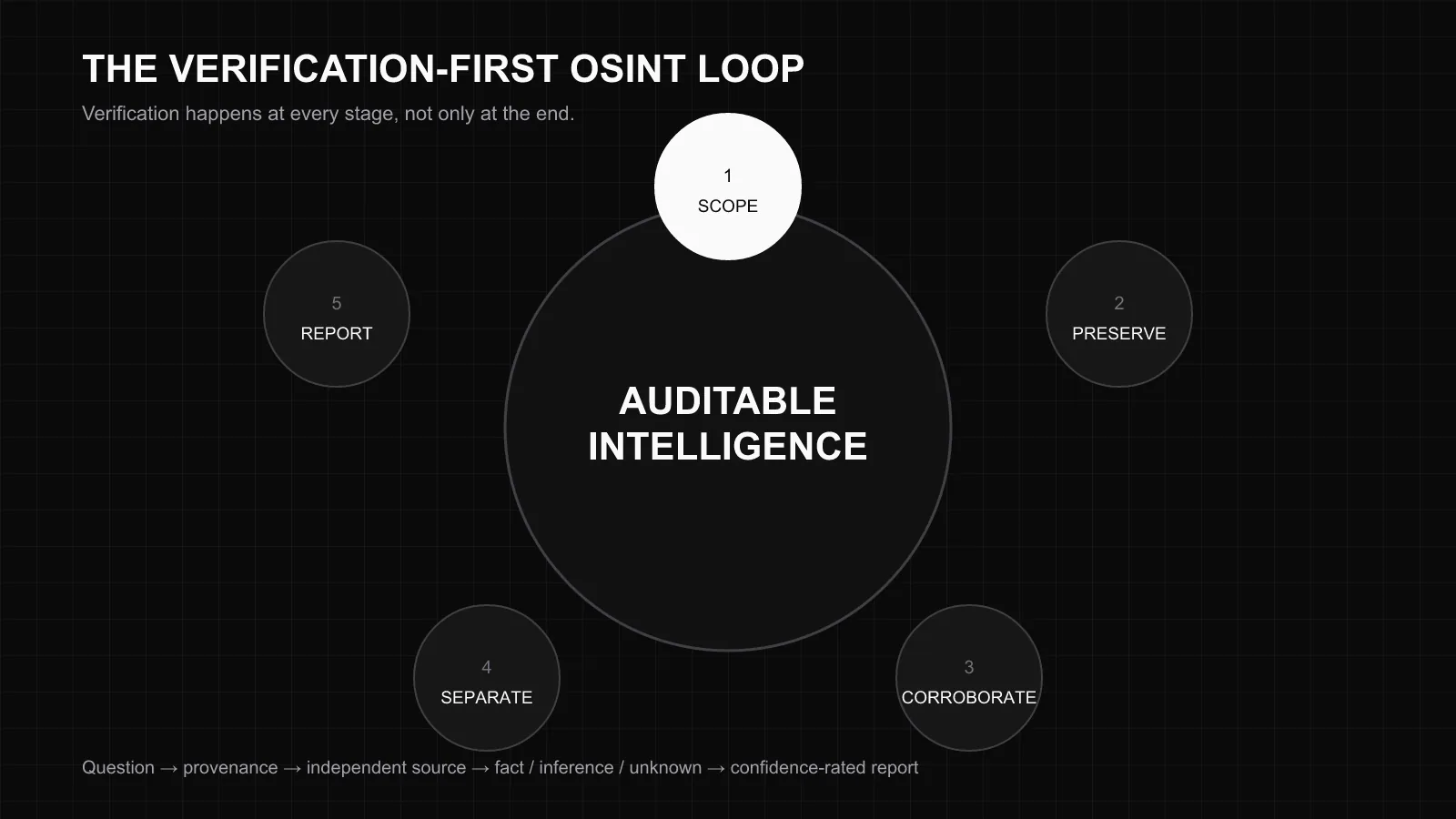
The classic intelligence cycle remains useful, but beginners often treat “analysis” as one final step. A better workflow verifies at every stage.
Step 1: Scope the Requirement
Write the decision you need to support, the facts that would answer it, and the boundary of the work.
“Audit our company’s exposed public footprint before a launch” is scoped. “Find everything about this person” is not.
Also record:
- who authorized the work;
- what jurisdictions and policies apply;
- which sources and methods are allowed;
- what data should never be collected;
- when the material will be deleted.
Step 2: Collect and Preserve
Capture the URL, publisher, timestamp, access date, and relevant excerpt. When appropriate, preserve a hash or an archived copy.
A screenshot without a source or date is weak evidence. It may still be a lead, but it should not carry a conclusion.
Step 3: Corroborate the Claim
Find a genuinely independent source. Two articles repeating the same press release are one source chain, not two confirmations.
Look for disconfirming evidence as deliberately as supporting evidence. If one source carries the entire theory, label the result provisional.
Step 4: Separate Fact, Inference, and Unknown
Use a claim ledger rather than a pile of browser tabs.
| Claim | Source | What the source directly proves | Competing explanation | Confidence |
|---|---|---|---|---|
| The organization controlled a domain on a given date | Historical DNS record | Domain-to-record relationship at that time | Record may reflect a service provider | Medium |
| A public account belongs to an employee | Company directory plus matching verified profile | Name and role align across independent records | Namesake or stale employment data | Medium |
| A document is authentic | Original file plus issuing authority confirmation | File and issuer agree | None found after stated checks | High |
Confidence is not a feeling. It is a summary of source quality, independence, corroboration, and unresolved alternatives.
Step 5: Report With Restraint
Lead with the answer, then state the evidence, confidence, gaps, and next action. Include only material needed for the decision.
The OSINT Foundation’s standards work treats planning, governance, collection, analysis, and dissemination as connected controls. A good report shows that chain.
How Should You Grade a Source?
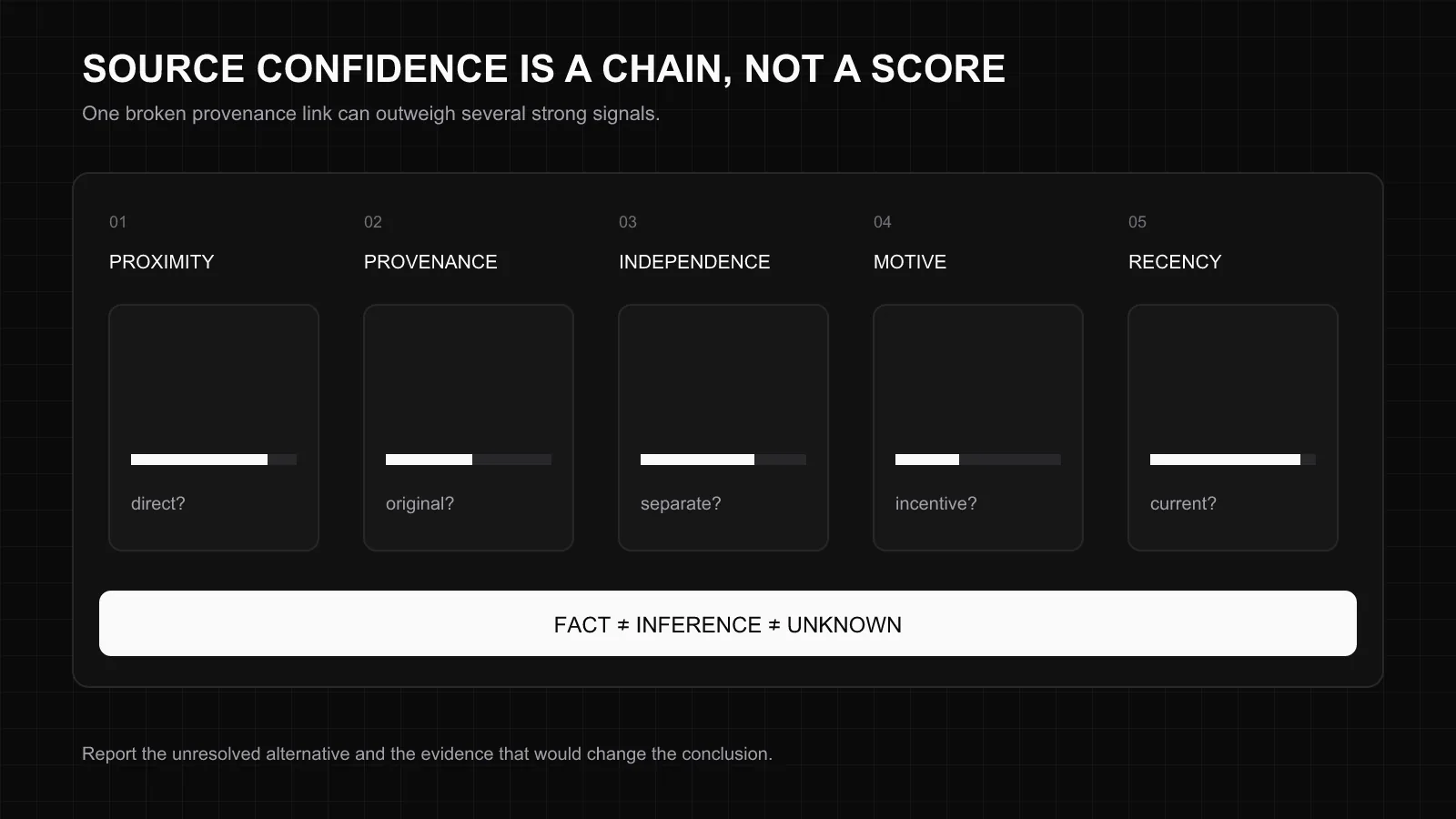
Use five questions before a source influences a high-stakes conclusion.
- Proximity: Did the source directly observe the event, or is it repeating someone else?
- Provenance: Can you identify the original file, record, author, or capture?
- Independence: Does this source have a different information path from the others?
- Motive: What does the source gain from this claim being believed?
- Recency: Is the evidence current enough for the decision?
Do not average these into a decorative score. A fatal provenance problem can outweigh four strong signals.
This is where AI summaries frequently fail. They collapse source chains, omit uncertainty, and make repeated claims look independently verified. The same failure appears in AI hallucinations: fluency can hide a missing evidence trail.
What Is a Safe First OSINT Exercise?
Audit your own organization’s public footprint with written permission.
Define the Question
Ask: “Which public assets, employee contact patterns, documents, and technical records expose information we did not intend to publish?”
Set a time limit and a deletion date before collection starts.
Build a Small Source Map
Review official web properties, public repositories, corporate records, certificate logs, and documents your organization published.
Record each source and classify the finding as intended, outdated, unnecessary, or risky.
Verify Before Escalating
Confirm a technical asset through more than one record. Confirm a document through its original publisher. Ask the internal owner before calling something an exposure.
Produce a Remediation List
The useful output is not a dossier. It is a prioritized list: remove an obsolete document, rotate a public credential, correct a registry entry, or document why the exposure is intended.
This exercise teaches the full loop without turning a stranger into a practice target.
Where Does OSINT Become Legally or Ethically Risky?
“It was public” is not a complete defense.
Public Data Still Has Privacy Rules
The UK Information Commissioner’s Office explains that using personal data from public sources can still require a lawful basis, transparency, and a proportionality assessment. Combining records can be more intrusive than any source alone. See the ICO’s guidance on data obtained from public sources.
Privacy requirements vary by jurisdiction. Treat this article as a workflow guide, not legal advice.
Access Controls Are a Hard Boundary
Do not guess credentials, reuse leaked passwords, evade a block, enter a private group under false pretenses, or exploit a system.
Terms of service, computer-misuse law, contract rules, employment policy, and sector-specific regulation can apply even when the underlying question is legitimate.
Biometric Matching Needs a Higher Bar
Face matching can produce false positives with serious consequences. NIST’s Face Recognition Technology Evaluation documents accuracy differences across algorithms and demographic groups.
Do not treat a face-match result as identity proof. High-stakes use needs legal review, human verification, and independent evidence.
Minimize Collection and Sharing
Collect only what the requirement needs. Restrict who can access the material. Redact unrelated personal data. Set a retention period.
OSINT without minimization can become surveillance by accumulation.
Which Open-Source OSINT Tools Fit Which Job?
A tool being free, hosted on GitHub, or developed in public does not establish its license. Check the exact repository and version.
| Tool | Main job | License signal checked on 27 July 2026 | Practical caveat |
|---|---|---|---|
| Sherlock | Username search across services | MIT | Matches accounts, not people; verify identity separately |
| SpiderFoot | Automated collection and correlation | MIT | A large result set can amplify false joins |
| OWASP Amass | Domain and attack-surface mapping | Apache-2.0 license text | Use only against authorized scope |
| Photon | Site crawling and artifact extraction | GPL-3.0 | Respect site rules and collection limits |
| Recon-ng | Modular reconnaissance | GPL-3.0 | Activity has slowed; check maintenance before relying on it |
| theHarvester | Email, host, and name discovery | GPL-2.0 text under README/COPYING | GitHub may not detect a nonstandard license location |
That last row is a useful lesson. Automated license badges can miss a valid license stored in an unusual path. Open the repository tree and read the actual text.
Tools should shorten collection, not replace judgment. Pick the tool after defining the question and authorization.
How Does AI Change OSINT?
AI improves throughput in four places:
- translation and transcription;
- entity and relationship extraction;
- document clustering and timeline building;
- lead generation across large collections.
It also creates four new failure modes:
- citation invention: a model supplies a plausible source that does not exist;
- source collapse: repeated reporting looks like independent corroboration;
- identity merging: two similar people or organizations become one entity;
- synthetic evidence: generated images, audio, and documents enter the source pool.
Use AI to propose and organize. Require the analyst to open every decisive source and record why it supports the claim.
The AI research-assistant monitoring playbook applies the same idea to production systems: track source coverage, citation validity, claim support, and plan drift rather than trusting a polished answer.
If an AI assistant is part of the workflow, FutureAGI’s Evaluate platform can run a fixed research dataset through citation and grounding evaluators without turning the model’s answer into evidence by default.
Verification Is the Product
OSINT does not become valuable when a tool returns more results. It becomes valuable when the final assessment is narrow, sourced, proportionate, and honest about uncertainty.
Start with a question you are authorized to answer. Preserve provenance. Corroborate through independent paths. Separate facts from inferences. Report confidence and delete what you did not need.
AI will keep making collection faster. The teams that stand out will be the ones that make verification visible.
Frequently Asked Questions About OSINT
What is OSINT?
Is OSINT legal?
What is the difference between OSINT and open-source software?
Can AI perform an OSINT investigation?
How should a beginner practice OSINT safely?
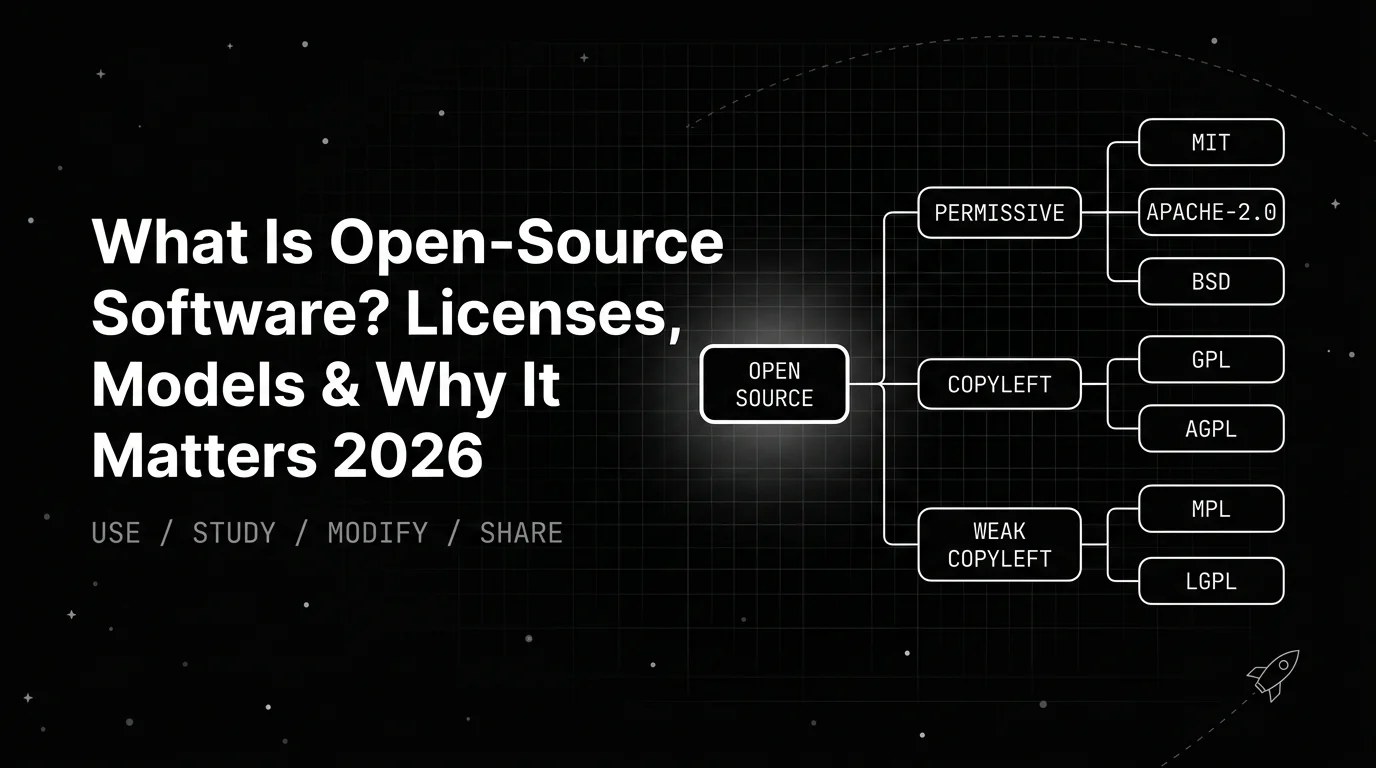
Open-source software lets you use, study, and change code under an OSI license. Here are the license families, what does not qualify, and why it matters.

How AI hallucinations happen in 2026, how to detect them with evaluators, and how RAG, structured output, and guardrails prevent them in production.

Generic monitoring misses how research assistants fail. Four metrics that actually catch citation invention, source collapse, plan drift in production.