Choosing an AI Evaluation Platform for Healthcare AI: 5 Questions to Ask
Five questions for choosing an AI evaluation platform for healthcare AI: clinical accuracy checks, no ground truth needed, custom medical criteria, and error localization.
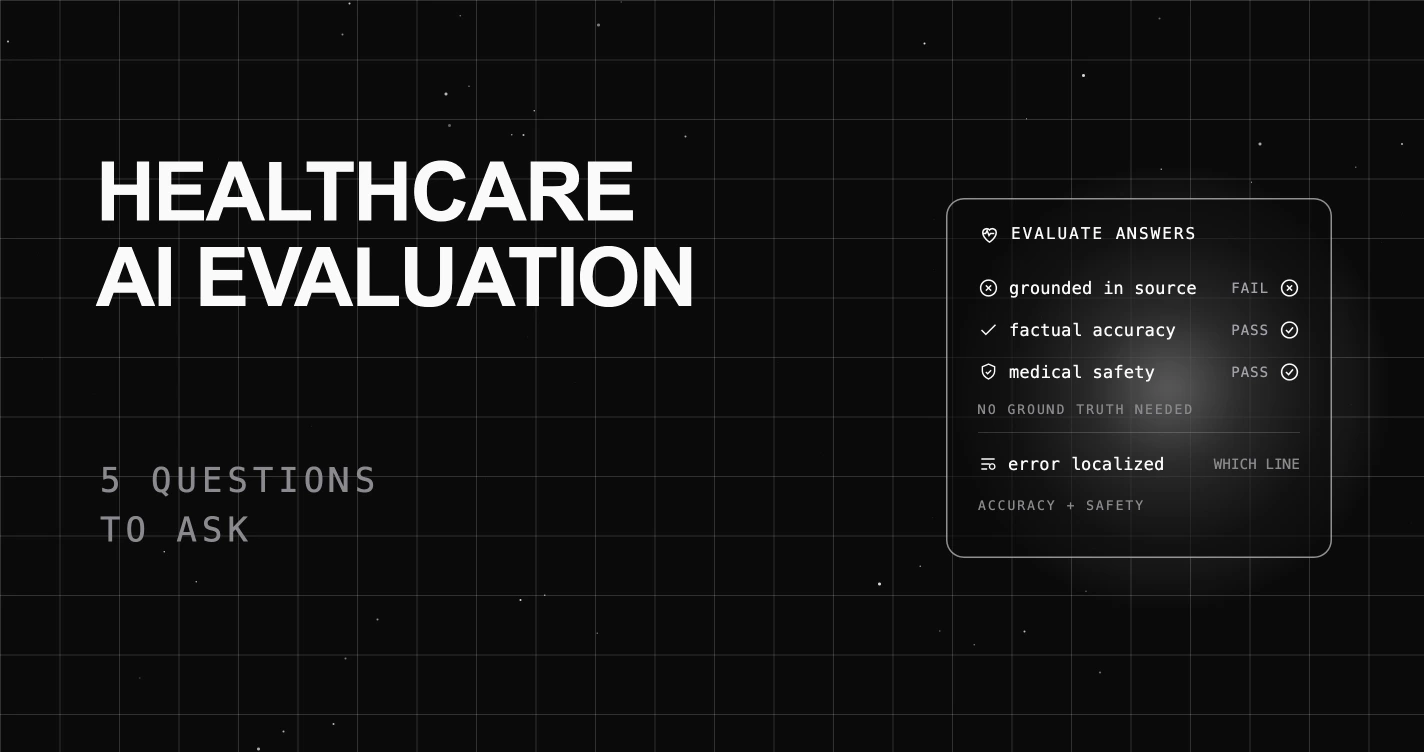
Table of Contents
A clinical assistant answers a nurse’s question about a medication, and the answer is fluent, confident, and wrong: it states a 30-day treatment course for a medication the source document clearly limits to 14 days, or it adds a dosage detail the retrieved guideline never mentioned. A generic evaluation score based on fluency or similarity waves it through, because the sentence reads perfectly. In most software a wrong answer is a bug. In healthcare it is a patient-safety and compliance problem.
That is why choosing an evaluation platform for healthcare AI is not the same as picking a general one. The stakes are higher, the answers have to be checked against real medical sources, and you almost never have a gold answer for every question to grade against. Here are the 5 questions that separate an evaluation platform you can trust with clinical AI from a generic scorer, and how to answer each.
TL;DR: choose a healthcare AI evaluation platform that checks answers against their source (not just fluency), works without a labeled gold answer for every query, lets you add your own medical safety and guideline checks, and tells you which part of an answer was wrong. And it does the scoring without sending patient data to a cloud you do not control.
If you want the vendor-by-vendor view, see our best healthcare AI evaluation platforms roundup. This guide is the criteria to judge any of them by. For neighboring pieces, see healthcare RAG evaluation and, on the safety side, healthcare AI guardrails.
Why choosing an evaluation platform for healthcare AI is harder than it looks
General evaluation tools were built to answer “is this a good answer” in a broad sense, often by measuring fluency or how closely the wording matches a reference. Healthcare breaks both of those. A dangerous clinical answer is usually fluent, so fluency scores pass it. And you rarely have a reference answer for a real patient question, so similarity-to-reference has nothing to compare against.
Healthcare adds requirements a generic tool does not have: the answer has to be grounded in the actual medical source, it has to be safe as well as correct, and when it fails you have to be able to point to exactly what was wrong. So the buying decision is not “does it score answers.” It is “does it check answers against their source, work without a gold label, let me add medical safety checks, and show me which part failed.” Treat the five questions below as a scorecard, the Healthcare Evaluation Readiness Test, and a platform should clear at least four of five before it scores a clinical workload.
The 5 questions to ask before you choose
The Healthcare Evaluation Readiness Test. Score each factor pass or fail. Aim for four or more.
| # | Factor | Pass if the platform… |
|---|---|---|
| 1 | Checks against the source | Verifies the answer is supported by the medical source, not just fluent |
| 2 | No gold label needed | Scores real queries without a stored correct answer for each one |
| 3 | Your own safety checks | Lets you add medical safety and guideline checks, not just generic metrics |
| 4 | Points to the error | Tells you which part of an answer was wrong, not just pass or fail |
| 5 | Keeps PHI safe | Scores answers without sending protected health information to a cloud you do not control |
1. Does it check the answer against its medical source, or just measure fluency?
Why it matters: the most dangerous healthcare AI answer is a fluent, confident invention: a fabricated dosage, a contradicted policy, a fact the source never stated. A score based on how well-written or how similar-to-a-reference an answer is will pass all of those, because they read perfectly.
What to look for: a check that scores whether the answer is actually supported by the source document it was given (often called groundedness or faithfulness), and flags an answer that contradicts or goes beyond the source.
What to avoid: a platform whose main signals are fluency, tone, or word-overlap with a reference, none of which can tell a grounded answer from a confident invention.
How FutureAGI fits: FutureAGI includes groundedness and factual-accuracy checks that score the answer against the source it was given, so an answer that contradicts a retrieved guideline or adds a fact the source never contained is caught and marked as failed. That is the check that matters for a clinical assistant, because a fabricated medical fact is fluent by definition. Fluency-based scorers cannot make that call.
2. Can it score real queries without a labeled gold answer for each one?
Why it matters: in healthcare you almost never have a written correct answer for every patient question, and paying clinicians to label everything does not scale. If the platform needs a reference answer to score anything, you can only measure the small set you had time to label, and never the real traffic.
What to look for: a platform that can judge an answer from the question, the source it was given, and the answer alone, without a stored gold answer, so you can score live queries.
What to avoid: a tool that says “upload your labeled dataset first” and cannot score anything without a reference answer for every case.
How FutureAGI fits: FutureAGI’s checks are reference-free by default. Groundedness and related checks score the answer against the retrieved source rather than a stored gold answer, because the source is the thing the answer must be faithful to. That means you can measure the real patient queries you will never hand-label, not just a small test set. A platform that needs a gold answer for everything is an offline test harness, not something you can run on production traffic.
3. Can you add your own medical safety and guideline checks?
Why it matters: accuracy is not the whole story in healthcare. An answer can be factually correct and still unsafe: giving advice it should not, straying outside approved guidance, or missing a required disclaimer. Generic, out-of-the-box metrics do not know your clinical policies.
What to look for: the ability to author your own checks for domain-specific concerns, such as guideline adherence, unsafe-advice detection, or required safety language, alongside the built-in ones.
What to avoid: a fixed set of generic metrics with no way to encode the safety rules your clinical team actually cares about.
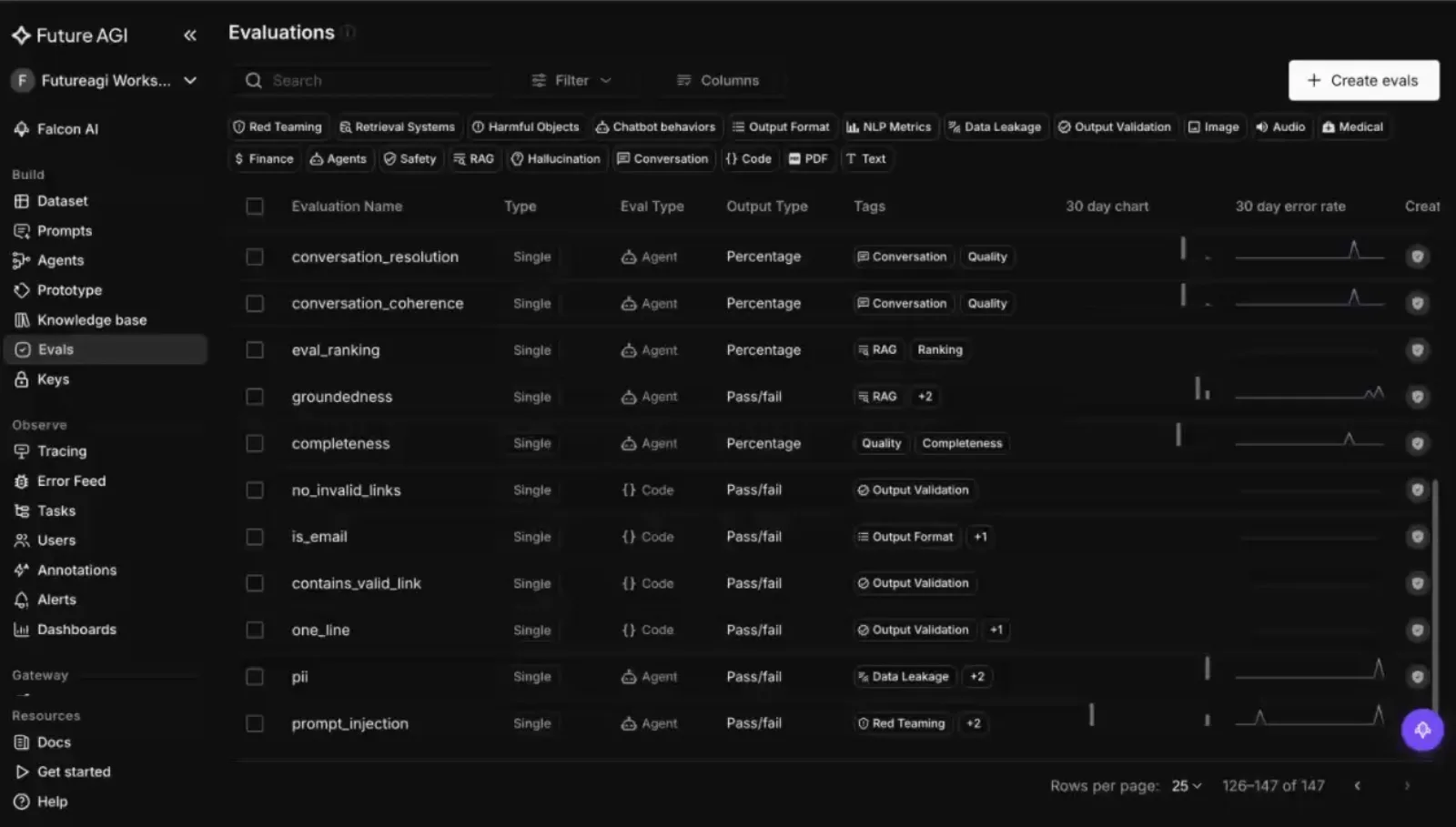
How FutureAGI fits: FutureAGI ships a broad library of built-in checks, including categories for medical and safety use cases, and lets you author custom checks for your own criteria, so you can add a guideline-adherence or unsafe-advice check that reflects your clinical policy rather than a generic rulebook. The screenshot below shows the catalog, including the medical and safety categories. A platform with only generic metrics leaves the safety judgments, the ones a clinical reviewer would flag, unmeasured.
4. When an answer fails, does it show you which part was wrong?
Why it matters: a single fail score on a multi-part clinical answer is not actionable. If a summary blends five facts and one contradicts the source, you need to know which sentence, not just that the whole thing failed. In healthcare you also have to be able to show exactly what went wrong and how you corrected it.
What to look for: error localization, where the platform points to the specific span or field that caused the failure and explains why, not just a red mark on the whole answer.
What to avoid: a scorer that returns pass or fail for the entire answer with no way to see which part broke.
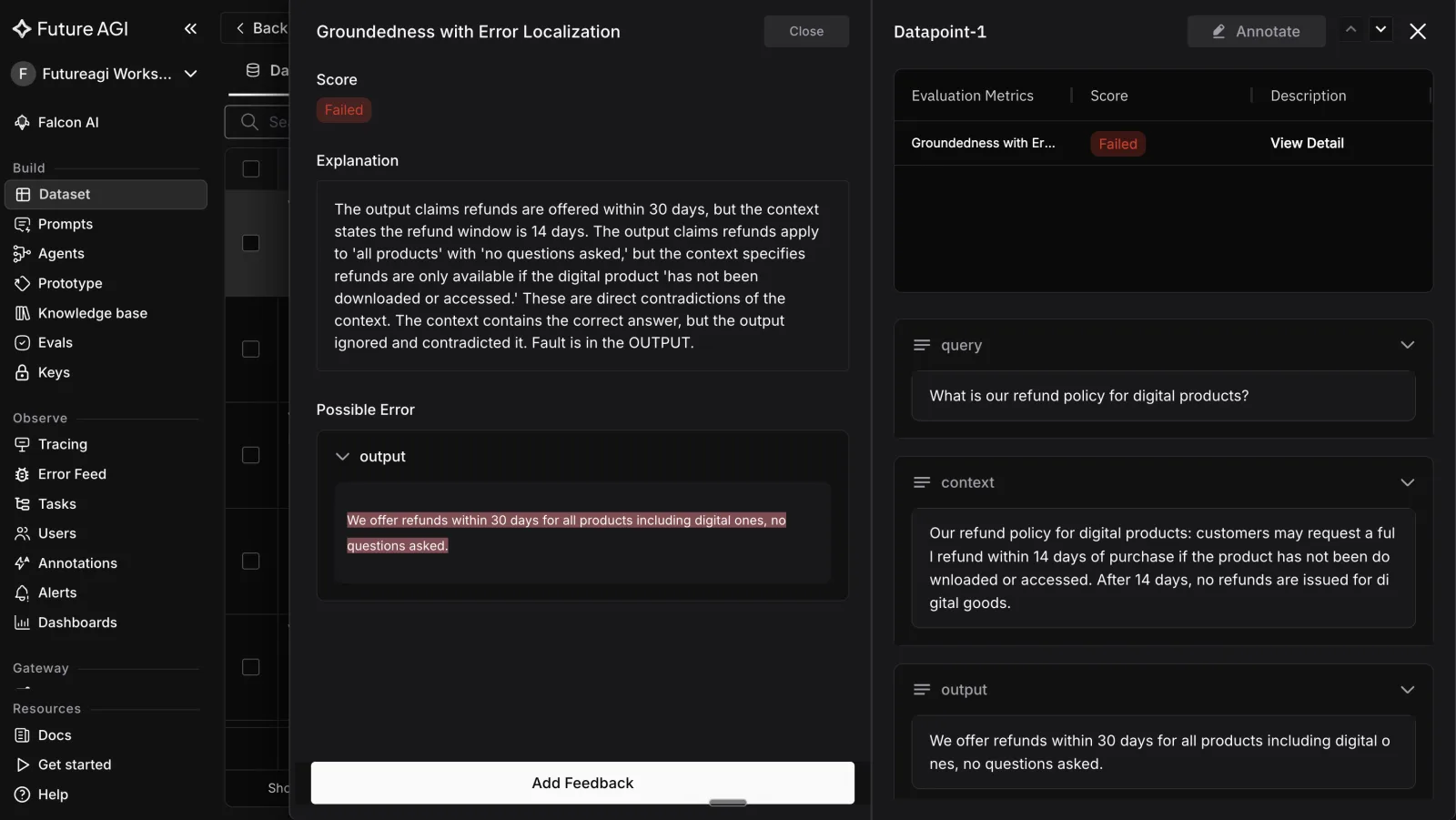
How FutureAGI fits: FutureAGI provides error localization: when an answer fails a check, it points to the specific part that caused it and explains the contradiction, so a failed clinical answer becomes a specific, fixable finding rather than a mystery. The screenshot below shows a groundedness failure with the exact contradicting sentence highlighted and the reason spelled out. That is the difference between knowing an answer was wrong and knowing what to fix.
5. Can it evaluate without exposing protected health information?
Why it matters: the prompts and answers you score often contain patient data. If the evaluation runs in a third-party cloud with no protection, you have leaked protected health information just to measure quality, so how the platform handles that data matters as much as the scores it produces.
What to look for: a platform you can run so patient data stays in a boundary you control (in your own environment, or under a signed agreement that keeps the data in a protected setting), that can redact sensitive fields, and that can run checks locally rather than shipping every answer to an outside service.
What to avoid: a scorer that sends every answer, patient data included, through an outside cloud with no protection and no way to keep the data in your control.
How FutureAGI fits: FutureAGI can run many checks locally and inside your own environment, so patient data stays where you control it while you measure quality. Deterministic checks run offline at no per-call cost, and the platform can run in your own setup rather than routing every clinical answer to an outside service. For the controls that sit next to evaluation, see our guides to healthcare AI guardrails and healthcare AI observability.
A quick decision framework
The five questions are the test; here is how the answers map to a pick.
| Choose | When | What decides it |
|---|---|---|
| A platform with source-based accuracy checks | Your AI answers from medical documents and a fabricated fact is a safety issue | Factors 1, 2; fluency-only scorers are disqualified |
| A platform with custom safety checks | Your clinical team has specific guidelines and unsafe-advice rules to enforce | Factor 3 |
| A platform with error localization | Your answers are multi-part and you must show exactly what failed | Factor 4 |
| A platform that keeps PHI controlled | You must score clinical answers without leaking patient data | Factor 5 |
Where FutureAGI fits
The five questions get you a platform that can tell you whether a clinical answer is accurate and safe. Past that, two things make FutureAGI a fit for a healthcare workload specifically.
A failed answer becomes a specific fix, not a mystery. Because FutureAGI localizes errors, a low groundedness score comes with the exact sentence that contradicted the source and the reason, so a clinical reviewer can confirm and correct it quickly instead of re-reading the whole transcript. In a setting where you have to document what went wrong, that specificity is the point.
The judges stay calibrated to your clinicians. Low-confidence and failed answers can route to human review, and those expert labels feed back to tune the checks, so the accuracy and safety judges keep tracking what your clinical reviewers would actually flag as your prompts and sources change. A fixed scorer cannot keep up with a changing clinical knowledge base on its own.
It connects to the rest of your healthcare AI controls. The same checks that score answers offline can run on simulated patient conversations before launch and on live traffic in production, and evaluation sits alongside simulation, guardrails, and observability rather than as a disconnected tool, so the accuracy and safety signal is consistent from pre-launch simulation through production.
To try the checks that matter most here, score one set of clinical answers against their source documents and read the localized failures. See the evaluation documentation and the evaluation platform to start.
What to read next
- Best Healthcare AI Evaluation Platforms (2026): the vendor-by-vendor roundup, if you want named options next to this criteria guide.
- Best Healthcare RAG Evaluation (2026): the retrieval side, if your clinical AI answers from a medical knowledge base.
- Best Healthcare AI Guardrails (2026): the safety control that sits next to evaluation, for protecting PHI and blocking unsafe output.
- Best Healthcare AI Observability (2026): watching clinical AI in production once it is live.
Inside Future AGI open source in Q2 2026: the platform shipped under Apache 2.0, Error Feed and the Agent Command Center went live, traces hit billions.

Eight factors for choosing an AI guardrails platform for legal AI: real-time blocking, confidentiality, fabricated-citation detection, tool permissioning, and self-hosting.

Seven questions for choosing an AI guardrails platform for healthcare AI: real-time PHI blocking, output-side scanning, hallucination checks, and self-hosting.