Best Voice AI Models in June 2026: STT, TTS, and Voice Agent Stack
Best Voice AI June 2026: Deepgram Nova-3 for streaming STT, Cartesia Sonic-3.5 for TTS, Retell for voice agents, plus latency budgets and cost at scale.
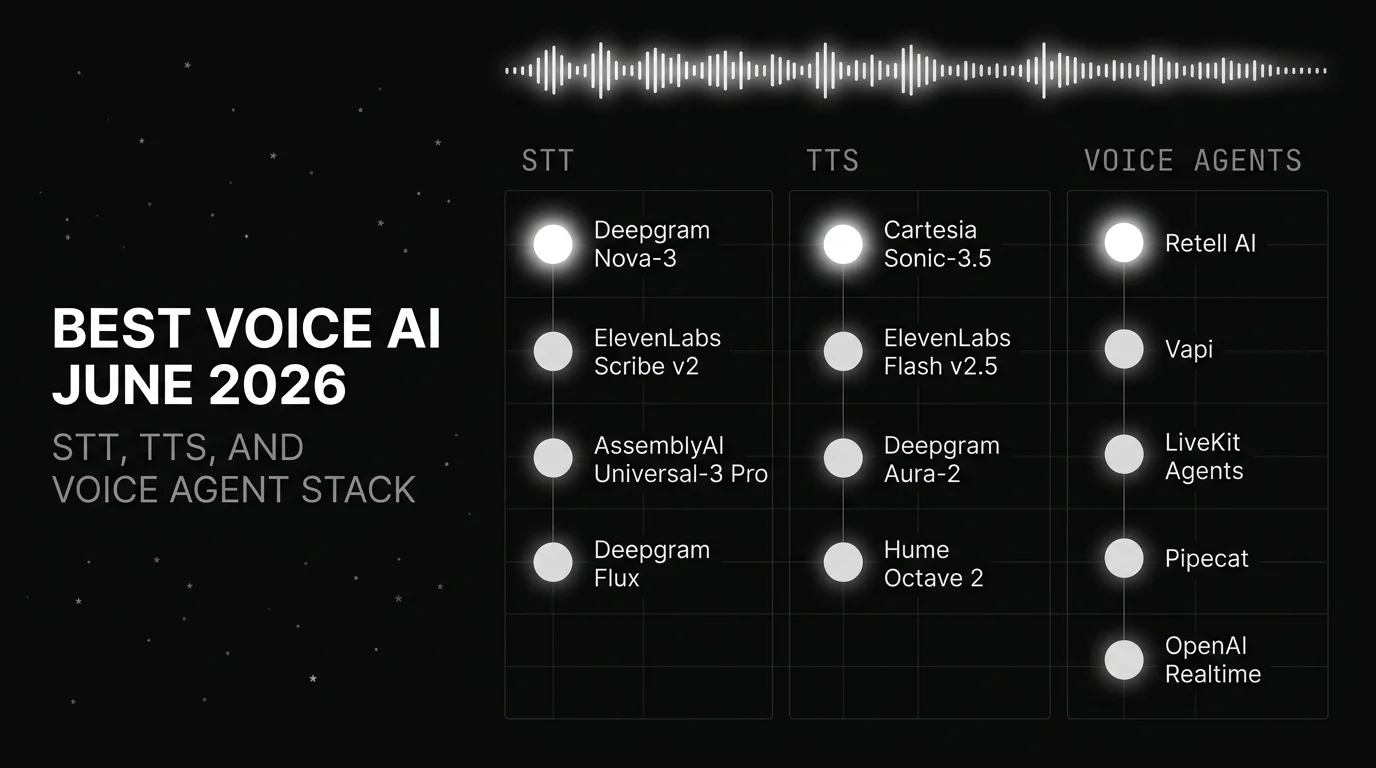
Table of Contents
Voice agents are the fastest-moving AI product category of 2026, and by June the component layers are all production-grade: streaming STT under 300ms, real-time TTS answering in well under 100ms on vendor timing, and fast LLMs closing the loop. The open question moved from whether the pieces work to which ones compose inside your latency and cost budget, with the ITU-T G.114 mouth-to-ear delay recommendation as the ceiling. This guide picks the components that actually assemble into a production voice agent in June 2026.
TL;DR: Best voice AI per layer, June 2026
| Layer | Best pick | Why | Pricing |
|---|---|---|---|
| Streaming STT (production) | Deepgram Nova-3 | ~5.26% batch WER (vendor; streaming ~6.84%), sub-300ms | $0.0048/min |
| STT accuracy (independent) | ElevenLabs Scribe v2 Realtime | 2.2% WER (Artificial Analysis), under 150ms | $0.39/hr ($0.28 Business) |
| STT with structure | AssemblyAI Universal-3.5 Pro Realtime | Real-time diarization, keyterm prompting, 99+ languages | $0.45/hr ($0.15/hr base) |
| Turn-taking detection | Deepgram Flux | Model-integrated end-of-turn | $0.0065/min EN |
| Hyperscaler STT (new) | Microsoft MAI-Transcribe-1.5 | 2.4% WER, #3 independent, 43 languages | ~$0.36/hr |
| OpenAI-ecosystem STT | OpenAI gpt-4o-transcribe | 99+ languages, near real-time | $0.006/min |
| TTS for real-time agents | Cartesia Sonic-3.5 | Sub-90ms vendor TTFA, 42 languages | credit tiers |
| TTS conversational | ElevenLabs Flash / Turbo v2.5 | ~75ms model inference, 32 languages | PAYG char |
| TTS expressive quality | ElevenLabs v3 | Most expressive, not real-time | media tier |
| TTS enterprise + HIPAA | Deepgram Aura-2 | ~90ms steady-state, signed BAA on Enterprise | $0.030/1k chars |
| TTS emotion | Hume Octave 2 | Under 200ms, 11 languages | ~half Octave 1 |
| Hyperscaler TTS (new) | Microsoft MAI-Voice-2 | 72% preferred over v1, 15 languages | Foundry / Azure |
| Speech-to-speech | OpenAI gpt-realtime-2 | GPT-5-class reasoning in the audio loop | $32/$64 per 1M audio tokens |
| Voice agent default | Retell AI | $0.07/min base, all-in ~$0.07-0.31/min | $0.07/min base |
| Voice agent at scale (BYO) | Vapi | $0.05/min platform fee, all-in ~$0.30-0.33/min | $0.05/min + passthrough |
| Open-source orchestration | LiveKit Agents / Pipecat | Apache-2.0, self-host free | infra + providers |
If you only read one row: Deepgram Nova-3 + Flux for STT, Cartesia Sonic-3.5 for TTS, a fast LLM such as Gemini 3.5 Flash or DeepSeek V4-Flash for the brain, and Retell or Vapi to orchestrate. That stack lands inside the roughly 540ms to sub-700ms practical round-trip and runs at production scale today.
The story of voice AI in June 2026
The component layers of voice AI reached production maturity through 2025, so June 2026 was a month of consolidation and one big new entrant. Streaming STT runs under 300ms, real-time TTS answers in well under 100ms on vendor timing, and a fast LLM closes the loop without dominating the budget. The work shifted from proving the pieces to composing the right ones for your accents, languages, and cost ceiling.
The headline of June was Microsoft. On June 2 at Build, the Superintelligence team shipped MAI-Voice-2 and MAI-Transcribe-1.5 into Foundry. MAI-Transcribe-1.5 landed at 2.4% WER on the independent Artificial Analysis leaderboard, third overall, across 43 languages. A hyperscaler putting a top-three independent STT and an expressive 15-language TTS into general availability in one release changes the pricing conversation for every incumbent.
On streaming STT, Deepgram Nova-3 stays the production default at sub-300ms, with a vendor-reported 5.26% batch WER on Deepgram’s own set (streaming closer to 6.84%), paired with Flux for turn detection. ElevenLabs Scribe v2 Realtime leads independent accuracy at 2.2% WER on Artificial Analysis while answering in under 150ms. AssemblyAI Universal-3.5 Pro Realtime brings diarization and keyterm prompting to real time. The axes that separate these picks are latency, independently measured accuracy, and structured-transcript features.
On TTS, Cartesia Sonic-3.5 replaced the retired Sonic Turbo and holds the latency lead at sub-90ms vendor time-to-first-audio across 42 languages. ElevenLabs Flash and Turbo v2.5 are the real-time conversational picks near 75ms, while v3 remains the expressive option for work that does not need real time. Deepgram Aura-2 carries enterprise HIPAA, and Hume Octave 2 leads emotional control in under 200ms.
Independent measurement matured in parallel. The Artificial Analysis Speech Arena now ranks TTS quality by blind-preference Elo, and the top cluster sits within a couple dozen points, so no single model runs away with quality. On orchestration, Retell and Vapi remain the managed defaults while LiveKit Agents and Pipecat cover the Apache-2.0 self-host path. OpenAI’s gpt-realtime-2 is the native speech-to-speech alternative for teams that want reasoning inside the audio loop.
The round-trip target still anchors on ITU-T G.114, which sets one-way mouth-to-ear delay at 150ms preferred and 400ms tolerable. Most production voice agents stay usable up to about 700ms round-trip. Hitting that budget in June 2026 is a matter of picking components that compose, then measuring your real p50 and p95 on your own traffic.
Best speech-to-text (STT) models in June 2026
Deepgram Nova-3. The streaming STT default
The right pick for any production voice agent that needs low-latency streaming transcription. Nova-3 is Deepgram’s streaming-optimized model, tuned for the sub-300ms budgets voice agents live in, and it pairs directly with Flux for turn detection.
Specs:
- WER: ~5.26% batch on Deepgram’s own benchmark; streaming ~6.84%
- Latency: sub-300ms streaming (independent tests)
- Languages: streaming plus broad batch coverage
- Pricing: $0.0048/min streaming (pay as you go)
- Pairs with Deepgram Flux for end-of-turn detection
Best for: Production voice agents where end-to-end latency is the binding constraint. Live captioning. Real-time conversational AI.
Skip if: You want the lowest independently measured WER (use ElevenLabs Scribe v2 Realtime). You need bundled diarization and keyterm prompting on the transcript (use AssemblyAI Universal-3.5 Pro Realtime).
ElevenLabs Scribe v2 Realtime. The accuracy leader
The pick when transcription accuracy is the priority and you still need real-time latency. Scribe v2 Realtime leads the independent Artificial Analysis word-error-rate index while staying inside a voice-agent budget.
Specs:
- WER: 2.2% on Artificial Analysis (independent); 93.5% accuracy across 30 languages (vendor)
- Latency: under 150ms (vendor)
- Languages: 90+ supported
- Pricing: $0.39/hr standard API; $0.28/hr on annual Business
Best for: Voice agents in accent-heavy or high-stakes domains where a transcription error cascades into a wrong action. Meeting and medical scribing. Accessibility.
Skip if: You are standardized on Deepgram tooling and want Flux turn detection in the same stack (use Nova-3).
AssemblyAI Universal-3.5 Pro Realtime. Streaming with structure
The pick when the transcript needs structure, not just words. Universal-3.5 Pro Realtime brings prompting, keyterm biasing, disfluency control, and real-time speaker diarization to streaming.
Specs:
- Real-time diarization new to streaming
- Keyterm prompting and code-switching
- Latency: ~150ms p50 (vendor)
- Languages: 99+
- Pricing: $0.45/hr Pro ($0.15/hr on the base Universal-Streaming tier)
Best for: Multi-speaker calls, domain jargon that generic models mistranscribe, and products that need speaker labels live rather than after the call.
Skip if: Pure lowest-latency transcription is all you need (use Deepgram Nova-3).
Microsoft MAI-Transcribe-1.5. The hyperscaler’s new entry
The June 2 arrival that reset expectations for a first-party cloud STT. MAI-Transcribe-1.5 reached 2.4% WER and third place on the independent Artificial Analysis leaderboard, and it transcribes an hour of audio in under 15 seconds.
Specs:
- WER: 2.4% on Artificial Analysis (independent), #3 overall
- Languages: 43 (expanded from 25)
- Throughput: roughly 276x real-time; an hour of audio in under 15 seconds
- Keyword biasing for domain terms
- Pricing: ~$0.36/hr ($6 per 1,000 minutes) in Microsoft Foundry
Best for: Teams already on Azure or Foundry, batch and near-real-time transcription at scale, multilingual workloads that benefit from keyword biasing.
Skip if: You need the tightest streaming turn-taking loop today (pair Nova-3 with Flux).
OpenAI gpt-4o-transcribe. The OpenAI-ecosystem pick
The default when your product already lives in the OpenAI API. gpt-4o-transcribe and its mini variant handle 99+ languages with near-real-time transcription and clean integration with the rest of the OpenAI audio stack.
Specs:
- Languages: 99+
- Latency: near real-time
- Pricing: $0.006/min ($0.003/min for the mini variant)
Best for: Teams building on OpenAI who want one vendor for transcription, LLM, and speech-to-speech.
Skip if: You need the lowest independent WER (Scribe v2 Realtime) or model-integrated turn detection (Flux).
Deepgram Flux. The turn-taking layer
Not a standalone transcriber, but it solves a problem the rest of the category leaves to the application. Generic STT APIs return a transcript and stop. Flux models when the speaker has actually finished, and its eager end-of-turn signal can fire 150 to 250ms earlier than waiting for a full pause.
Best for: Any turn-based production voice agent. The difference between an agent that interrupts naturally and one that talks over users or stalls.
Skip if: Your product is dictation or transcription only, with no turn-taking.
Best text-to-speech (TTS) models in June 2026
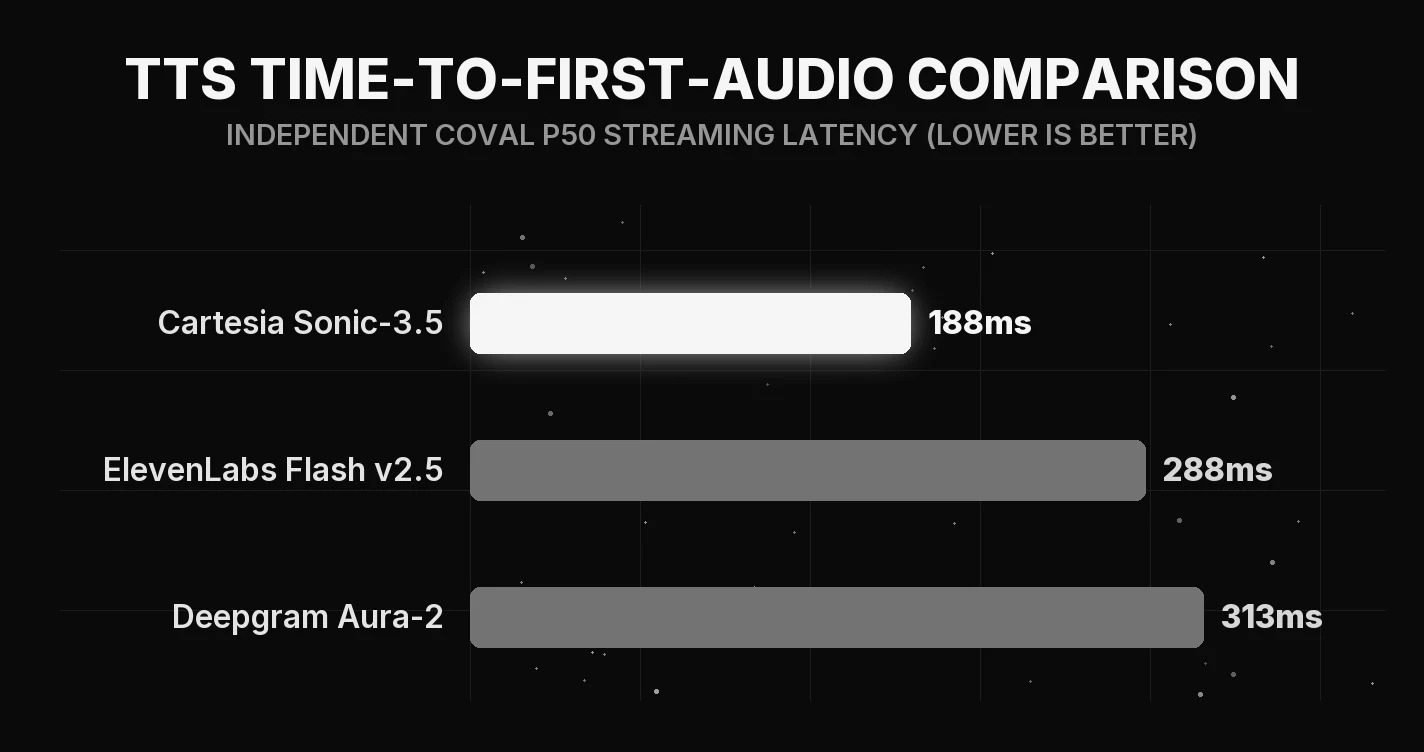
TTS is now optimization on three independent axes: latency, naturalness, and emotional control. They do not move together, so pick by your dominant constraint. One caution up front: vendor time-to-first-audio numbers are best-case, and independent p50 streaming latency runs meaningfully higher.
Cartesia Sonic-3.5. The latency leader
The structural pick when round-trip latency is the binding constraint. Cartesia Sonic-3.5 (sonic-3.5-2026-05-04) replaced the retired Sonic Turbo and posts sub-90ms vendor time-to-first-audio across 42 languages, leaving budget for the rest of the stack.
Specs:
- TTFA: sub-90ms (vendor); higher on independent p50 streaming benchmarks
- Languages: 42
- Ranks in the top cluster of the independent Artificial Analysis Speech Arena
- Streaming output, voice cloning supported
- Pricing: credit-based tiers (Pro from $5/mo, Scale $299/mo)
Best for: Sub-500ms round-trip voice agents, telephony where latency drives perceived call quality, real-time interactive applications.
Skip if: Maximum expressive range matters more than latency (use ElevenLabs v3 or Hume Octave 2).
ElevenLabs Flash v2.5 and Turbo v2.5. The conversational pick
The real-time ElevenLabs path. Flash and Turbo v2.5 answer near 75ms model inference, which keeps ElevenLabs voice quality inside a live agent budget without reaching for the slower v3.
Specs:
- TTFA: ~75ms model inference (vendor); higher on independent p50 streaming benchmarks
- Languages: 32
- Voice cloning supported
- Pricing: pay as you go, character-based
Best for: Conversational agents that want ElevenLabs voices with real-time latency, branded consumer voice products.
Skip if: You need the lowest possible time-to-first-audio (use Cartesia Sonic-3.5).
ElevenLabs v3. Expressive quality, not real-time
The most expressive ElevenLabs model, positioned for quality rather than latency. v3 is the pick for produced content and character voices where you can afford non-real-time synthesis.
Specs:
- Most expressive voice range in the ElevenLabs lineup
- High latency by design; not real-time-optimized
- Voice cloning: best in category
- Pricing: media / expressive tier
Best for: Audiobooks, branded voice, character work, and any output rendered ahead of time.
Skip if: The voice runs inside a live agent turn (use Flash or Turbo v2.5).
Deepgram Aura-2. Enterprise TTS with HIPAA
The pick when you want Deepgram’s stack end to end with a compliance path. Aura-2 ships 40+ voices and a signed BAA on Enterprise, which matters for regulated deployments.
Specs:
- TTFB: ~90ms steady-state, p95 under 200ms (vendor); higher on independent p50 streaming benchmarks
- Voices: 40+ across 7 languages
- Compliance: HIPAA BAA on Enterprise
- Pricing: $0.030 per 1,000 characters (pay as you go)
Best for: Healthcare and regulated voice agents already using Deepgram Nova-3 and Flux, teams that want one vendor for STT and TTS.
Skip if: You need broad multilingual coverage (Cartesia 42 languages, ElevenLabs 32).
Hume Octave 2. The emotion specialist
The emotion-first TTS pick. Hume Octave 2 is built for prosody and emotional expression, with voice conversion and phoneme editing on top.
Specs:
- Latency: under 200ms
- Languages: 11
- Voice conversion and phoneme-level editing
- Pricing: roughly half of Octave 1; under 1 cent per minute on dedicated capacity
Best for: Mental-health products, character voices for games, emotion-sensitive content.
Skip if: Latency or broad language coverage is the primary constraint.
Microsoft MAI-Voice-2. The hyperscaler’s expressive TTS
The other half of Microsoft’s June 2 wave. MAI-Voice-2 is positioned as Microsoft’s most expressive text-to-speech model, with granular emotion control and zero-shot voice prompting.
Specs:
- Preference: chosen 72% of the time over MAI-Voice-1 (vendor)
- Languages: 15, including code-switching pairs such as Hindi-English
- 5-second voice cloning with system-level consent enforcement
- Pricing: Microsoft Foundry / Azure Speech
Best for: Azure and Foundry teams that want first-party expressive TTS, assistants and contact-center voices in the Microsoft ecosystem.
Skip if: You need a published real-time latency figure to budget against (Microsoft has not released a clean time-to-first-audio number; use Cartesia or ElevenLabs for latency-critical paths).
OpenAI gpt-realtime-2. Speech-to-speech
The native speech-to-speech option. gpt-realtime-2 keeps GPT-5-class reasoning inside the audio loop, which skips the separate STT and TTS steps for a single low-latency model.
Specs:
- Speech-to-speech with reasoning in the audio loop
- Pricing: audio at $32 / $64 per 1M input / output tokens; cached input at $0.40 per 1M
- Priced per token, not per minute
Best for: Products where prosody and reasoning matter more than per-minute price, and where a single-model loop simplifies the stack.
Skip if: Per-minute cost predictability is the priority (use a classic STT-LLM-TTS pipeline).
Best voice agent platforms in June 2026
If you do not want to wire STT, LLM, TTS, and orchestration yourself, the platforms below ship in days what custom builds ship in quarters. The June correction worth knowing: on most major managed platforms HIPAA sits behind Enterprise or a paid add-on, though Retell now offers a self-serve signed BAA on pay-as-you-go, so confirm the compliance line before you build.
Retell AI. The most-teams default
The right default for most production voice-agent teams. Retell charges $0.07 per minute base and lands all-in around $0.07 to $0.31 per minute once LLM, TTS, and telephony are included, with a no-code builder and a developer SDK.
Specs:
- Pricing: $0.07/min base; all-in ~$0.07-0.31/min (aggregator estimate)
- Builder: no-code visual builder plus SDK
- Compliance: self-serve signed BAA on pay-as-you-go (no extra fee); Enterprise options for larger deployments
- Latency: sub-700ms round-trip achievable with fast components
Best for: Most production voice agents where sub-700ms is acceptable and a managed platform reduces engineering load.
Skip if: You need bring-your-own-component control at scale (use Vapi) or a fully self-hosted stack (use LiveKit or Pipecat).
Vapi. The scale and BYO pick
The pick when you want to bring your own STT, LLM, and TTS and run at volume. Vapi charges a $0.05 per minute platform fee on top of component passthrough, landing all-in around $0.30 to $0.33 per minute.
Specs:
- Pricing: $0.05/min platform fee plus passthrough; all-in ~$0.30-0.33/min (aggregator estimate)
- Bring-your-own STT / LLM / TTS
- Multi-channel: voice, plus SMS and chat
- Compliance: HIPAA add-on at $2,000/mo; Zero Data Retention at $1,000/mo
Best for: Teams that want component-level control, multi-channel deployments, and volume scale.
Skip if: You want the lowest total cost of ownership under 100K minutes/month (Retell’s flat base usually wins) or a self-hosted stack (LiveKit or Pipecat).
OpenAI Realtime API. Native speech-to-speech
The pick when you want one model for the whole audio loop. The Realtime API runs gpt-realtime-2 speech-to-speech, priced per audio token rather than per minute.
Specs:
- Model: gpt-realtime-2, speech-to-speech
- Pricing: $32 / $64 per 1M input / output audio tokens; cached input $0.40 per 1M
- No separate STT and TTS steps
Best for: Prosody-sensitive products, single-vendor OpenAI stacks, and teams that value a simpler loop over per-minute predictability.
Skip if: You need per-minute cost control or self-hosting.
LiveKit Agents. Open-source orchestration at scale
The pick when you want to own the orchestration and still get first-party adapters for every STT and TTS. LiveKit Agents is Apache-2.0 and free to self-host, with a managed Cloud on top.
Specs:
- License: Apache-2.0 (self-host free)
- Cloud tiers: Build $0 / Ship $50/mo / Scale $500/mo / Enterprise
- Compliance: SOC 2 Type II from the Scale tier; signed HIPAA BAA on Enterprise only
- First-party adapters for major STT and TTS providers
Best for: Teams that want open-source orchestration with production infrastructure and broad provider support.
Skip if: You want a fully managed no-code platform (use Retell) or a signed HIPAA BAA below Enterprise.
Pipecat. The open-source framework
The pick for a fully open, self-composed STT-LLM-TTS loop. Pipecat is Apache-2.0 with a strong plugin ecosystem for Cartesia, Deepgram, ElevenLabs, and OpenAI, plus a managed Pipecat Cloud.
Specs:
- License: Apache-2.0 (framework free)
- Managed option: Pipecat Cloud
- Plugin ecosystem across major STT / TTS / LLM providers
- Compliance: whatever your own deployment provides
Best for: Teams that want full control of the orchestration code, retry logic, and barge-in handling.
Skip if: You want a managed platform to own reliability and on-call for you (use Retell or Vapi).
HIPAA tier matrix
HIPAA support is the cleanest differentiator across the managed platforms. Signed BAAs sit behind Enterprise or a paid add-on on most of them, with Retell the exception at a self-serve BAA on pay-as-you-go, so this single matrix often decides the pick for regulated teams:
| Platform | HIPAA / signed BAA | Where it lands |
|---|---|---|
| Retell AI | Self-serve BAA on pay-as-you-go | Sign in-dashboard, no extra fee |
| Vapi | $2,000/mo add-on | Zero Data Retention is a separate $1,000/mo |
| LiveKit Agents | Enterprise only | SOC 2 Type II from the Scale tier |
| Deepgram (Aura-2 / Voice Agent) | Signed BAA on Enterprise | Bundled STT and TTS compliance path |
| Pipecat / self-host | Your own deployment | You own the compliance boundary |
Vendor latency vs independent benchmarks
Every TTS vendor publishes a best-case time-to-first-audio, and those numbers do not match what you measure in production. Independent p50 streaming latency runs meaningfully higher than the sub-90ms vendor figures, so the vendor number is a floor, not what your users hear. On the STT side, self-reported WER also runs optimistic against the neutral Artificial Analysis index. Run a domain reproduction with your accents, your background noise, and your prompts before you commit.
End-to-end latency budget. The math
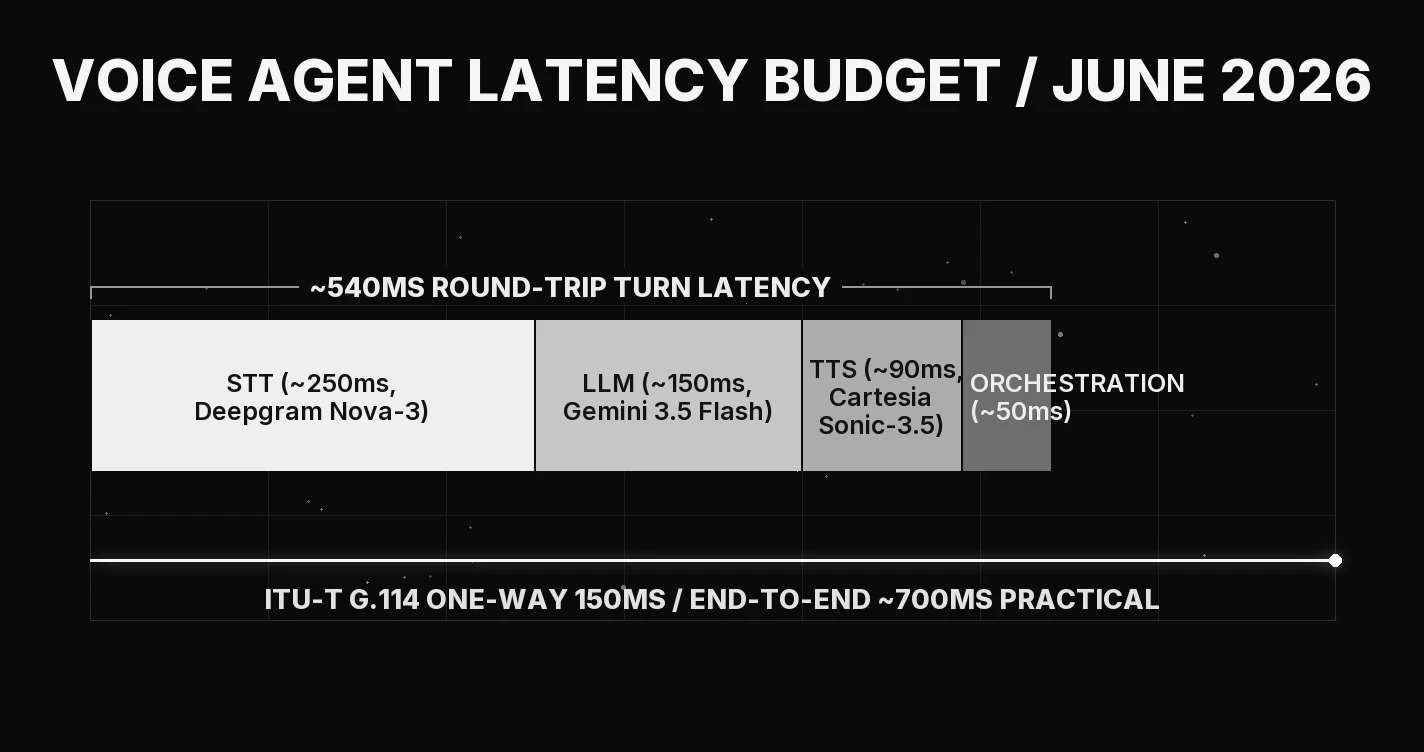
Voice agents have a hard latency target. The ITU-T G.114 one-way mouth-to-ear recommendation is 150ms preferred and 400ms tolerable, and that constraint shapes any voice-agent budget. Sub-500ms round-trip is the aggressive target, and sub-700ms is the threshold most production use cases accept. Hitting either requires component picks that compose to the budget.
The breakdown:
| Component | Typical range | Aggressive (sub-500ms) pick | Practical (sub-700ms) pick |
|---|---|---|---|
| STT | 250-300ms | Deepgram Nova-3 (sub-300ms) | Nova-3 or AssemblyAI Universal-3.5 Pro Realtime |
| LLM inference | 100-200ms | Fast model (Gemini 3.5 Flash, DeepSeek V4-Flash) | GPT-5.5, Claude Sonnet 5, etc. |
| TTS first audio | sub-90ms vendor / higher p50 | Cartesia Sonic-3.5 | ElevenLabs Flash v2.5 or Aura-2 |
| Orchestration | 50-100ms | Tight platform-native | Standard platform |
| Total | sum of above | ~450-500ms best-case round-trip | ~600-700ms practical round-trip |
The chart above uses vendor best-case TTFA (roughly 90ms for Cartesia Sonic-3.5) to show the component budget. Independent p50 streaming latency runs meaningfully higher, so a real deployment sits nearer the top of each range. That gap between vendor timing and measured p50 is exactly why the last step of any voice build is to profile your own p50 and p95 rather than sum the datasheet numbers. For the LLM slot, a fast model keeps the loop tight; see the June LLM guide for the current low-latency picks.
Cost at scale: what 100K minutes/month actually costs
Per-minute list price hides the real production cost, and by June 2026 the paths split into managed flat-fee, bring-your-own with passthrough, native token-metered audio, and self-hosted with engineering load. The two figures that clear an independent check are the all-in aggregator estimates for Retell and Vapi:
| Stack | Pricing basis (verified) | Est. monthly (100K min) |
|---|---|---|
| Retell (managed) | $0.07/min base; all-in ~$0.07-0.31/min | ~$7,000-31,000 all-in |
| Vapi (BYO + passthrough) | $0.05/min platform fee; all-in ~$0.30-0.33/min | ~$30,000-33,000 |
| Deepgram-native (Nova-3 + Flux + Aura-2) | $0.0048/min STT + $0.0065/min Flux + $0.030/1k chars TTS | component sum + LLM |
| Self-host (LiveKit / Pipecat + providers) | Apache-2.0 framework free + provider passthrough | provider sum + engineering / on-call |
| OpenAI Realtime (gpt-realtime-2) | $32 / $64 per 1M audio tokens | premium; scales with audio tokens |
The honest framing holds from prior months: under roughly 100K minutes/month, Retell’s flat base usually wins on total cost of ownership because the engineering time saved on passthrough tuning, retry logic, and compliance paperwork dominates the per-minute delta. Above about 1M minutes/month, bring-your-own or self-hosted economics start to flip, and the crossover depends on your retry rate and engineering cost. The OpenAI Realtime path is the premium option and the right pick only when prosody and a single-model loop matter more than per-minute price.
Decision framework
Choose Retell AI if:
- You are building most-team production voice agents.
- Sub-700ms round-trip is acceptable.
- You want a managed platform with a no-code builder and an SDK.
- You can self-serve a signed BAA on pay-as-you-go when you need HIPAA.
Choose Vapi if:
- You want bring-your-own STT, LLM, and TTS control.
- You need multi-channel (voice plus SMS and chat).
- You are running at volume and can absorb the $2,000/mo HIPAA add-on if regulated.
Choose OpenAI Realtime API (gpt-realtime-2) if:
- You want native speech-to-speech with reasoning in the audio loop.
- Prosody matters more than per-minute price predictability.
- A single-vendor OpenAI stack simplifies your build.
Choose LiveKit Agents or Pipecat if:
- You want Apache-2.0 open-source orchestration with no platform fee.
- You are willing to own reliability, retries, and on-call.
- You need first-party adapters across many STT and TTS providers.
Roll your own (Cartesia + Deepgram + a fast LLM) if:
- Sub-500ms round-trip is the target.
- You have the engineering team to build and run orchestration.
- The managed platforms do not support your specific stack.
Common mistakes when picking voice AI components in June 2026
-
Budgeting from vendor best-case latency. Cartesia’s sub-90ms time-to-first-audio is a best case; independent p50 streaming benchmarks put it meaningfully higher. Budget from measured p50, not the datasheet.
-
Skipping turn-taking detection. Generic STT APIs stop at the transcript. Without Flux or an equivalent end-of-turn layer, agents talk over users who pause or sit silent when they stop.
-
Treating the LLM as free latency. A 300ms STT paired with a 1,200ms LLM is not a fast agent. Pick a fast model for sub-500ms targets and measure the whole loop.
-
Reading HIPAA as included. In June 2026 Vapi and LiveKit gate signed BAAs behind a paid add-on or Enterprise, while Retell offers a self-serve BAA on pay-as-you-go. Confirm the compliance line before you build, not after.
-
Trusting self-reported accuracy and latency. Vendor WER and TTFA are best-case. Measure your real p50 and p95 on production audio, with your accents and noise, before committing.
How Future AGI fits
Voice agents fail in production for the same reasons text agents do: hallucinations, retry loops, accent edge cases, off-policy responses, and prompt injection through transcript contamination. Future AGI ships the eval, simulate, and observability layer that voice teams pair with their framework of choice:
- Simulate generates voice scenarios (accents, background noise, interruptions, ambiguous phrasing) and replays them against your agent before you ship.
- Evaluate scores every turn on groundedness, hallucination, tool-call accuracy, and accent handling, with voice-specific axes that text-only evals miss.
- Agent Command Center applies runtime guardrails that block bad outputs at the gateway in low hundreds of milliseconds, which fits inside the voice latency budget.
- Error Feeds cluster live failures so you see “accent-X failing on intent-Y” instead of dozens of unrelated tickets.
- Optimize auto-rewrites prompts and policies, then re-validates against your regression set.
Future AGI is a companion to Vapi, Retell, LiveKit, and Pipecat rather than a competitor on the voice-framework axis. For voice specifically, the eval suite adds accent-handling, sentiment-consistency, and tool-call-accuracy checks that a text-only harness never surfaces.
June 2026 settled the component question. Microsoft’s Build entry, ElevenLabs’ independent accuracy lead, and Cartesia’s latency floor mean every layer now has at least two production-grade picks, so the stack you assemble matters less than the budget it lands inside. The differentiator moved from model choice to the measurement loop around it.
Treat a voice agent as a latency, cost, and reliability system rather than a favorite-model bet. Shortlist by your binding constraint, wire the STT-LLM-TTS-orchestration path, then measure real p50 and p95 on your own accents and noise before you ship. That eval loop, not the leaderboard row, is what turns June’s mature components into an agent that holds up on a live call.
Sources
STT primary
- Deepgram Nova-3 announcement (~5.26% batch WER)
- Deepgram Flux conversational STT (model-integrated end-of-turn)
- Deepgram pricing
- AssemblyAI Universal-3.5 Pro Realtime
- AssemblyAI pricing
- ElevenLabs Scribe v2 Realtime (under 150ms, 2.2% WER on Artificial Analysis)
- Microsoft MAI-Transcribe-1.5 (2.4% WER, #3 independent, 43 languages)
- OpenAI new voice models in the API
TTS primary
- Cartesia Sonic-3.5 launch (sub-90ms TTFA, 42 languages)
- Cartesia TTS models docs
- ElevenLabs model overview
- ElevenLabs Flash v2.5 latency (~75ms model inference)
- ElevenLabs v3
- Deepgram Aura-2 enterprise TTS
- Hume Octave 2 (under 200ms, 11 languages)
- Microsoft MAI-Voice-2 (72% preferred, 15 languages)
- OpenAI API pricing (gpt-realtime-2 audio tokens)
Voice agent platforms
Independent benchmarks and standards
- Artificial Analysis Text-to-Speech Arena (quality Elo)
- Artificial Analysis Speech-to-Text (independent WER)
- Open ASR Leaderboard (arXiv:2510.06961)
- ITU-T Recommendation G.114 (one-way transmission time)
See also: Best LLMs of June 2026 for the LLM brain in your voice agent. Previous voice post: Best Voice AI of May 2026.
Frequently Asked Questions
What is the best speech-to-text model in June 2026?
What is the best text-to-speech model for voice agents in June 2026?
What is the best voice agent platform in June 2026?
What end-to-end latency does a production voice agent need in June 2026?
What changed in voice AI in June 2026?
What is Deepgram Flux and why does turn detection matter?
Best Voice AI May 2026: compare Deepgram, Cartesia, ElevenLabs, Retell, and Vapi for STT, TTS, latency budgets, and production voice agents.

Best TTS APIs in May 2026: Cartesia Sonic 4 at 40ms, ElevenLabs v3, Deepgram Aura-2, Hume Octave, plus pricing, latency, and the right pick by use case.
Best STT APIs in May 2026: Deepgram Nova-3 + Flux, AssemblyAI Universal-2, Whisper, ElevenLabs Scribe v2 with WER, latency, and pricing compared.
